







RFID (Radio Frequency Identification) technology has been around in various forms since World War II.
At that time, work on the first radar systems led to early RFID-style systems that distinguished friendly aircraft from enemy aircraft in the skies over war-torn Europe.
In the decades since, the move in electronics from transistors to microchips, and the shrinking of components, has made radio frequency technology a cost-effective, non-interfering tool for industry worldwide.
RFID technology has transformed many industries, including automation, manufacturing, medical science, retail, telecommunications, and oil and gas.
Sectors such as retail were keen to adopt RFID in global commerce, while caution within the oil and gas industry meant RFID solutions were taken up piece by piece.
However, attitudes have begun to change. RFID has been tried and tested across the business world, and it is now turning heads in some of the most conservative corners of global industry.
The oil and gas industry now uses RFID extensively to improve operational efficiency, production, and the safety of workers and equipment.
RFID technology, including tags and readers, provides a strong, long-lasting solution for asset management, administration, operations, and production and distribution in the oil and gas industry.
It helps operations run smoothly from the facility to the delivery of the final product.
How does RFID help the oil and gas industry function?
RFID technology is very useful during the exploration and production of crude oil and natural gas.
RFID tags are attached to drill pipes to identify each length of pipe and record its use, which supports pipe health checks and depth measurements.
RFID tags can also be paired with downhole sensors that record data such as underground temperature, flow rate, stress and mud composition.
Used pipes and drills are also tagged with RFID tags that give information such as the pipe identification number, age, length, the number of times it has been used for drilling and the most recent job ID.
This helps drilling companies select the right equipment for each operation.
Also Read: Which Industries are using RFID for Asset Tracking?
How does RFID help with maintenance in the oil and gas industry?
RFID technology is used extensively at facilities and on oil rigs, where pipelines and other equipment face extreme temperatures that cause them to deteriorate quickly. Over time, that can lead to oil loss and become a threat to marine life.
To maintain this equipment, RFID tags are used to identify individual pipeline joints and their assemblies, record inspections for leaks and joint pressure, confirm pipework is assembled correctly during exploration, and identify hard-to-reach pipes or flanges.
RFID tags are also attached to underwater equipment to help identify factors that might harm the marine environment.
The tags also help in tracking remote vehicles and divers working in remote areas.
On-metal RFID tags are used on all kinds of drilling, exploration and transportation equipment.
How does RFID provide safety and security?
RFID technology is also used for the safety and security of the workers on site.
Workers and divers are issued RFID badges, sometimes combined with GPS, for their fieldwork. These badges help locate and rescue workers if an incident occurs.
Workers at inspection sites and on rigs are also given the safety equipment their work requires.
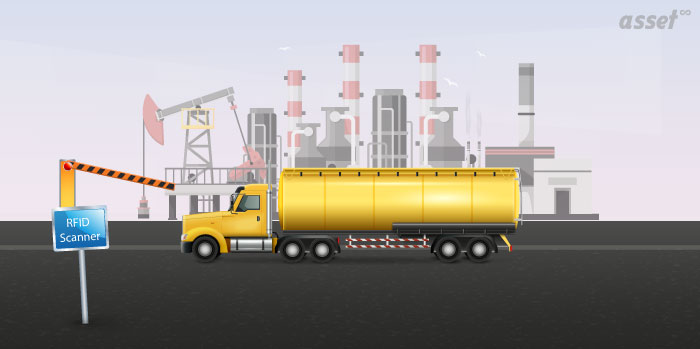
RFID readers at the site gates verify workers’ equipment and location as they pass through during working hours. They also flag any unauthorized person on site, and the same records support headcounts after a fire drill.
Also Read: RFID vs NFC: How They are Different in Terms of Asset Tracking?
How does RFID help run day-to-day processes?
The RFID badges issued to workers make it possible to track daily attendance, entry and exit times, activity logs and even parking.
The parking area is equipped with RFID readers that automatically authorize and log vehicles entering and leaving.
For document inventory and tracking, a handheld RFID reader paired with a mobile device reads the RFID tags attached to documents.
How does RFID affect your business?
The many benefits of RFID technology make a solid business case for using it across different industries and applications.
RFID is a versatile technology used in construction, engineering, chemicals, manufacturing, retail, logistics, the public sector and many others.
How useful each benefit is varies from sector to sector, as our guide to RFID in different sectors explains.
The Benefits of RFID for Oil and Gas Operations
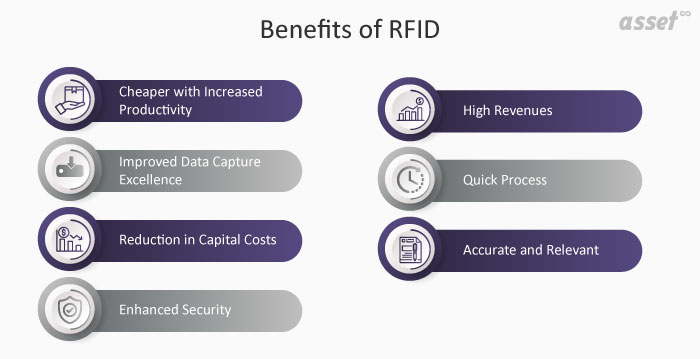
1. Lower Cost with Higher Productivity
RFID applications can automatically update information about the movement and location of assets, components, stock and other items.
Because data is saved automatically, work takes less time, gets done faster, costs less and is more accurate.
RFID is more reliable than manual methods and captures more detail than techniques such as barcoding.
Data collection can happen as a by-product of other work, removing the effort of filling in forms. Identifying products with RFID is faster than barcode scanning or entering product details by hand.
2. Better Data Capture
With RFID technology, you can be confident that data is captured quickly and accurately.
Collecting data electronically with RFID avoids transcription errors and avoids missing items when many items are counted at once.
3. Reduction in Capital Costs
RFID technology helps lower costs by giving better control of stock and assets.
It helps keep track of business assets such as equipment, transport packaging, computers, and other portable and fixed devices.
4. Better Security
RFID access control has greatly improved the security of business premises.
RFID tagging of stock and assets makes it easier to track inventory when it goes missing, and tags can help fight counterfeiting.
Recommend To Read: Businesses Must Know About the Best Practices in Asset Monitoring
5. Higher Revenue
RFID can help a business increase revenue, first by closing the gap between the stock it thinks is available for orders and the stock actually in the warehouse, and second by providing better data on product movements.
Organizations with RFID can offer better service, which sets them apart from competitors and raises customer satisfaction, creating opportunities for more sales and better margins.
6. Faster Processes
Processing from order to dispatch and delivery is quick with RFID, because it works with other manufacturing and supply chain technologies, such as automated pallet handling and stock-picking systems.
7. Accurate and Relevant
Because RFID captures data in real time as stock and assets move, detailed information stays up to date, and management information is available for planning and operations.
Also Read: Oil & Gas Efficiency and Reduced Downtime
Why Oil and Gas Operators Are Adopting RFID
If you run an oil and gas business without RFID technology, you are missing something big. If you already use it, you know how efficiently it works.
It is cost-effective and gives accurate, real-time information about inventory, which is why RFID technology can be used in any industry.
Also Read: RFID vs Barcodes: Which One is Better for Asset Tracking?
Frequently Asked Questions (FAQs)
1. What is asset tracking software?
Asset tracking software records the movement of devices, equipment and software within a business. It brings together the technologies a business uses to track the location of each of its assets.
2. What are asset tags used for?
Asset tags are labels, usually with an adhesive back, that identify an asset. Asset tags are generally made of anodized aluminum or laminated polyester. The design commonly includes the organization’s logo and a code linked to the asset’s details. Barcodes and QR codes are used on asset tags to speed up data entry and reduce errors in the field.