





Utility asset management software for water and wastewater plants
Our utility asset management software puts treatment works, pumping stations and their equipment on one register. Shift logs, SCADA alarms, permits to work and capital asset counts all land on the asset they belong to.
- EPA Safe Drinking Water Act
- NPDES permits under the Clean Water Act
- OSHA 29 CFR 1910.146 (permit-required confined spaces)
- OSHA 29 CFR 1910.147 (lockout/tagout)
- GASB Statement 34 (capital asset reporting)

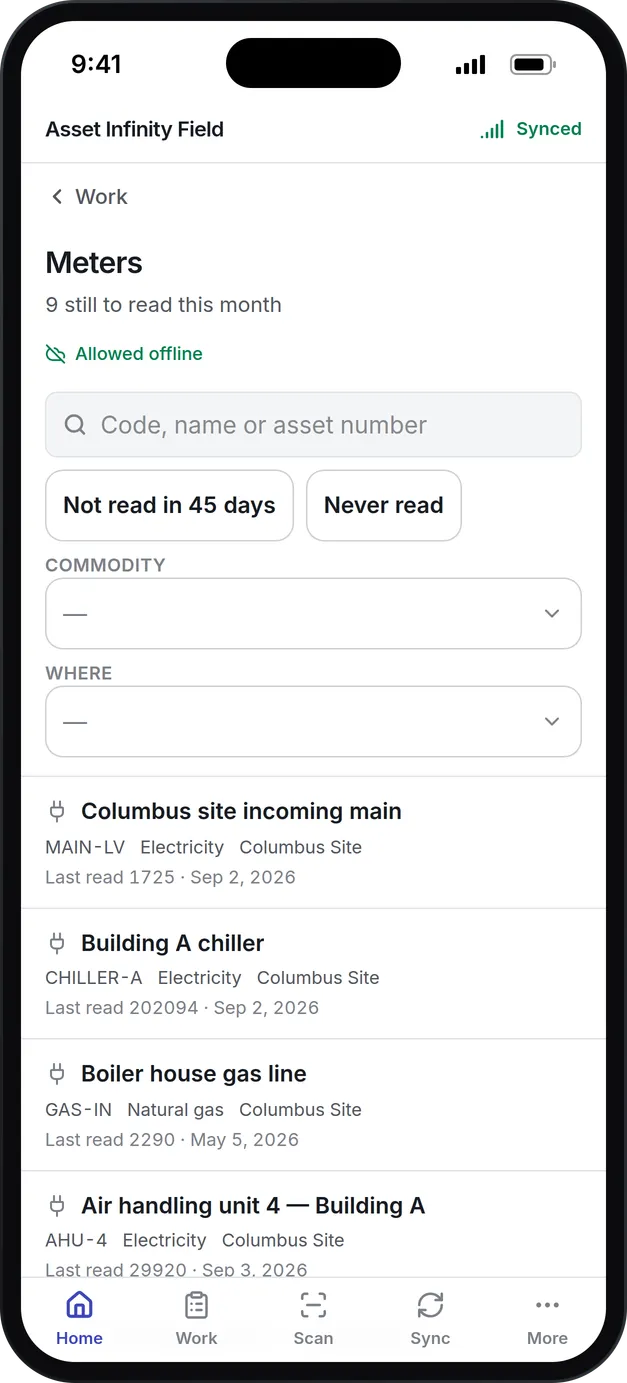
What our utility asset management software does from intake to distribution
Pumps that stop failing
Repeat failures are classified and traced with five-whys root cause analysis. Availability, MTBF and MTTR rank intake, plant and distribution assets together.
SCADA limits raise work
Readings arrive over HTTPS or MQTT. Each sensor has its own limits, and a crossed limit can raise a work order on the asset.
Shift logs with limits
Operators record turbidity, chlorine residual and other readings against limits. A critical reading fails the round and opens a corrective job.
Permits for confined space and chlorine
Lockout, confined space, chemical and excavation permits list each isolation and who signed it. Work cannot start until the permit is in force.
Chemicals and critical spares
Coagulant, chlorine and pump seals are stocked by store against reorder points. Shortfalls become purchase requests with the reasons shown.
Capital assets counted
Verification rounds count assets plant by plant, and depreciation runs on the same register for capital reporting.
What is utility asset management software?
Utility asset management software is a system that keeps a register of a water or wastewater utility’s plants, pumping stations and equipment, and records the maintenance, condition, readings and cost of each asset over its life. It plans preventive work, controls hazardous jobs with permits, connects to SCADA readings and supports capital asset reporting.
Utilities buy it because their assets run around the clock, sit far apart and fail expensively. A high-lift pump that trips at 2 a.m. matters to every customer downstream, and so does a third seal failure on the same pump in three months.
How utility asset management software works in Asset Infinity
Each treatment works, wastewater works and pumping station is a site on one register, with its process areas beneath it: intake, clarifiers, filters, the chlorine house, the clear water tank and the high-lift pumps. A day’s work flows through it in six steps.
- Operators log the shift.The daily works round records turbidity, chlorine residual and other readings against limits on the mobile app. A critical reading outside its range fails the round and raises a corrective job.
- SCADA readings arrive by themselves.SCADA systems and data loggers post readings over HTTPS or MQTT. A sensor with a limit raises an alert when it is crossed, and can raise a work order on the asset.
- Plans raise planned work.Monthly pump checks, weekly chlorinator checks, generator load tests and a blower service every 2,000 run hours fall due by calendar, meter or whichever comes first.
- Hazardous work waits for a permit.Confined space, lockout, chemical and excavation work cannot start until a permit covering it has been issued and accepted.
- Repeat failures get investigated.Breakdowns closed with failure codes feed reliability rankings, and a repeat fault opens a root cause investigation with its evidence linked.
- Finance counts and depreciates.Verification rounds count assets plant by plant, and depreciation runs on the same register, so the capital asset records and the maintenance records describe the same pumps.
The preventive maintenance software page covers plan triggers, lead time and tolerance in detail.
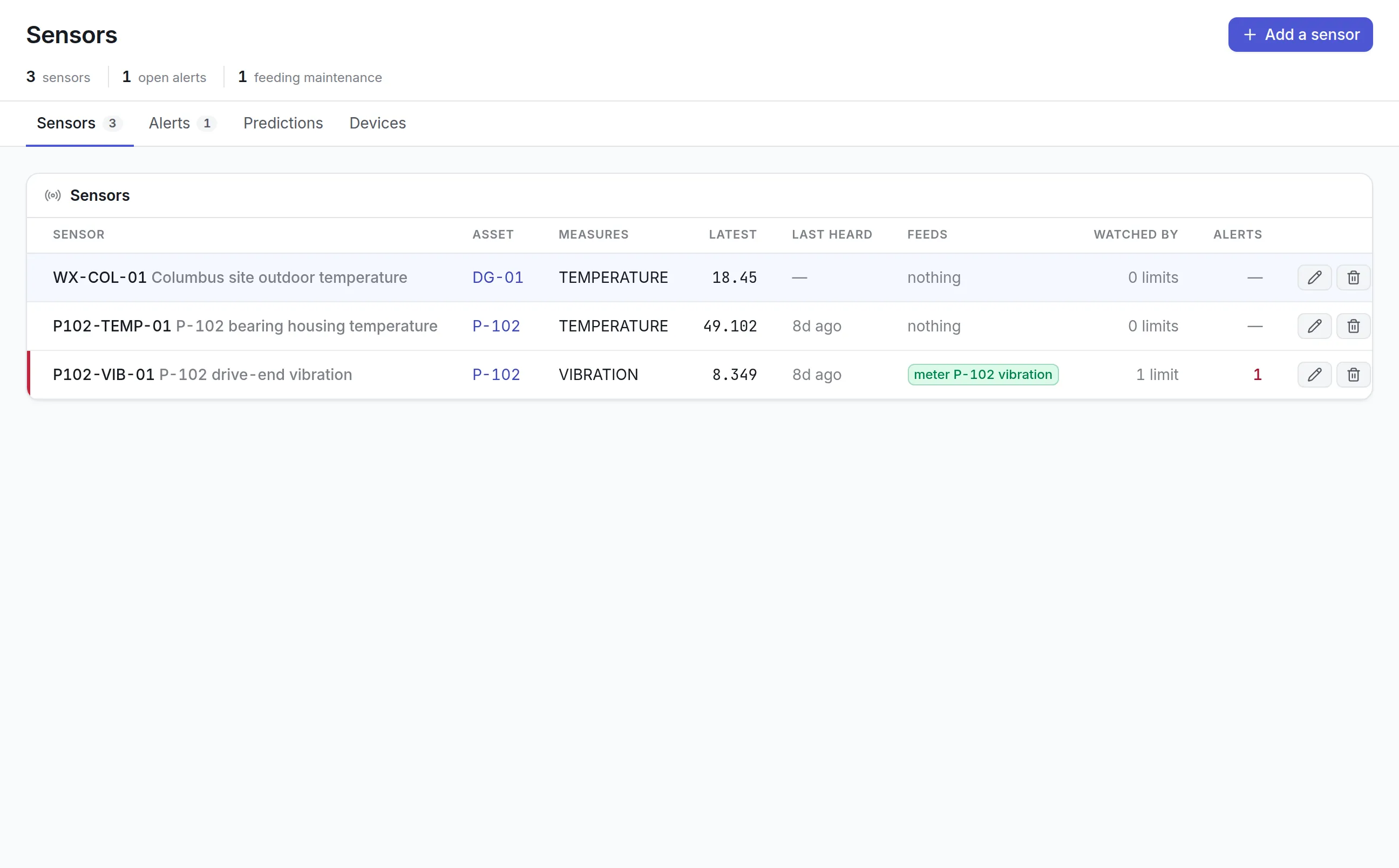
SCADA and sensor readings that raise work
A reading on its own is a number. What makes it useful is a limit, and a decision about what crossing that limit should do: draw a red line, alert the operator on duty, or raise a work order.
- Sensors on an asset or at a place, each with its own limits
- Sensors bound to a meter, so meter and condition plans fall due by themselves
- A banner when a device stops reporting, because a silent sensor raises no alerts
- A trace of each sensor over 24 hours, 7 days or 30 days, drawn against its limit
More detail
What you can set up:
More detail
Predictive maintenance software explains how condition data and plans fit together.
Permits for confined space, chlorine and excavation
Water and wastewater plants carry more permit-required work than most sites: wet wells, clear water tanks, chlorine drum changes and excavation on a burst main.
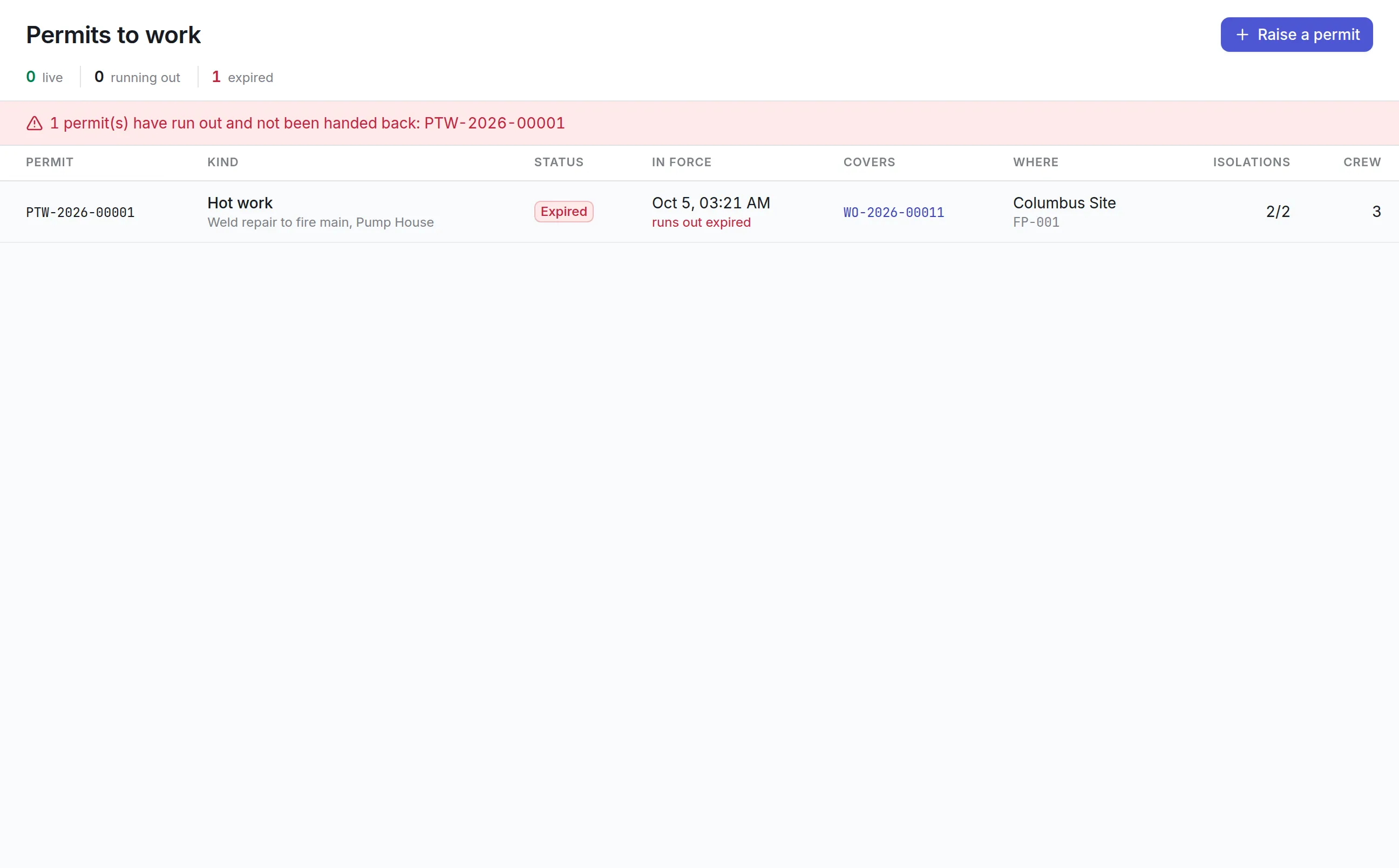
- The kind of work: confined space, lockout/tagout, chemical, excavation, hot work and others
- The hazards, method and limits, as the person at the gate reads them
- Each isolation, and whether it is applied
- The crew named on it, and a window in force with a clock that runs out
- Two signatures, issue and acceptance, plus who handed it back and in what state
More detail
A permit in Asset Infinity holds:
More detail
A red banner names any permit that has run out without being handed back. With lockout tagout software these are the records an OSHA 1910.146 or 1910.147 review asks to see. Asset Infinity keeps them; it does not certify compliance.
Energy, the largest cost of pumping
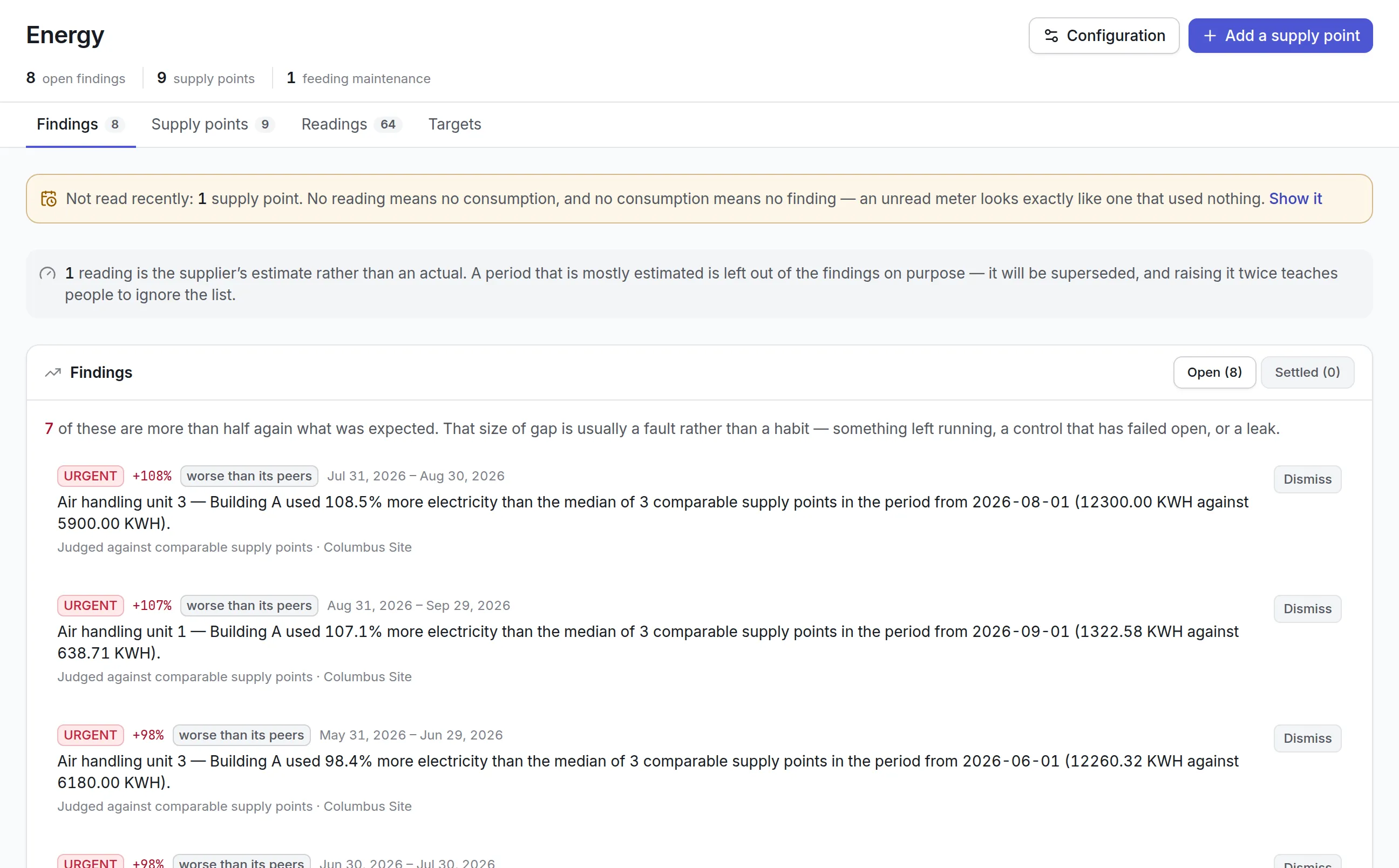
Pumping is usually the biggest line on a utility’s power bill. The energy module records supply points, meters and tariffs, and flags a supply point using far more than expected, judged against comparable supply points.
More detail
Findings like these point at a pump running against a throttled valve, a blower left on, or a meter that has stopped being read. See energy management software for supply points, tariffs and reduction targets.
Repeat failures traced to their root cause
A burst rising main is rarely the whole story. In the water trial’s sample history, the burst is traced back through a high-lift pump trip to a surge vessel nothing was checking, and the corrective actions are followed until someone can say they worked. That chain is what root cause analysis software is for:
More detail
When a review finds an action did not work, the screen says so in red, because it means the diagnosis was wrong and the pump will fail again.
What to look for when choosing utility asset management software
| Capability | Why it matters | In Asset Infinity |
|---|---|---|
| Multi-site register | Plants, stations and reservoirs sit miles apart | Each works and station is a site with its own process areas |
| SCADA and sensor input | Alarms should raise work without retyping | Readings over HTTPS or MQTT, limits per sensor, alerts and work orders |
| Operator rounds | Shift logs are evidence | Graded rounds with limits, photos and automatic corrective jobs |
| Run-hour maintenance | Pumps and blowers wear by hours | Meter and calendar triggers, whichever comes first |
| Permits to work | Confined space and chlorine work can be fatal | Permits with isolations, signatures, windows and a hard stop on the job |
| Shutdown planning | Tank cleans and filter work need a window | Work packages, readiness and critical path against the outage |
| Root cause analysis | Repeat failures cost more than one-off breakdowns | Investigations with actions verified and reviewed for effect |
| Chemicals and spares | A missing seal or coagulant delivery stops treatment | Stock by store, reorder points and purchase requests |
| Capital asset records | Finance reports on the same assets | Verification rounds and depreciation books on the same register |
| Offline mobile app | Remote stations have no signal | iOS and Android app that syncs when back in range |
See it on your own assets, or price it in two minutes.
Utility asset management software by team and site type
Water treatment works
The plant team runs the daily works round, weekly chlorine room safety checks and quarterly filter backwash and nozzle inspections. Clear water tank cleaning is planned as a shutdown with its tank entry permit drafted weeks ahead, and readiness shows which parts and people are still missing. Each failed reading raises its own corrective job.
Wastewater works
Blowers run on a 2,000-hour service, sludge pumps wait for stators on hold with the clock paused, and wet well entry needs a confined space permit. Repeat blower bearing failures go to a root cause investigation, with each corrective action verified before it closes. Blower electricity use can be tracked as supply points in the energy module.
Pumping stations and distribution
Remote booster stations are visited on rounds from the mobile app, which works without signal. SCADA alarms raise work on the right pump, and contractors repairing a burst main work under an excavation permit tied to the job. Generator load tests at each station run monthly on the same schedule, and a contractor’s SCADA and telemetry support agreement sits on the contract register with its response time.
Finance and capital planning
Finance counts capital assets with verification rounds plant by plant, using asset inventory software, and keeps depreciation books on the same register. Capital plans and budgets can be added when replacement planning moves into the system. A pump whose maintenance cost has passed what it cost to buy is flagged for replacement on the Reliability screen.
What utility asset management software costs with Asset Infinity
The asset register starts at $130 a month for up to 500 assets, with unlimited users. Maintenance is $25 per user per month. Plant add-ons are flat per organization:
- Permits to work, $100 a month
- Reliability and root cause, $150 a month
- Energy and utilities, $150 a month
- Sensors, $5 per connected sensor a month
- Finance (depreciation books), $30 per user a month
Build a quote for your plants and stations. The water trial opens with a water treatment works, a wastewater works and a booster pumping station, eight weeks of sample history including a high-lift pump trip and a burst main, permits in every state, two shutdowns and a root cause investigation traced through to its corrective actions.
Getting started
To see it with your own plant list, book a demo.
What teams in this industry use most
Common questions
What is utility asset management software?
Utility asset management software keeps a register of a utility's plants, pumps, mains and equipment, and records the maintenance, condition and cost of each. It helps a utility plan work, avoid repeat failures and report on its capital assets.
Does it work for wastewater as well as drinking water?
Yes. Water treatment works, wastewater works and pumping stations are sites on the same register, each with its own assets, rounds and permits.
Can it take readings from SCADA?
Yes. SCADA systems and data loggers can post readings over HTTPS or MQTT. Each sensor carries its own limits, and a crossed limit can raise an alert or a work order.
Does it handle permits to work?
Yes. Permits for lockout, confined space entry, chemical work, excavation and hot work record isolations, precautions and signatures, and a job that needs a permit cannot start without one.
Can it help with GASB 34 capital asset reporting?
It keeps the asset register, physical verification counts and depreciation books that capital asset reporting draws on. Your finance team prepares the statements; Asset Infinity does not certify compliance.
Does it work at remote pumping stations with no signal?
Yes. The iOS and Android app keeps jobs, rounds and meter readings on the phone and sends them when it is back in range.
See it with your own assets
A demo run on an example from your industry. Or start the trial and look around on your own.