





Enterprise asset management software for the whole life of an asset
Asset Infinity is enterprise asset management software for everything you own, from the day it arrives to the day it is disposed of. Operations, maintenance, stores and finance work on the same asset record, so nobody keeps a second list.
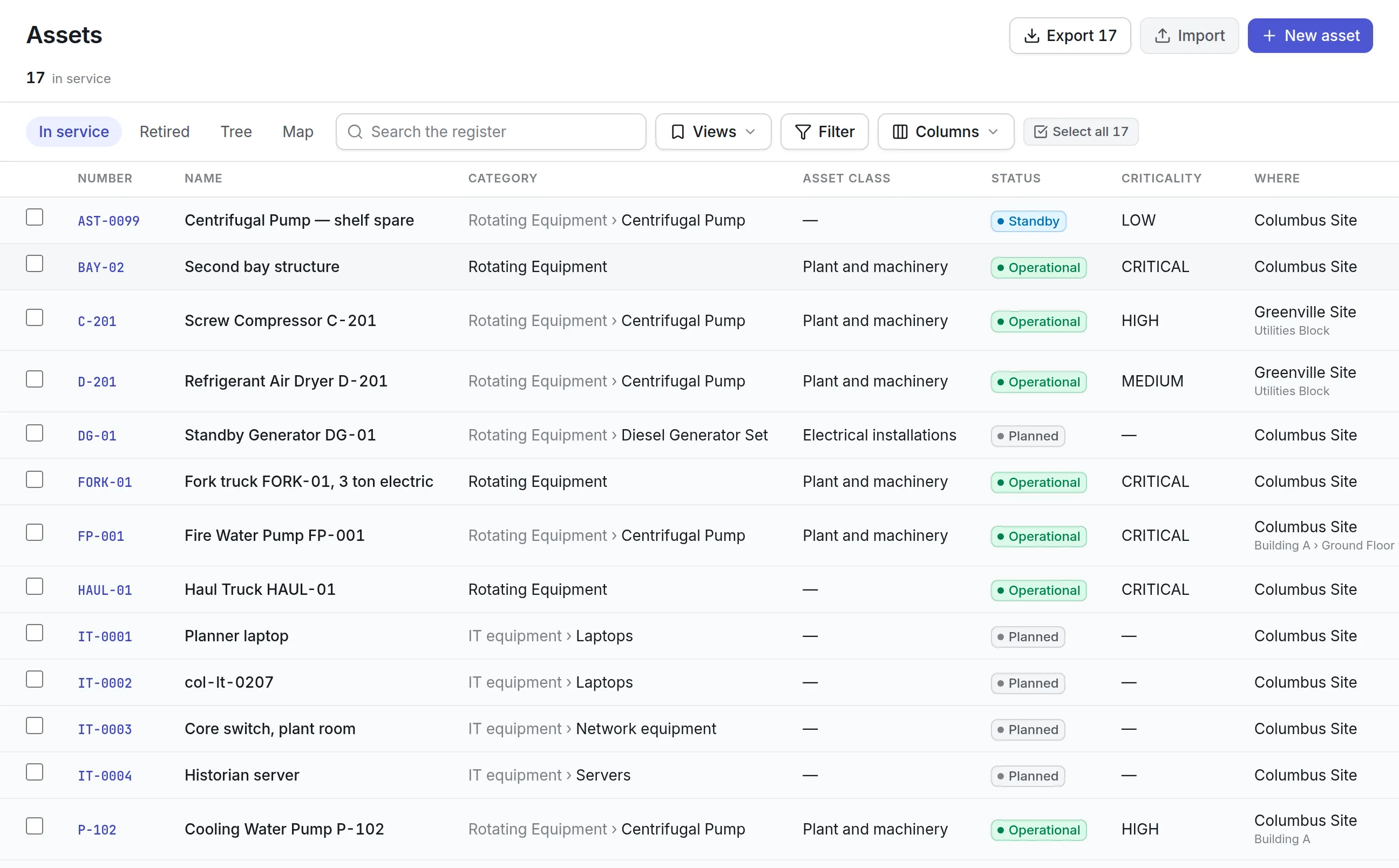
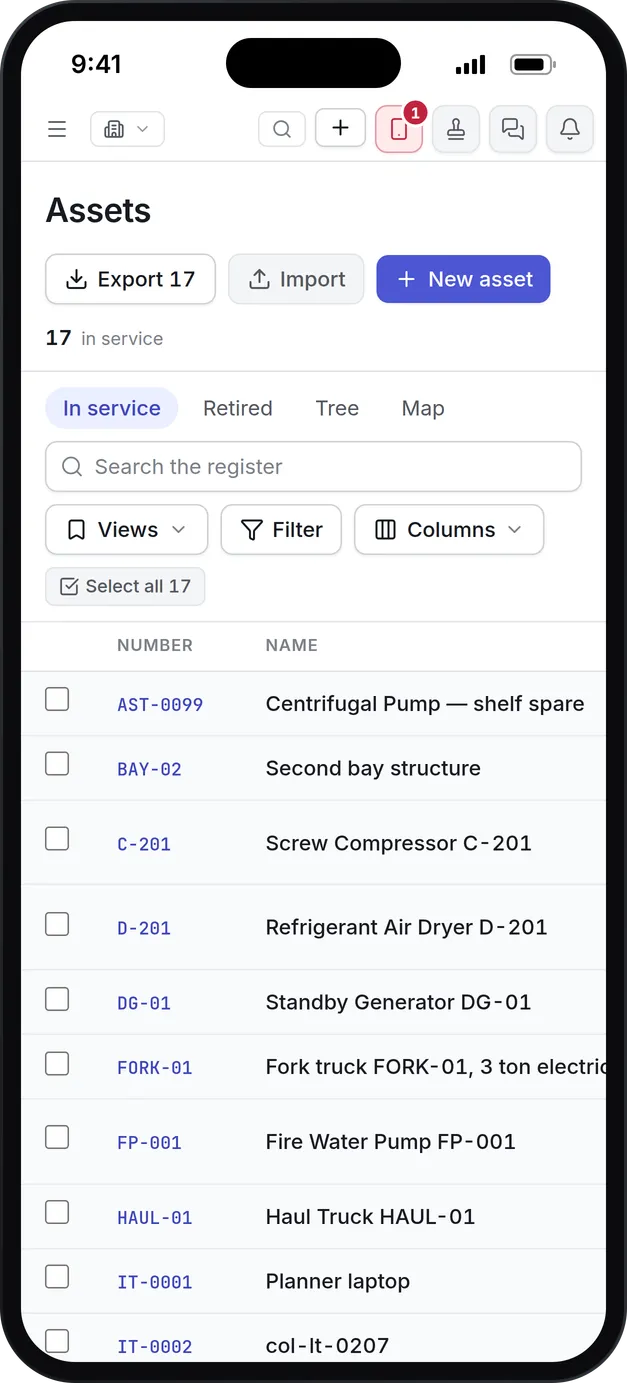
What our enterprise asset management software covers
Track
One register for plant, fleet, IT and furniture, with labels, RFID, BLE and GPS tags, and physical counts that prove what is still there.
Maintain
Work orders, preventive maintenance, scheduling, permits and root cause analysis, run against the same assets the register holds.
Supply
Parts, reorder points, purchase requests, quotes, purchase orders, receiving and vendor contracts, tied to the jobs that need them.
Account
Depreciation, budgets and capital plans on the asset finance already owns, so the cost of keeping it running lands where it belongs.
One record per asset
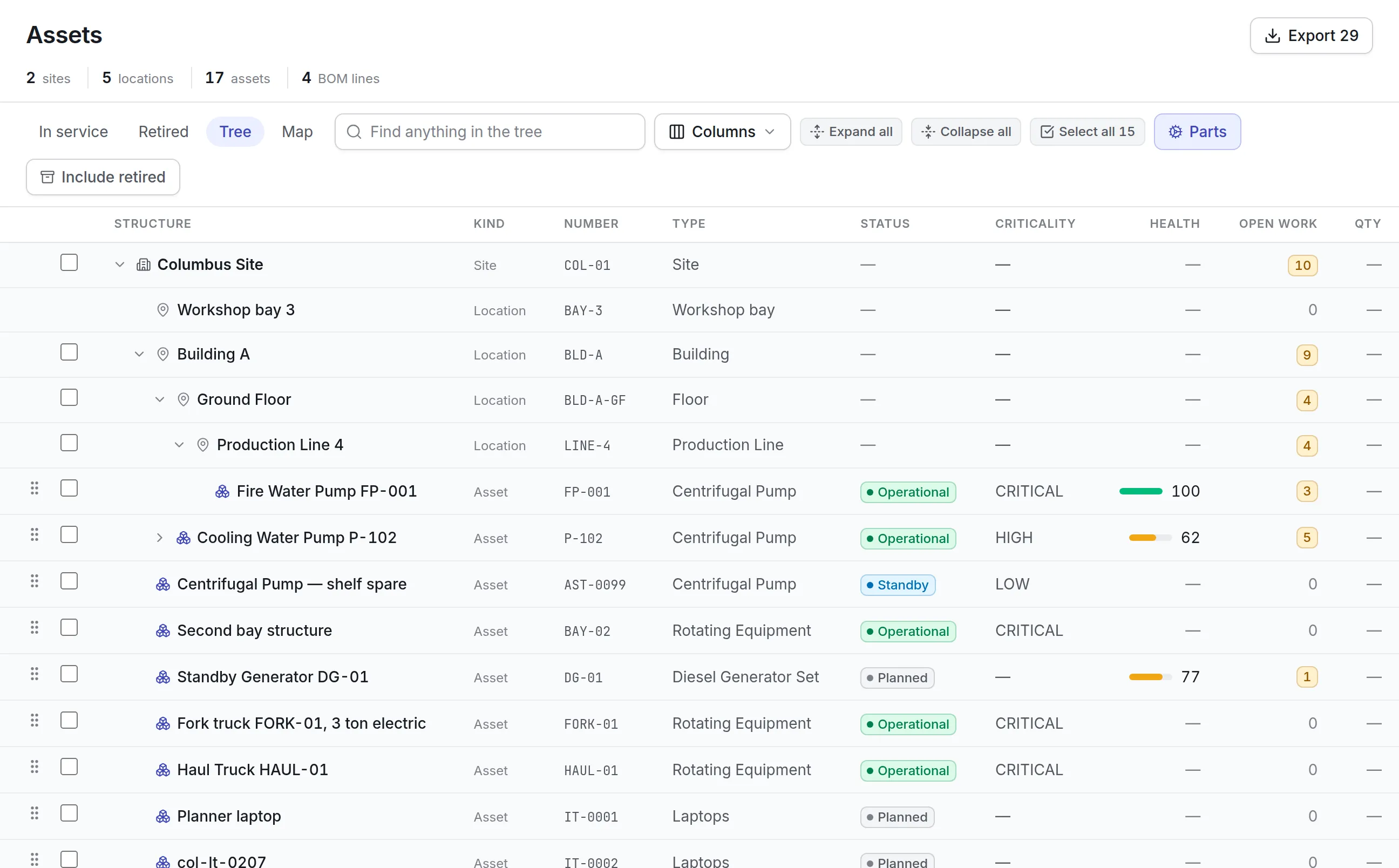
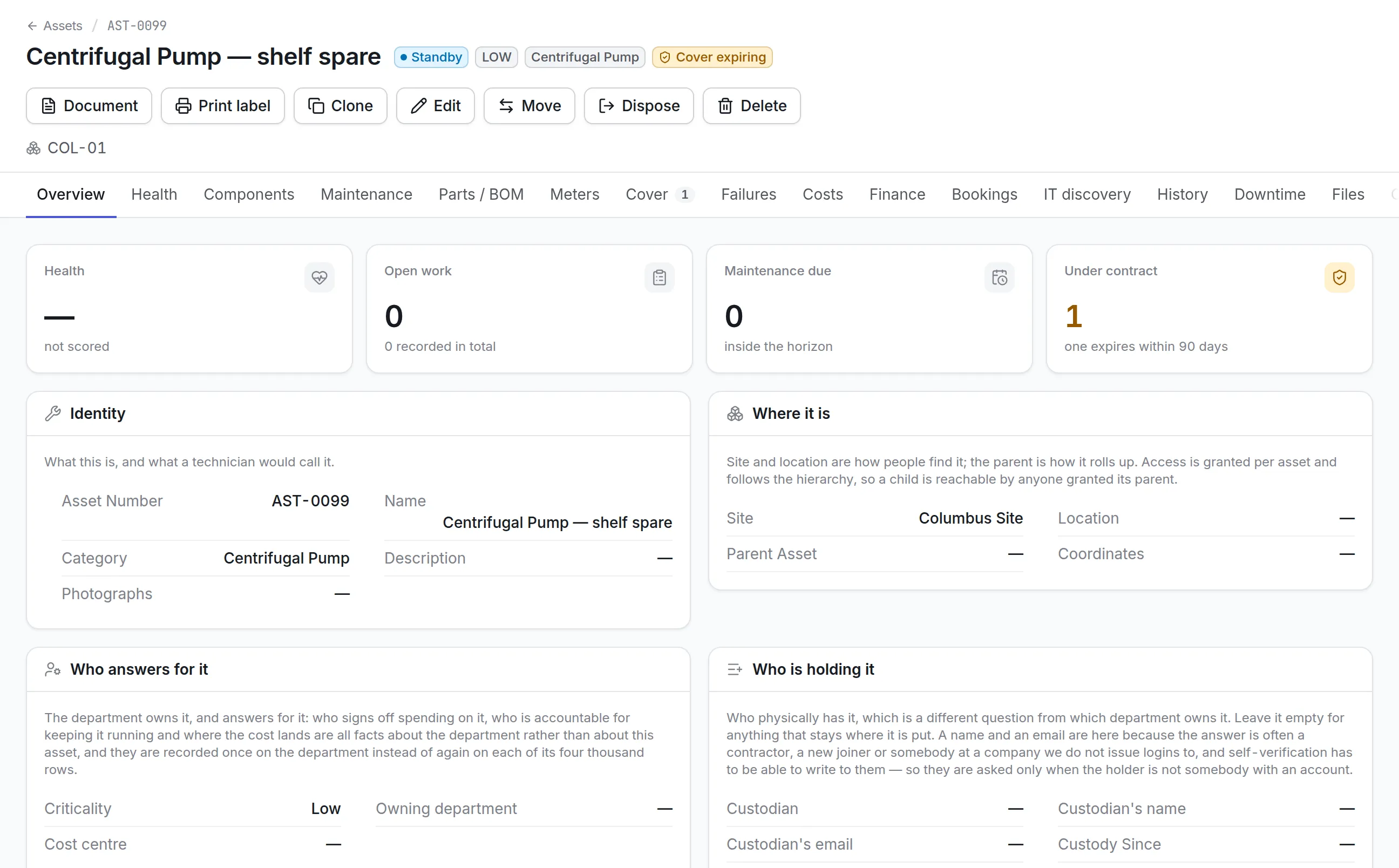
Each asset carries its maintenance, parts, contracts, failures, costs, bookings and history on tabs of one page.
Phones and Copilot included
Technicians and auditors work from the iOS and Android app, and an optional Copilot answers questions about the record you are looking at.
What is enterprise asset management software?
Enterprise asset management software is a single system of record for the physical assets an organization owns, covering each asset’s whole life: planning and buying it, tracking where it is, maintaining it, stocking its spare parts and accounting for its value until it is disposed of. EAM software gives operations, maintenance, stores and finance one shared record of every asset.
Teams buy it so that the person deciding whether to repair or replace a machine can see the cost of both, on one page, without asking three departments.
Why one asset record matters more than any single module
Without an EAM system, the same pump exists four times: in the maintenance system, in a stores spreadsheet, in the fixed asset register and in a purchasing tool. Each copy is right about something and wrong about the rest, and the gaps show up as everyday mistakes:
More detail
Enterprise asset management closes those gaps by letting each team work on the same record rather than keeping its own list.
How enterprise asset management software follows one asset through its life
Asset Infinity tracks an asset through a default lifecycle of seven statuses: Planned, Standby, Operational, Under Maintenance, Breakdown, Retired and Disposed. You can rename them or add your own. Here is one compressor’s life at a manufacturing site, and which team touches it at each stage.
- Planned and bought.The compressor begins as a scheme in a capital plan, proposed with a justification and a value and approved before money is released into a budget head. Purchasing raises a request, which can be met from a spare in Standby at another site before anyone buys new. Otherwise it goes out for quotes, becomes a purchase order and is received against it. See capital planning software.
- Registered, labeled and placed.The asset enters the register as Planned, then moves to Standby on receipt or straight to Operational when commissioned. An asset in service cannot be saved without a custodian. It sits in a hierarchy of site, building, line, machine and sub-assembly, and work, cost, downtime and failures roll up that tree. A QR, barcode or RFID label printed from the register means any scan opens the right record, and verification counts later prove it is still there. Asset tracking software covers this part.
- Maintained.Plans service the compressor every 90 days or every 2,000 running hours, whichever comes first, and corrective jobs come in from requests. Before a job is raised, the product checks the contracts and warranties covering the asset and records whether a vendor should pay. Components such as motors are fitted, replaced and taken off with a reason. The maintenance side is described on the CMMS software page.
- Supplied with parts.The compressor’s parts list says which spares it uses. Reorder recommendations count what upcoming maintenance plans will consume as well as past usage, and a recommendation becomes a purchase request with the part, quantity, store and date filled in. See inventory and purchasing.
- Accounted for.Finance capitalizes the compressor from the asset’s own Finance tab into one or more depreciation books, typically one for the accounts and one for tax. Each period’s charge is calculated as a draft, checked and posted, and the posted run produces journals for your general ledger. Something still being built is held as a project under construction until it is commissioned.
- Replaced and disposed.Every asset carries a health score out of 100, built from availability, unplanned work, emergencies, maintenance done on time and age against expected life. The Reliability screen recommends a replacement when maintenance cost approaches what the asset cost to buy. On disposal, open work is called off, the reason, buyer and price are recorded, and depreciation ends in every book with a gain or loss for each.
EAM, CMMS and fixed asset software compared
Buyers often meet three overlapping categories: maintenance software, the accountants’ fixed asset register, and enterprise asset management, which joins them. The finance side alone looks like this.

| Question | CMMS | Fixed asset software | Enterprise asset management software |
|---|---|---|---|
| Who uses it | Maintenance | Finance and accounting | Maintenance, stores, purchasing, finance and operations |
| What it records | Work orders, plans, failures | Cost, depreciation, disposal | All of these on one asset record |
| Spare parts and purchasing | Sometimes | No | Yes |
| Repair-or-replace decisions | Maintenance cost only | Book value only | Both, side by side |
Read more about the accounting side on the fixed asset management software page.
See it on your own assets, or price it in two minutes.
What to look for when choosing enterprise asset management software
Many products call themselves EAM software. The test is whether the teams really share one record or pass data between modules that were built separately.
| Capability | Why it matters | In Asset Infinity |
|---|---|---|
| One asset record across teams | Two copies of an asset drift apart within months | Maintenance, parts, contracts, costs, finance and history are tabs of one asset page |
| Configurable lifecycle | Your statuses and approvals are not the vendor’s | Asset, work order and request lifecycles are yours to rename, extend and put approvals on |
| Asset hierarchy | Cost and downtime need to roll up to the line and the site | Site, location, asset, sub-asset and fitted components in one tree |
| Contract and warranty cover | Paying for repairs a vendor owes you is a quiet, steady loss | Cover is checked when work is raised, and the decision is recorded |
| Depreciation in several books | Statutory and tax books disagree, legitimately | Straight line, written-down value and units-of-production in parallel books |
| Mobile and offline | Audits and repairs happen where there is no signal | iOS and Android app that works offline for jobs, counts and readings |
| Modular adoption | Buying everything on day one slows the rollout | Start with the register and add maintenance, stores, purchasing and finance later |
| Deployment choice | Some sites cannot use a public cloud | Our cloud or your own servers, same product |
| Open integration | The EAM system has to feed the ERP and the BI tools | A documented API and webhooks for record events |
Enterprise asset management examples by industry
Water and wastewater utilities
A utility has assets spread across treatment plants, pump stations and networks, with long lives and capital plans that run for years. The register holds the hierarchy, meter and condition triggers drive maintenance, and capital schemes are argued from health scores and lifetime cost rather than age alone. See water utilities.
Manufacturing
A plant needs maintenance, stores and finance to agree on what a line is worth and what it costs to keep running. Running-hour plans, reorder points that count planned work, and depreciation by units of production all read the same meters, so one reading serves three teams and nobody types it twice.
Hotels and hospitality
Hotels replace furniture, fixtures and equipment on a cycle, room by room. FF&E plans sit beside the register, so a renovation is planned against the assets actually in the rooms rather than an old list. Housekeeping and engineering report faults into the same maintenance queue, so a room’s repair history is there when the replacement is planned.
Mixed estates with IT
Many sites run pumps next to laptops and network switches. Both live in one register with the same labels, counts and disposal process. IT teams add device discovery and software license tracking on top, and a laptop that fails is repaired through the same work order process as a forklift.
What enterprise asset management software costs here
Asset Infinity publishes its prices. The asset register starts at $130 a month for up to 500 assets, with unlimited users, and includes labels and verification counts. Other modules are added as you need them:
- Maintenance, parts and stock, purchasing, finance and analytics are bundles priced per user per month, for the people who use them.
- Add-ons such as contracts, budgets or capital planning are flat monthly fees.
- On-premise runs at twice the cloud price, billed yearly.
Build a quote for your asset count and the teams that will use it.
Rolling it out in stages
Most organizations do not switch everything on at once. A typical order is:
Each stage adds to the same records, so nothing is migrated twice.
Common questions
What is enterprise asset management software?
Enterprise asset management (EAM) software records every asset an organization owns and manages its whole life, from purchase and tracking through maintenance and spare parts to depreciation and disposal.
What is the difference between EAM and a CMMS?
A CMMS plans and records maintenance. EAM software covers the rest of the asset's life as well, including the register, purchasing, contracts and the financial value. Asset Infinity includes a full CMMS.
What does an EAM system include?
An EAM system usually includes an asset register, work orders and preventive maintenance, spare parts inventory, purchasing, vendor contracts and the asset's financial records. In Asset Infinity these are modules on one asset record, switched on as you need them.
Do we have to buy every part at once?
No. The asset register is the base, and maintenance, inventory and purchasing, finance and other features are added as you need them. See the pricing page for each one.
How do we choose the best EAM software?
Follow one asset through a demo, from purchase to disposal, and check that maintenance, stores and finance each see the same record. Then check the mobile app offline, how data is imported, and whether the prices are published.
Can it run on our own servers?
Yes. The same product runs in our cloud or on your own servers, billed yearly.
See it with your own assets
A demo run on an example from your industry. Or start the trial and look around on your own.