





Asset inventory software that proves every asset is where the register says
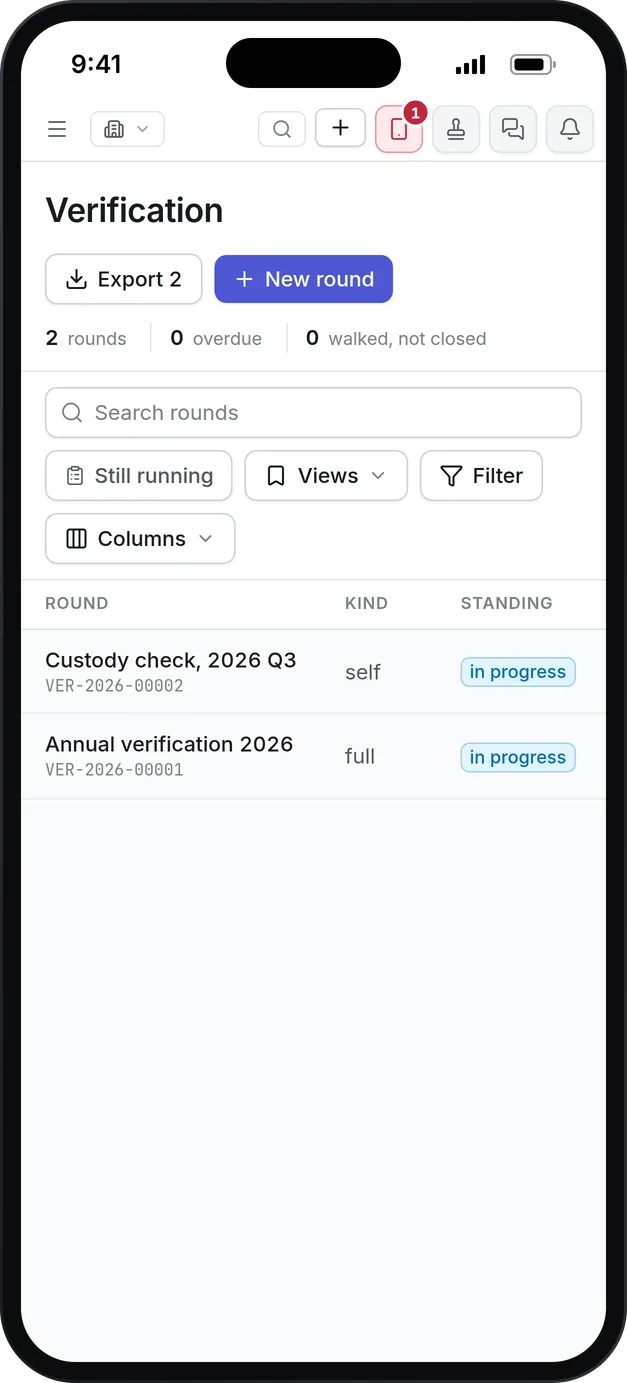
Asset inventory software that fixes the expected list the moment a count starts. People scan what they find, and the report shows every asset missing, damaged or in the wrong place.

What our asset inventory software does for counts and audits
A list that holds still
Starting a round fixes the list of assets it expects. An asset edited during the count cannot quietly drop out of the total.
Full, sample or targeted
Count everything in scope, a random sample, or a targeted list. Assign people and areas, and set a due date.
Scan in the mobile app
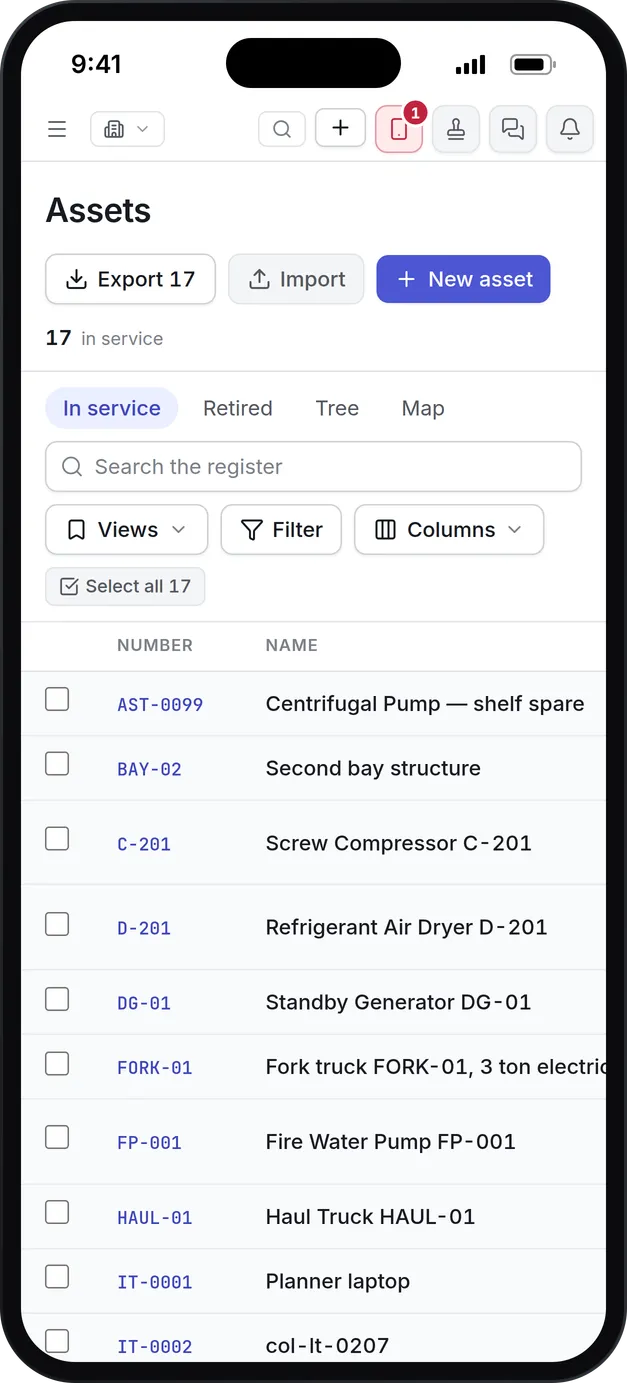
Counters scan QR codes, barcodes or RFID tags with the iOS and Android app, and keep counting where there is no signal.
Every outcome named
Each asset is verified, found somewhere else, not found, damaged or skipped. An asset nobody expected is recorded too, beside the rest.
Custodians confirm by email
People who hold equipment, including contractors without a login, confirm what they have from a link in an email.
Reports by plant and person
The round report breaks counts down by plant and lists each exception with a remark and the person who recorded it, ready to print.
What is asset inventory software?
Asset inventory software helps you count the physical assets you own and compare that count with your records. It gives counters a fixed list to work through, records what they find with a scan, and reports every asset that is missing, damaged, in the wrong place or not on the list at all.
Organizations run these counts for auditors, insurers and their own finance teams, and because a register nobody has checked drifts a little further from the floor every month.
Why the list has to hold still
A count is only as good as the list it is measured against. If assets can be added, moved or retired in the register while people are counting, “not found” stops meaning anything. Asset Infinity fixes the list at the moment a round is published.
- A round starts as a scope: sites, locations, categories, departments, asset statuses, criticality or custodians, with exclusions that subtract.
- While the round is a draft, a preview shows how many assets the scope selects, by site, so a wrong figure is obvious before anyone walks.
- Publish turns the scope into a fixed list, one line per asset.
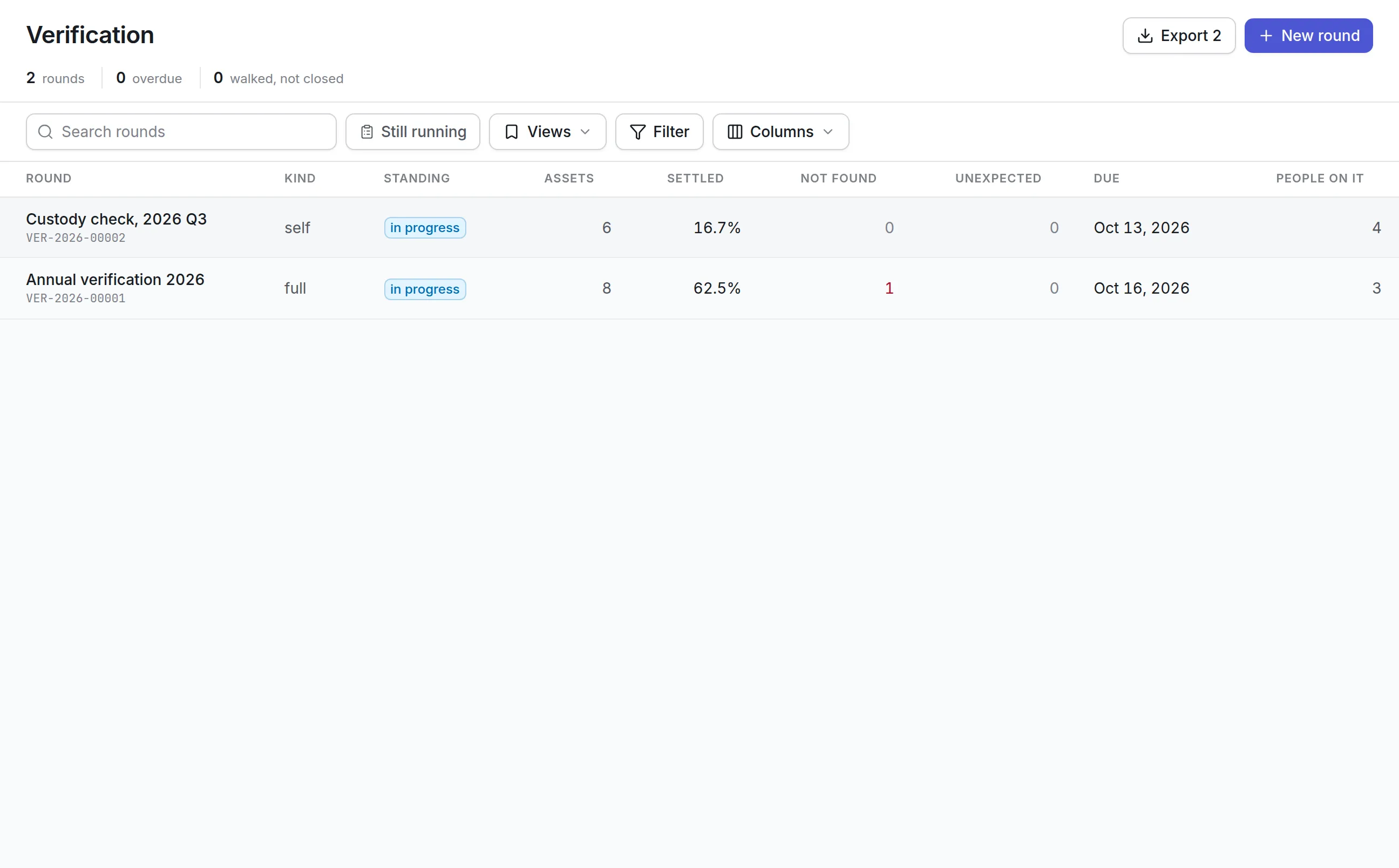
- The register header warns about rounds that are overdue and rounds walked, not closed, because both look ordinary on a list sorted by date.
How asset inventory software works in Asset Infinity
The steps below follow an annual count at a manufacturing company with two sites, run by the finance team with auditors from each plant.
- Create the round.New round asks for a name, a kind and the dates it should run. The kind is Full, Sample (a random draw by percentage or number, recorded so it can be reproduced), Targeted (a list someone supplies) or Self-verification.
- Set what counts as having looked.Switch on Photograph required, Remarks required, Condition required or Location fix required. Reason required when not found is on by default.
- Write the scope and publish.Add rules for each site and category, check the preview, and publish. The list is now fixed.
- Send somebody.Give each auditor a site or location as their slice. A line belongs to at most one auditor, so nothing is counted twice.
- Walk it.Auditors scan each label in the mobile app or a browser, and record It is here, It is somewhere else, I cannot find it, It is damaged or Could not get to it, with a condition of Good, Fair, Poor or Unserviceable.
- Look again.A round set to Recount sends every unfound asset back once for a second look before it can be recorded as missing.
- Close and report.Close round asks what to do with lines nobody reached, takes a closing note and fixes the report.
Scans are recorded on the phone without a signal and sent on the next sync. An asset found somewhere else can be moved in the register from its line with Move it, recorded as a movement.
Scanning: camera, barcode scanner or RFID reader
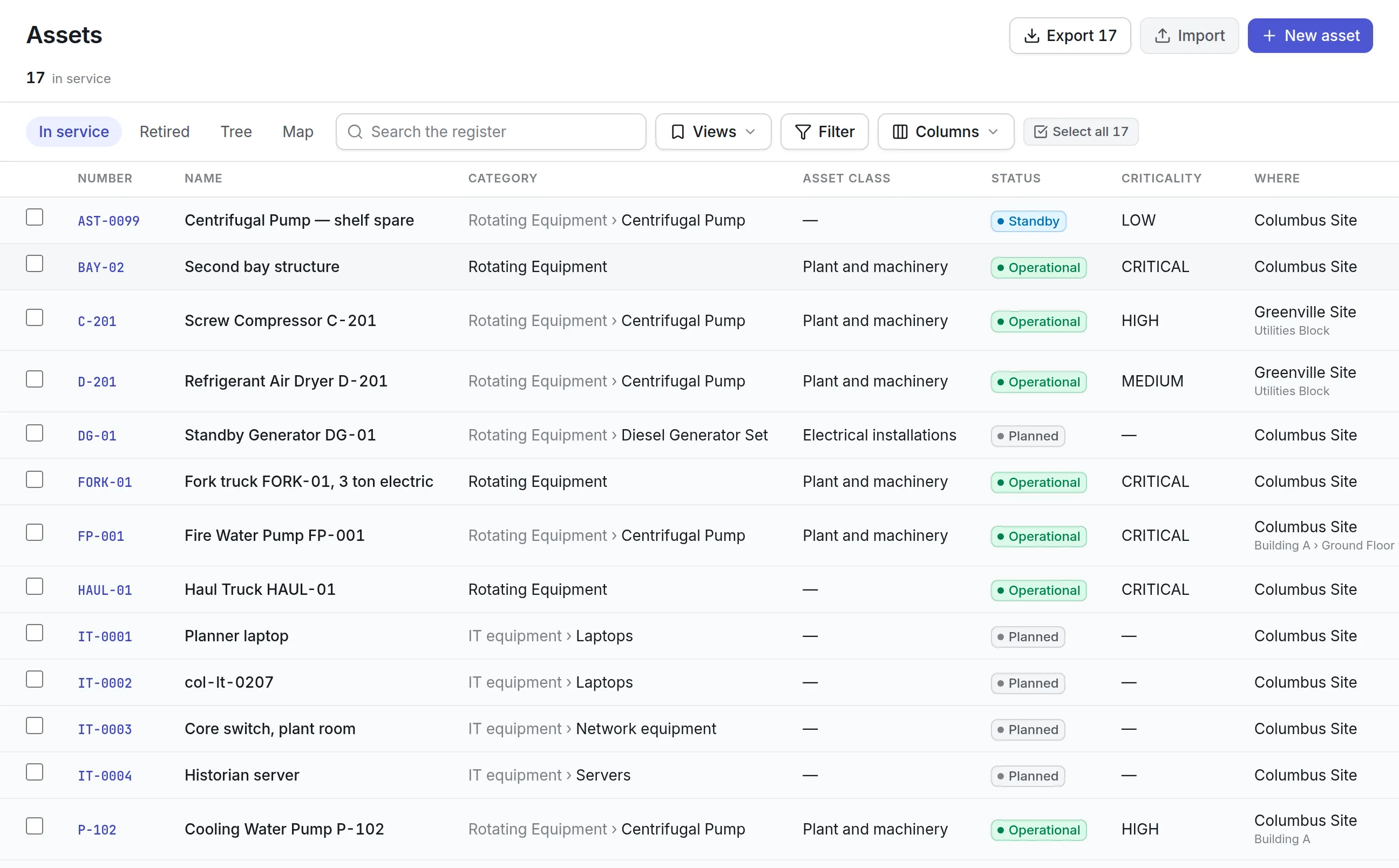
Counting is only as fast as finding each asset, so the walk screen takes whatever your site uses. Labels printed from the register carry a QR code, a barcode or an RFID tag, and the same round can mix them.
Asset inventory, physical verification and fixed asset audits
Buyers search for the same job under several names. Here is how each one runs in Asset Infinity:
| What it is called | What it usually means | How to run it |
|---|---|---|
| Asset inventory | Counting what you own against the register | A full round scoped by site and category |
| Physical asset verification | Proving each asset exists, where and in what condition | A full round with photograph and condition required |
| Fixed asset audit | Evidence for auditors that the books match the floor | A full or sample round with a printed report |
| Spot check | A small, frequent check between annual counts | A sample round by percentage |
| Custodian attestation | People confirm what they hold | A self-verification round by email |
See it on your own assets, or price it in two minutes.
When the person holding it has no login
Laptops, test meters and radios often sit with contractors, new hires and staff at other sites. A Self-verification round sends nobody to walk. Each custodian gets an email with a link listing the assets recorded against them.
- No account is needed: the asset only has to record the custodian’s name and email.
- For each item they answer I have it, I have it, but it is damaged or I do not have it, with a photograph where the round asks for one.
- Answers save as they go, so someone with forty laptops can finish in three sittings.
- Who was asked shows each person as not opened, opened but not answered, or answered, and Send it again issues a fresh link.
The report your auditor reads
Report prints the round’s result. Until the round is closed, it says its figures will still move.
| Section | What it shows |
|---|---|
| The counts | Expected, walked, settled at closure, verified, somewhere else, not found, damaged, skipped and unexpected |
| By site | Expected, verified, somewhere else and not found for each site |
| Exceptions | Every line missing, moved, damaged or not reached, with expected and found locations, remarks and who recorded it |
| Found that nobody asked about | Unexpected finds, kept out of every percentage |
| Who walked it | Each auditor’s slice and what they actually recorded |
| What it concluded | The closing note, or why the round was abandoned |
Good asset inventory software leaves a record that outlasts the count. Closing a round fixes its report, lines settled at closure are marked as such instead of being credited to an auditor, and the full list can be exported for the working papers. Next year’s count starts from a fresh round, and last year’s stays exactly as it was signed off.
What to look for when choosing asset inventory software
| Capability | Why it matters | In Asset Infinity |
|---|---|---|
| A fixed expected list | “Not found” only means something against a list that did not move | Publishing a round freezes its list |
| Several kinds of count | Annual full counts, quarterly samples and recounts are different jobs | Full, sample, targeted and self-verification rounds |
| Rules enforced at the scan | Evidence asked for afterwards is evidence that never arrives | Photo, remark, condition and location rules checked before an outcome is recorded |
| Offline counting | Basements, plant rooms and warehouses have no signal | Scans queue on the phone and sync later |
| Custodian confirmation | Many assets sit with people who never log in | Email links that need no account |
| Unexpected finds | Assets missing from the register are as important as assets missing from the floor | Recorded on the round and reported separately |
| A printable report | Auditors want one document | Counts by site, exceptions and who counted |
Asset inventory by industry
Asset inventory software is used differently by each kind of organization. These are the counts teams usually set up first.
Manufacturing
A plant runs a full annual count of plant and machinery for its auditors, scoped by site and category, with Photograph required on so every verified line carries evidence. Quarterly sample rounds in between keep the register honest, and each plant gets its own line in the report’s by-site table.
Schools and universities
IT and facilities teams count laptops, projectors and lab instruments room by room each summer. A self-verification round asks staff to confirm the devices issued to them before they leave for the break. Custodians answer from an email without an account, and anyone who has not opened the link shows on the Who was asked list for a reminder. See school asset management.
Hospitals
Biomedical engineering counts equipment by ward, with Condition required so damaged devices are found during the count. A targeted round recounts what was missing last time. Auditors record Could not get to it for a room in use, and a round set to recount sends every unfound device back for a second look before it is recorded as missing.
Finance and fixed assets
Controllers scope a count by site, category and owning department so the result lines up with how the books are kept. A sample round records its random draw, so an auditor can reproduce the same sample. The exceptions list becomes the list of disposals and transfers to post in fixed asset management software.
What asset inventory software costs with Asset Infinity
Counting rounds come with the asset register, which starts at $130 a month for up to 500 assets, with unlimited users. If you would rather not tag and count the first time yourselves, tagging and a first count can be done for you at $1 per asset. Build a quote with your asset count.
Getting started
A first count usually starts with labels and a small pilot:
Every count starts from the asset register.
What it uses
Common questions
What is asset inventory software?
Asset inventory software helps you count the physical assets you own and compare the count with your records. It shows which assets were found, which are missing and which are in a different place.
How often should we run an asset inventory?
Many organizations run a full count once a year for their auditors and smaller sample or targeted counts in between. You can run as many rounds as you need, each with its own scope and due date.
Does a count change the asset register automatically?
No. An asset found somewhere else stays a finding on the round until someone presses Move it on its line, which records the move in the register. That keeps a mistaken scan from rewriting your records.
Can we count assets without an internet connection?
Yes. The mobile app records scans offline and sends them when the device is back in signal.
What is the difference between asset inventory and a fixed asset audit?
An asset inventory counts what you own against the register. A fixed asset audit uses that count as evidence that the books match the floor. In Asset Infinity both run as verification rounds, and the printed report is what the auditor reads.
See it with your own assets
A demo run on an example from your industry. Or start the trial and look around on your own.