






RFID asset tracking that tells you where an asset is and when it left
RFID asset tracking in Asset Infinity puts fixed readers on your doorways and BLE gateways on your floor plans. Each sighting updates the same asset record your maintenance team already uses.
What our RFID asset tracking does at doorways, rooms and yards
Antennas mean places
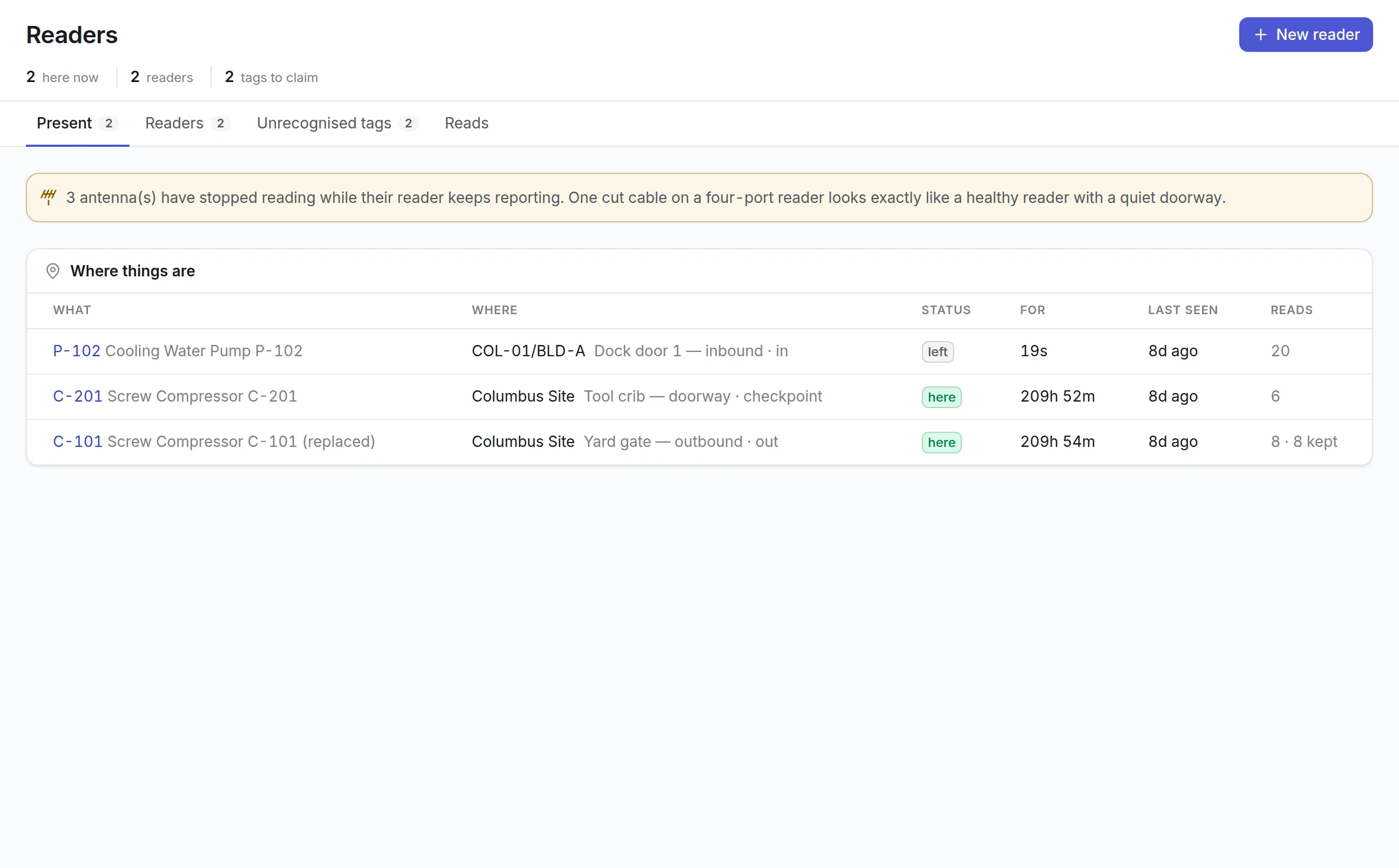
Each antenna is set to a site and location and marked as an entry, an exit or a watch point. A read says the tag was at the inbound side of dock door 1.
One visit, one record
A tag read twenty times a second becomes one presence with an arrival and a departure. Read thresholds and a grace window stop a parked forklift from arriving four times.
Rules on arrival
Switch on events for the doorways that matter. A rule can notify a supervisor or move the asset's recorded location when a tag arrives.
BLE on the floor plan
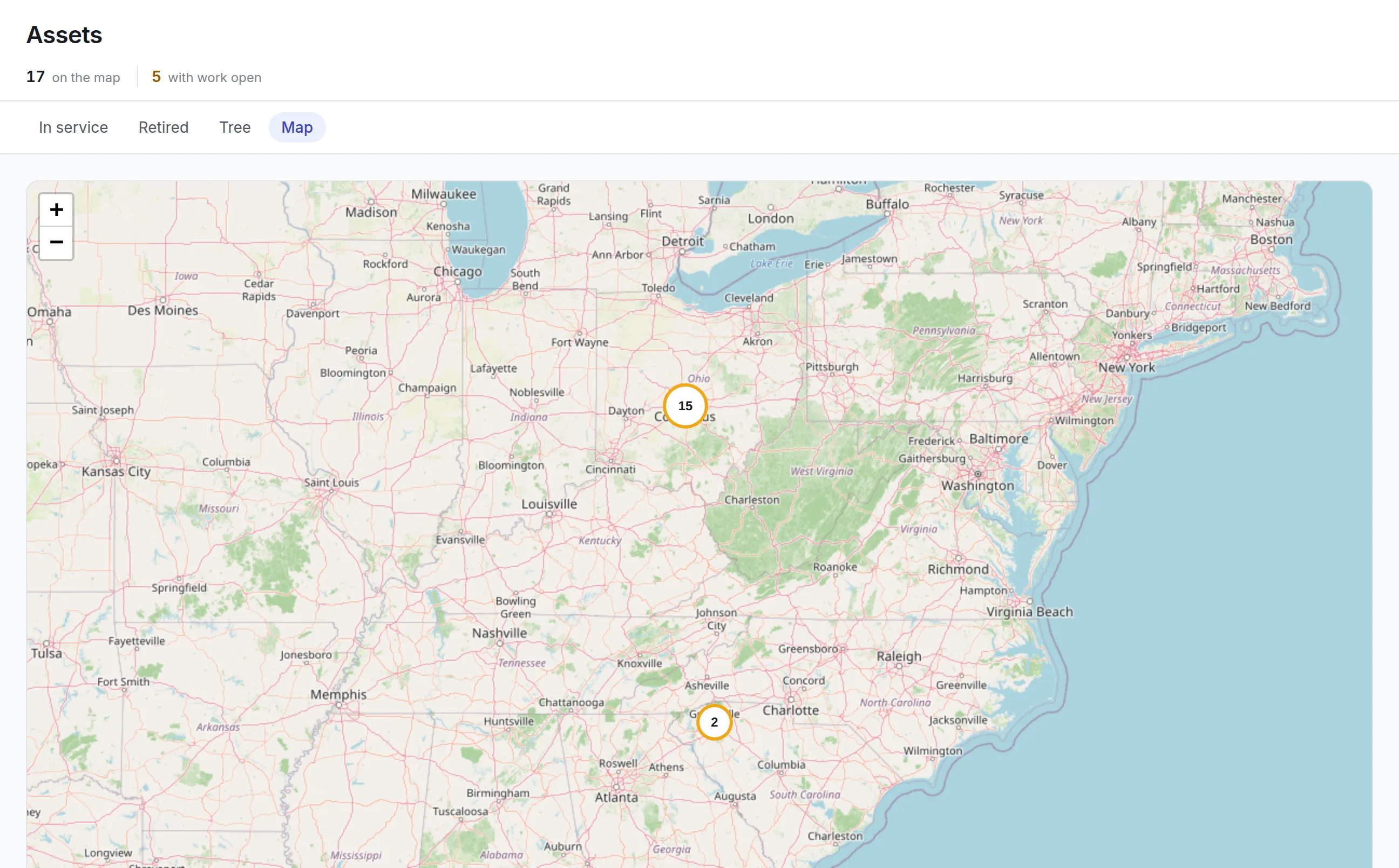
BLE gateways placed on a scaled drawing locate tagged assets in a room, with an accuracy circle and a trail you can replay.
Handheld RFID guns
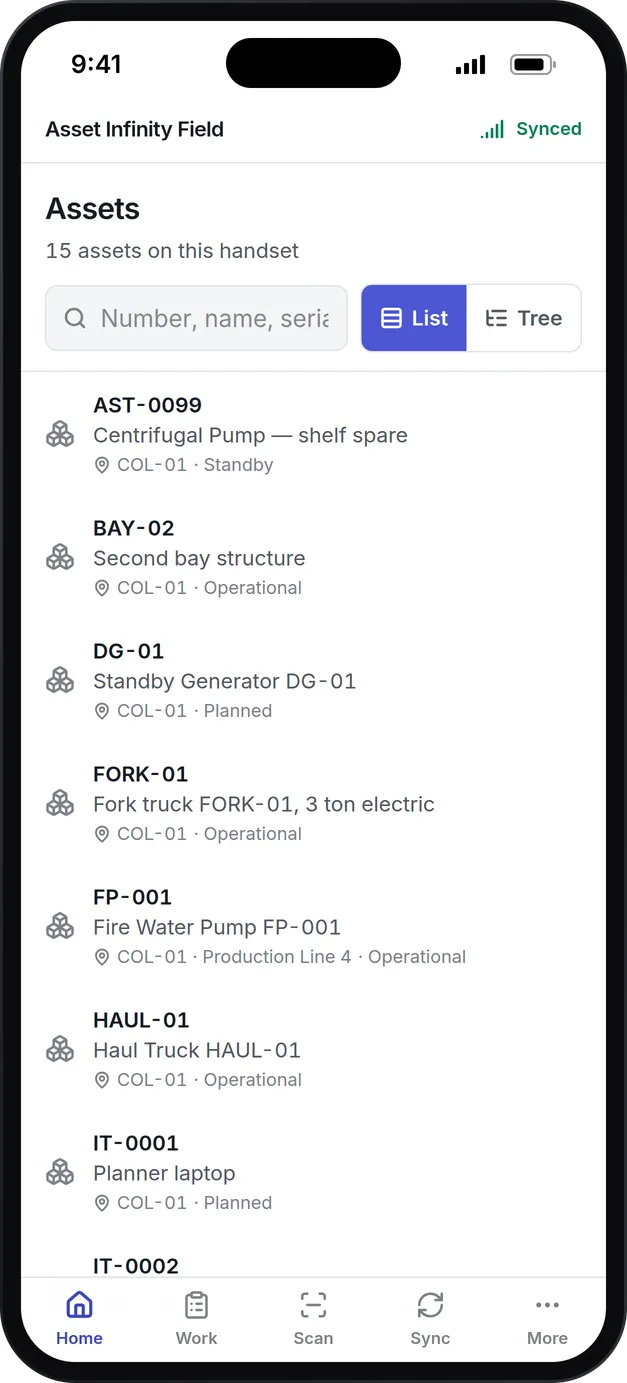
Technicians use Zebra, TSL or Chainway handhelds with the mobile app to scan a tag, write an asset's number onto a new one, or walk towards a missing item.
GPS outdoors
Where readers cannot reach, GPS trackers report vehicle and plant positions on the same asset record.
What is RFID asset tracking?
RFID asset tracking puts a radio frequency tag on each asset and uses readers to record where and when that tag is seen, without anyone scanning a label by hand. Fixed readers at doorways show movement in and out of a space, and handheld readers find and count tagged items without line of sight.
Teams buy it when the register says an asset is in one place and nobody can find it there. A barcode only updates when someone remembers to scan it. An RFID reader on a doorway updates every time the asset passes.
How RFID asset tracking works in Asset Infinity
Everywhere else in the product, an asset’s location is where somebody last said it was. A reader records where the asset was seen. The steps below follow a plant that puts a fixed reader on its dock door and another on its tool crib doorway.
- Add the reader.On the Readers screen, New reader asks for a code, a name, the site and how it reports: the product subscribes to the reader’s MQTT broker, or the reader posts its messages in over HTTPS with a key issued for it.
- Point each antenna at a place.Every antenna has a site and location and a Purpose of observe, entry, exit or checkpoint. A read on antenna 1 then means “dock door 1, inbound”.
- Map the message.Every brand of reader sends a differently shaped message, so a payload map says which fields hold the tag, the antenna and the signal. What does this give? runs a real message through the map, and Try it without hardware sends one through the whole path.
- Claim the tags.Reads from tags nobody has registered land on Unrecognized tags, most seen first. This tag is on… attaches a tag to its asset, and Not ours stops a carton’s tag being asked about again.
- Turn reads into visits.A tag read many times a second becomes one visit with an arrival and a departure. Min reads to open (3 by default), Absence timeout seconds (120) and Reopen grace seconds (300) stop a forklift parked in a doorway from arriving four times.
- Act on arrivals.Switch on Raises events for the doorways that matter, then write an automation rule. A rule can move the asset to the place the antenna points at, or tell someone when an asset leaves the yard.
Raises events is off by default on purpose. Switched on everywhere, it would tell a site about every pallet in the building.
A reader that says when it has stopped reading
A cut antenna cable on a four-port reader looks exactly like a quiet doorway. Asset Infinity watches the hardware as closely as the tags, and tells someone once when a reader is down and once when it is back.
RFID, BLE and GPS: which one tracks what
RFID answers “did it pass this doorway?”. It is not the only way to find assets, and most sites end up using more than one.
| Technology | What it tells you | Best for | In Asset Infinity |
|---|---|---|---|
| Passive RFID, fixed readers | A tag passed a particular antenna, and when | Dock doors, tool cribs, yard gates, ward entrances | Readers screen, visits and arrival rules |
| Passive RFID, handheld | Which tags are near you now | Counts, audits and finding one item on a shelf | Zebra, TSL and Chainway readers with the Android app |
| BLE tags and gateways | Which room a tag is in, continuously | Mobile equipment inside a building | BLE tags register and live positions on floor plans |
| GPS trackers | Where a vehicle or machine is outdoors | Fleets, yards and plant that moves between sites | GPS trackers screen, trips and areas |
All four write to the same asset record, so GPS asset tracking, BLE positions and RFID visits sit beside the asset’s work orders, meters and costs.
See it on your own assets, or price it in two minutes.
Indoor tracking with BLE tags
For “which room is it in?”, BLE does what doorway RFID cannot. Gateways on the ceiling hear battery tags continuously, and the product places each tag on a scaled floor plan with a trail you can replay. Asset Infinity has presets for HPE Aruba access points, Kontakt.io and Minew gateways.
Handheld readers and RFID labels
A handheld reader turns the mobile app into an RFID asset tracking tool for counts and searches. It works with Zebra, TSL and Chainway readers paired to the Android app; the iOS app does not connect to readers.
- Encode RFID tag writes an asset’s code onto a blank tag, and checks first that the code will scan back as that asset.
- Locate tag follows a bar and a beep that rise as you get closer to one asset’s tag.
- A connected reader works in every scan box in the app, including verification counts in asset inventory software.
- Label designs can write the tag as they print on a printer with an RFID encoder, to the EPC, User or TID memory bank. See asset tags.
What to look for in an RFID asset tracking system
| Capability | Why it matters | In Asset Infinity |
|---|---|---|
| Reads turned into visits | Thousands of reads per hour are noise until they become arrivals and departures | Visits with arrival, departure, read count and duration |
| Per-antenna tuning | A yard gate and a tool crib need different thresholds | Signal floor, min reads, absence timeout and grace per antenna |
| Reader-agnostic setup | You should not be tied to one hardware brand | MQTT or HTTPS with a payload map edited in settings |
| Unknown tag handling | Day one brings thousands of tags you do not own | An unrecognized tags list with claim and dismiss, capped per hour |
| Hardware health | A dead antenna looks like a quiet doorway | Down, back and quiet-antenna notifications to named people |
| Rules on arrival | Location should follow the asset without a person | Automation rules can move the asset or notify someone |
| One register | Tracking data is wasted if it lives apart from maintenance | Visits sit on the same asset record as work and cost |
RFID asset tracking by industry
Hospitals
Infusion pumps, wheelchairs and monitors move between wards. BLE tags place them on each floor plan, so biomedical engineering finds a pump due for its safety check in the room it is in. A fixed reader at the loading dock records equipment leaving for repair. Silent BLE tags are listed first, so a flat battery is replaced before the pump goes missing. See healthcare asset management.
Manufacturing plants
A reader on the tool crib doorway records gauges and torque wrenches going out and coming back, and a reader on each dock door records pallets of spares arriving. Rules move a tagged asset to the production line it was carried into. See tool tracking software for the check-out side.
Warehouses and distribution centers
Readers on dock doors and yard gates record reusable containers, pallets of equipment and forklifts passing through. A rule on the exit antennas notifies the yard supervisor when a tagged asset leaves. Each antenna has a signal floor that stops it answering for the next door, and the thousands of carton tags seen on the first day are dismissed from the unrecognized list with Not ours.
Campuses and offices
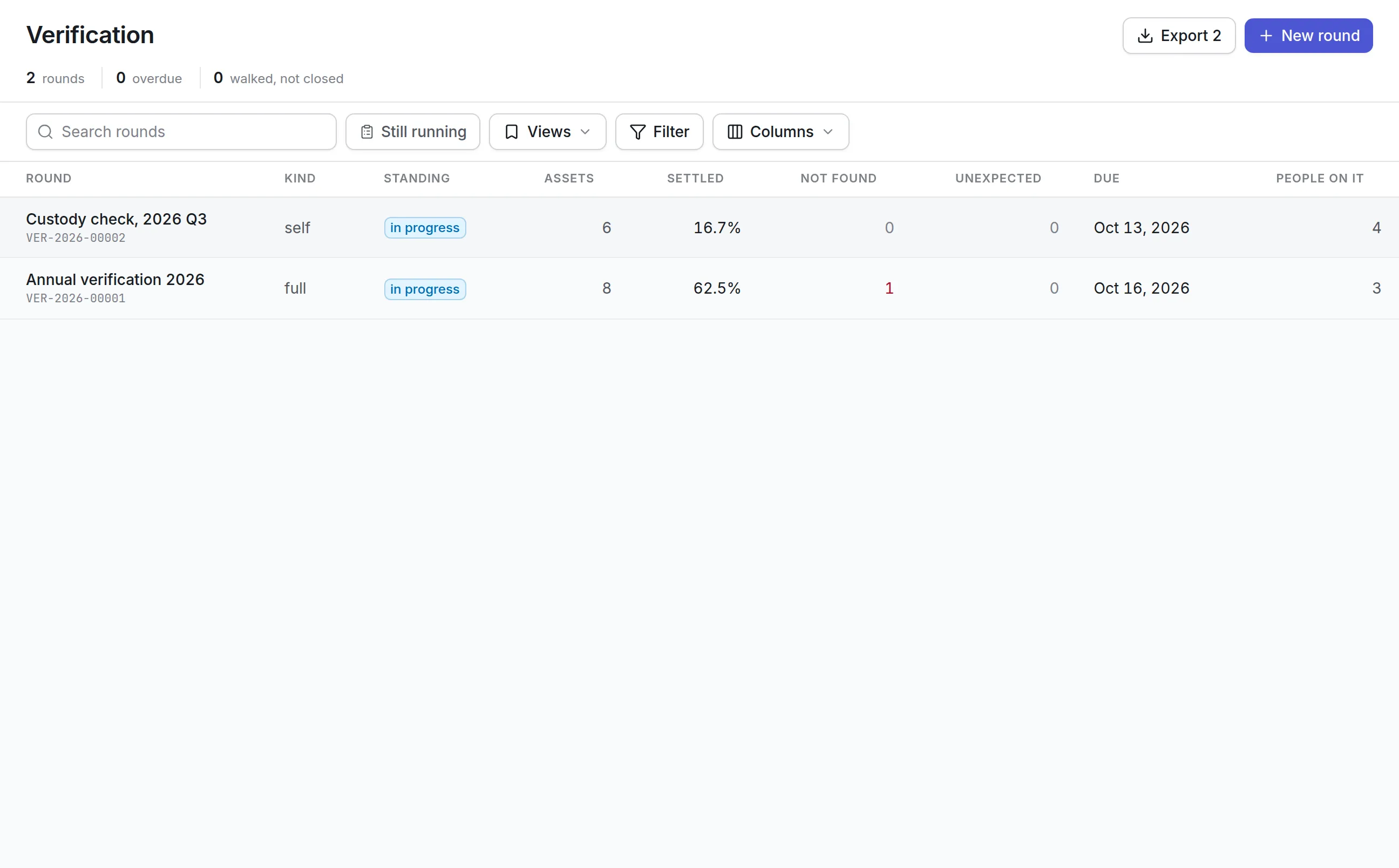
Laptops, projectors and lab instruments are tagged at receiving. Handheld readers make the annual count a walk through each room instead of a hunt for barcodes, and readers on building exits record equipment leaving the site. Unexpected tags found during a count are recorded on the round, and the report lists what is missing site by site.
What RFID asset tracking costs with Asset Infinity
The asset register starts at $130 a month for up to 500 assets, with unlimited users. RFID fixed readers are $670 per reader per year with the reader included, BLE tags are $1 per tag per month, and GPS trackers are quoted with the tracker model you choose. Tagging and a first count can be done for you at $1 per asset. Build a quote for your sites.
Getting started
Start with one doorway and widen once the visits look right:
For the wider picture, see asset tracking software.
What it uses
Common questions
What is RFID asset tracking?
RFID asset tracking puts a radio tag on each asset and uses readers to record when a tag is seen. Fixed readers at doorways show movement in and out, and handheld readers find and count items without line of sight.
Which RFID readers work with Asset Infinity?
Fixed readers connect over MQTT or HTTPS, and each reader's message format is mapped in settings, so adding a new brand is a settings change. Handheld readers from Zebra, TSL and Chainway work with the Android app.
What is the difference between RFID and BLE tracking?
An RFID reader tells you a tag passed a particular antenna. BLE gateways hear tags continuously, so the system can place a tag on a floor plan and show which room it is in.
Can we print RFID labels?
Yes. A label design can write the asset's number to the RFID tag as it prints, and a reprint writes the same number so the replacement reads as the same asset.
What happens to a tag the system does not know?
It is kept on the Unrecognized tags list with where it was seen, so someone can claim it for the right asset.
How much does an RFID asset tracking system cost?
In Asset Infinity, RFID fixed readers are $670 per reader per year with the reader included, on top of the asset register from $130 a month. BLE tags are $1 per tag per month.
See it with your own assets
A demo run on an example from your industry. Or start the trial and look around on your own.