






Predictive maintenance software that acts on what your equipment reports
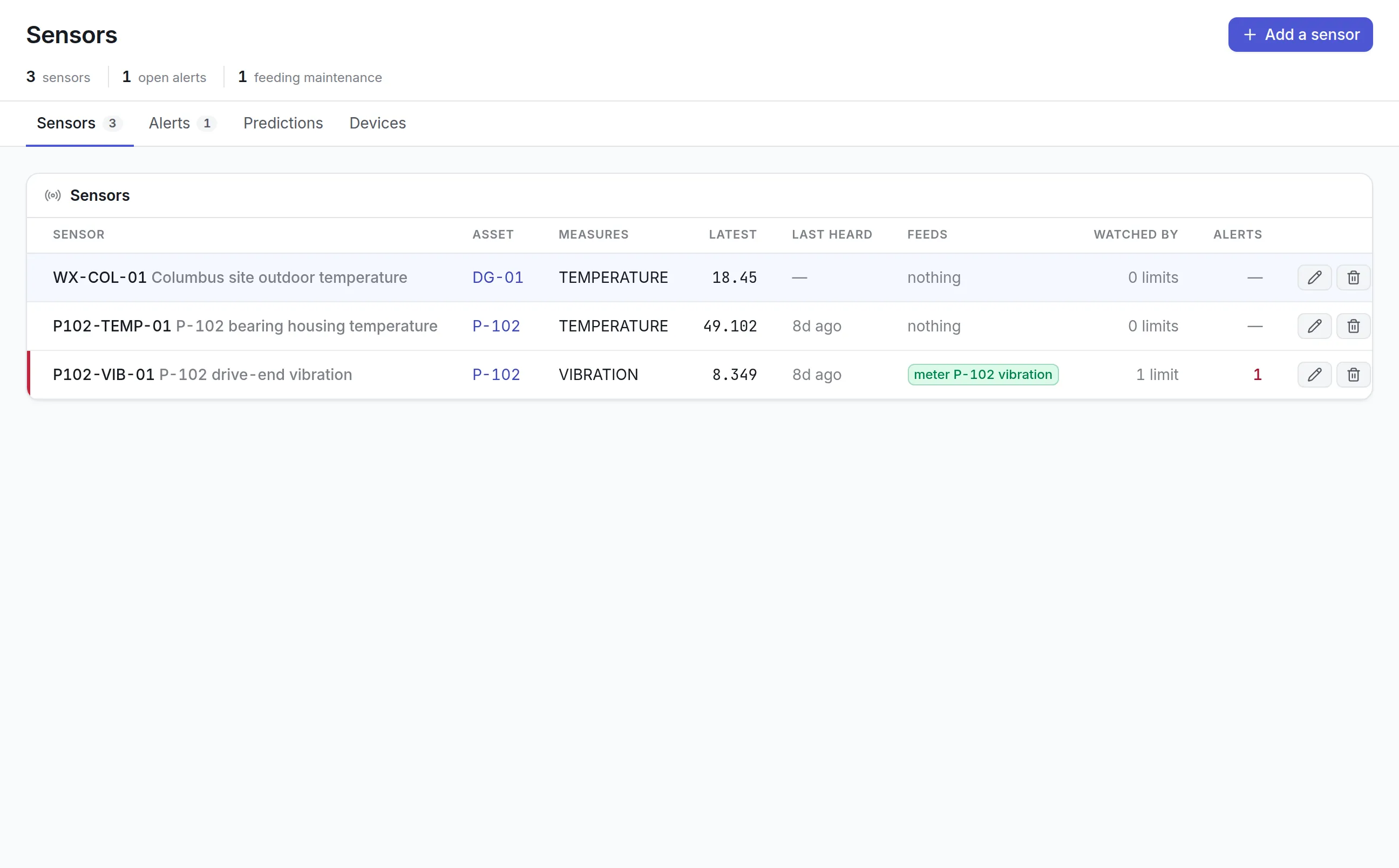
Asset Infinity is predictive maintenance software built on condition monitoring. Connect vibration, temperature, pressure and runtime sensors, and a reading that crosses its limit opens an alert and can raise the work order itself.
What our predictive maintenance software does on the plant floor
Limits that raise work
Set a limit above, below, inside or outside a band. Crossing it opens an alert, and the limit can raise a work order at the type and priority you choose.
No alert storms
Hysteresis and a count of readings in a row are part of every limit, so a value hovering at the line opens one alert instead of hundreds.
Sensors that feed meters
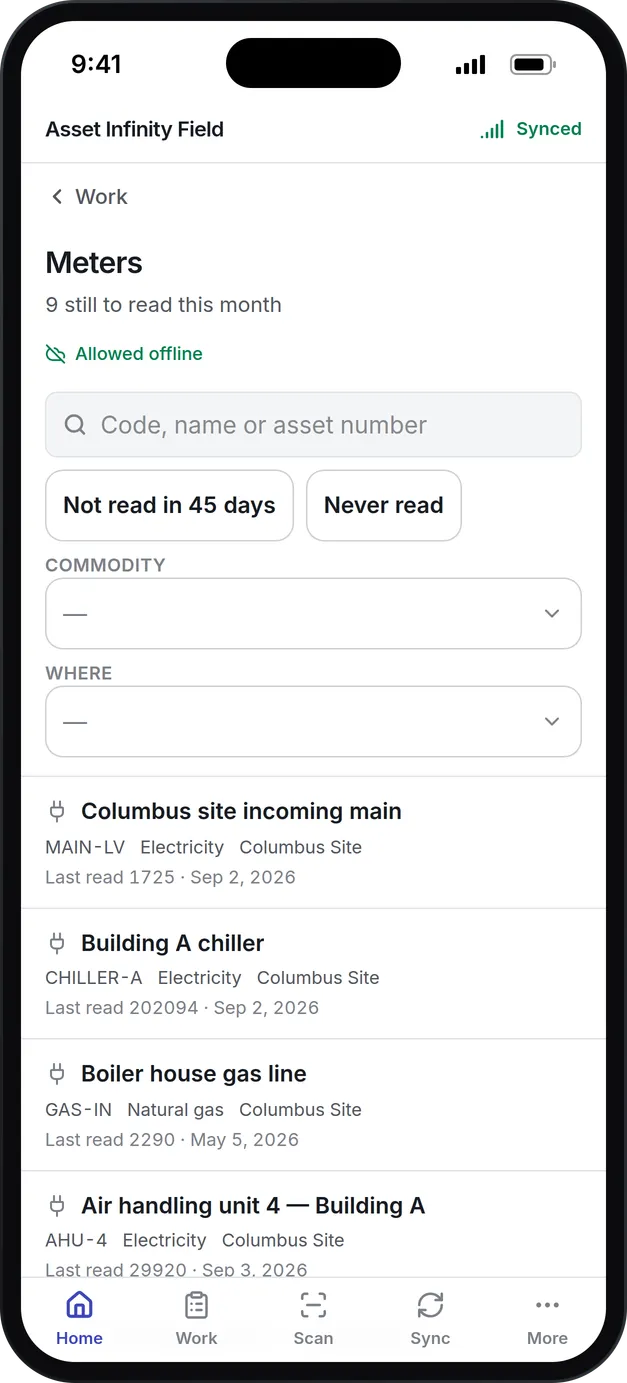
Bind a sensor to an asset's meter and its readings move that meter, so plans set to every 2,000 run hours fall due from actual running time.
Condition-based plans
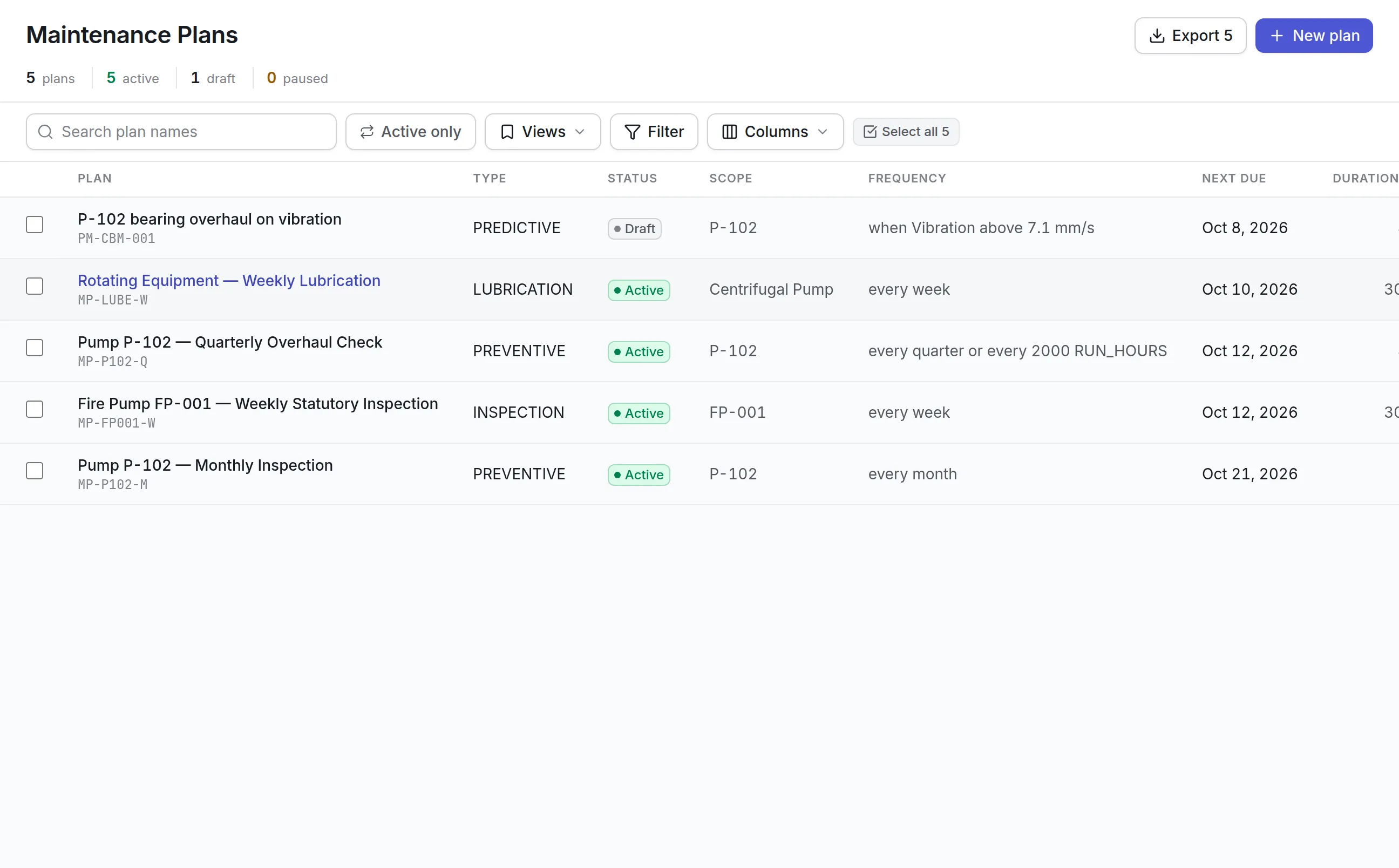
A maintenance plan can fall due on a condition, such as vibration above 7.1 mm/s, alongside calendar and meter triggers.
Gateways and APIs
Readings arrive from an edge gateway over MQTT or from any system that can call the API, so PLC data reaches the CMMS without exposing the plant network.
Reliability that points at causes
Repeat faults, bad actors and assets costing more than they are worth are flagged on the reliability screen for investigation.
What is predictive maintenance software?
Predictive maintenance software watches the condition of your equipment through sensor readings and meters, and schedules maintenance when that condition says work is needed instead of on a fixed calendar alone. It compares each reading with a limit, opens an alert when the limit is crossed, and turns that alert into a work order on the asset.
Teams buy it because calendar maintenance is a guess. A pump serviced every quarter gets the same attention whether it ran two shifts a day or sat on standby, and a bearing that starts to wear in week three is not looked at until week thirteen. Condition data sends work to the machines that need it and leaves the others alone.
Condition-based, and you can check every alert
Asset Infinity takes the condition-based route to predictive maintenance. It does not forecast failures with a statistical model. It acts on readings you can see, against limits you set, on meters that move with real use, and on the failure history your technicians record.
- Every alert names the limit it crossed, the reading that opened it and the worst reading since.
- An alert that raised a work order links straight to that job.
- Condition, meter and calendar triggers live on the same maintenance plans, so one plan can say “every quarter, every 2,000 run hours, or when vibration passes 7.1 mm/s, whichever comes first”.
- Nothing depends on a model nobody on the team can question.
More detail
That choice shapes what you get:
More detail
Click any sensor and its trace opens over 24 hours, 7 days or 30 days, drawn against its limits. The line is the average in each slice of time, a shaded band shows the highest and lowest reading inside the slice, and a gap in the data is drawn as a gap. A spike that lasted one sample stays visible, and an outage is never mistaken for a steady reading.
How predictive maintenance software works in Asset Infinity
The steps below follow a cooling water pump at a manufacturing plant, from the sensor on its drive-end bearing to the work order in a technician’s hands.
- Register the device and its sensors.The Devices tab on the Sensors screen holds the gateways, loggers, PLCs and edge boxes your sensors report through. Each sensor is one measurement on one asset, with a Measurement of temperature, vibration, pressure, current, flow, runtime, energy, humidity, speed or level.
- Get the readings in.A gateway either pushes readings over HTTPS with its own API key, or publishes to an MQTT broker that Asset Infinity subscribes to. A payload map says which field holds the sensor code and which holds the value, and Try it tests the map on a real message before anything is stored.
- Set the limits.A limit compares readings above, below, outside or inside a band, at a severity of info, warning, alarm or critical. Hysteresis and Consecutive samples stop a value hovering at the line from opening a hundred alerts overnight.
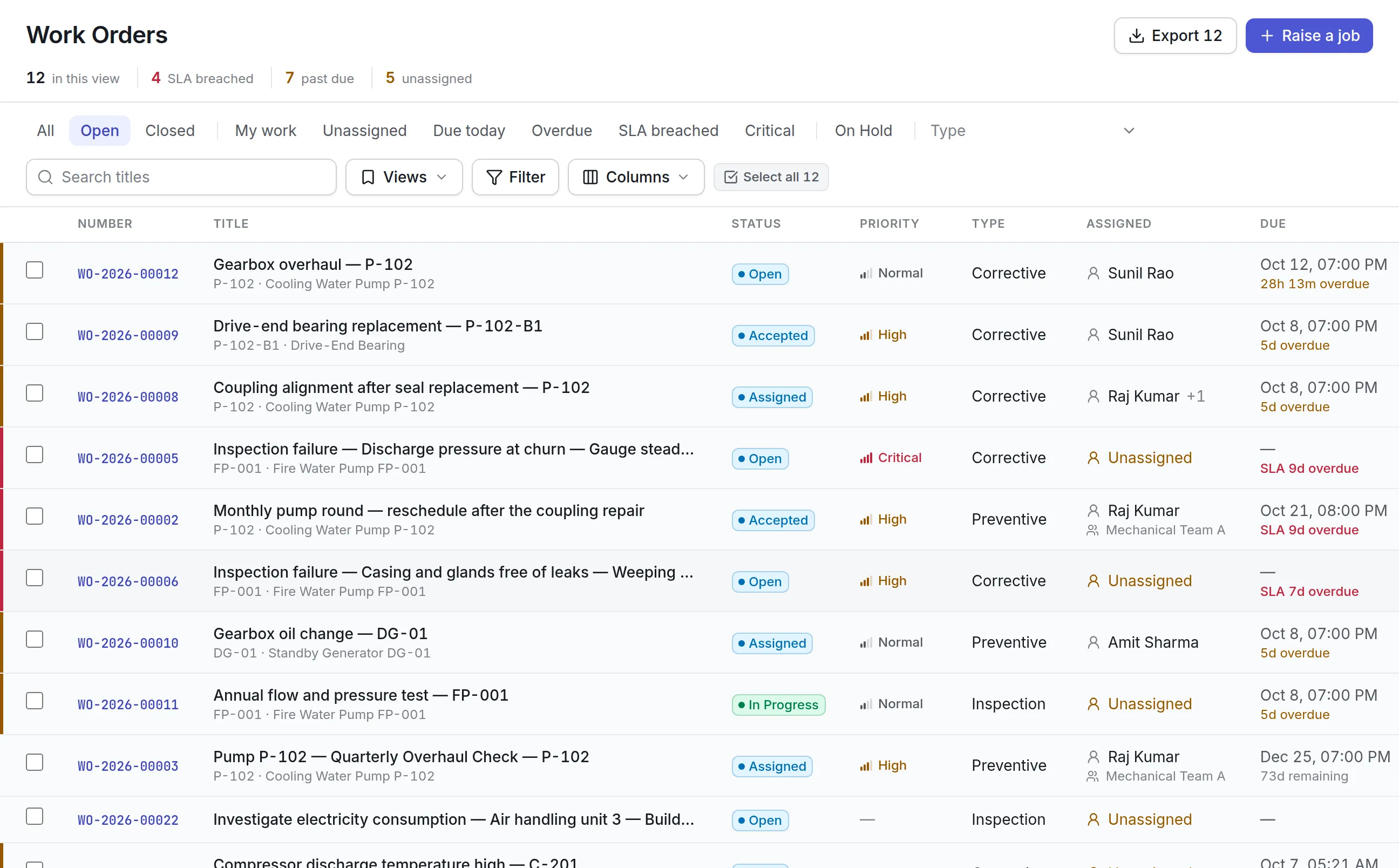
- Raise the work.Switch on Raises work order and choose the type and priority. When the bearing wears and vibration stays above the limit, an alert opens and a corrective job lands in work order software and on the dispatch board.
- Clear the alert with the repair.Acknowledge records that someone has seen the alert. Only the reading clears it, when it comes back past the hysteresis band after the fix.
- Feed the meters.A sensor bound to the pump’s runtime meter writes a reading through once an hour by default, so the plans in preventive maintenance software fall due from real running time.
Modbus TCP, OPC UA and BACnet are not polled directly, because those protocols carry no authentication. Your edge gateway reads the PLC, as it already does for a historian, and publishes over MQTT or HTTPS. See integrations for the other systems Asset Infinity talks to.
A silent gateway is the failure condition monitoring is worst at spotting, because a sensor that reports nothing raises no alerts and looks exactly like a healthy machine. Each device has an Offline after (minutes) setting, 60 by default, and the Sensors screen shows a banner whenever a sensor sits on a device that has stopped reporting.
Turning alerts into reliability decisions
Condition data pays off twice: once when it catches a failing bearing, and again when the history shows which assets keep failing. The Reliability screen rolls up failures, downtime and cost every night and reports availability, MTBF, MTTR and the assets at risk.
More detail
Its recommendations read as arguments you can accept or dispute:
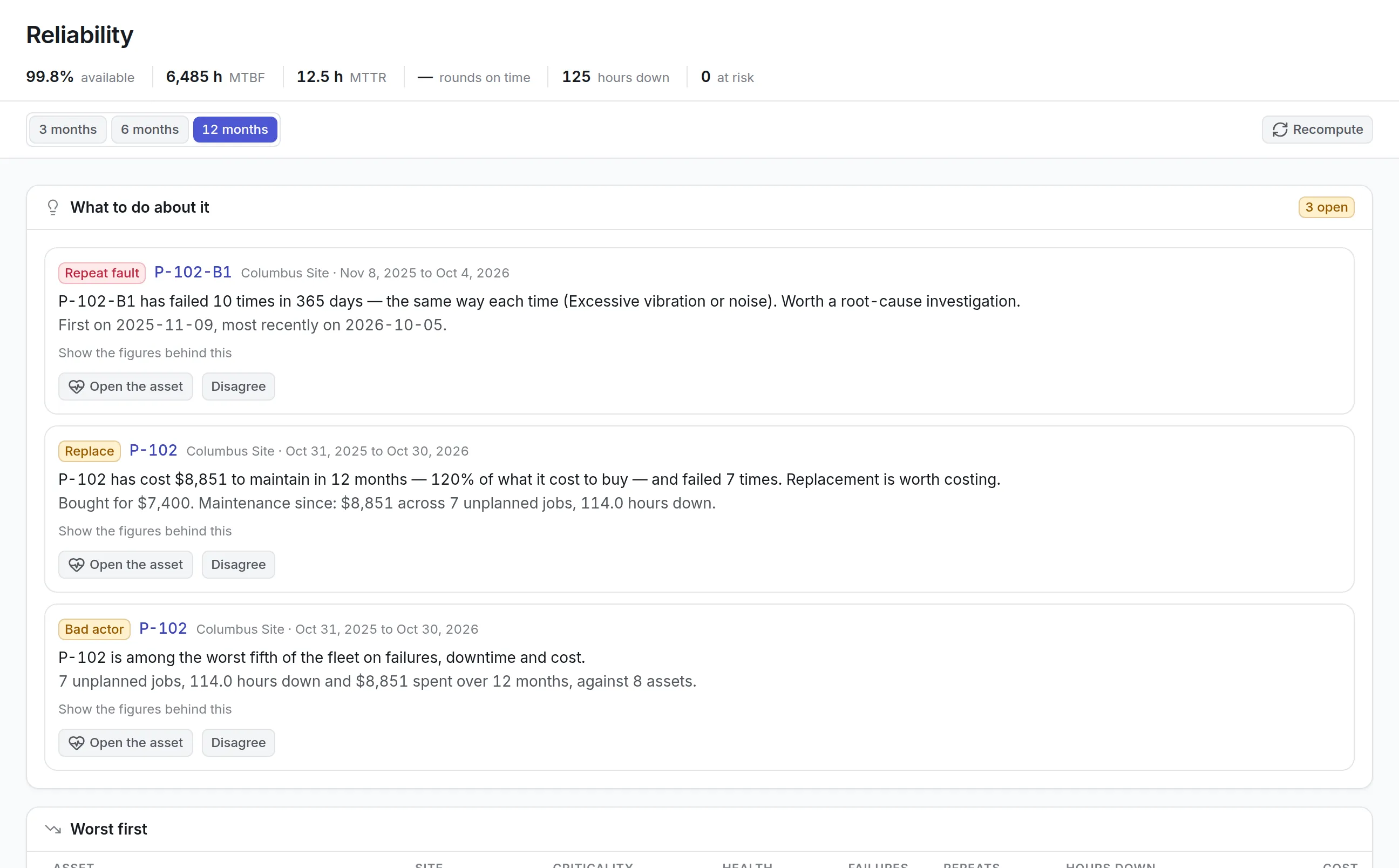
More detail
A repeat fault is the natural start of an investigation in root cause analysis software.
Predictive, preventive and reactive maintenance compared
| Approach | What raises the work | Where it fits | In Asset Infinity |
|---|---|---|---|
| Reactive | A breakdown or a reported fault | Low-cost assets where failure is cheap | Maintenance requests and corrective work orders |
| Preventive, by calendar | A fixed date interval | Statutory checks and assets with steady use | Calendar triggers on maintenance plans |
| Preventive, by usage | Run hours, cycles or miles on a meter | Assets whose wear follows use | Meter triggers, fed by hand, by import or by a sensor |
| Predictive, by condition | A measured reading crossing a limit | Critical rotating equipment, HVAC, process plant | Sensor limits that raise work, and condition triggers on plans |
Most sites use all four. The job of predictive maintenance software is to move the assets that justify a sensor out of the calendar rows and into the condition row.
See it on your own assets, or price it in two minutes.
What to look for when choosing predictive maintenance software
| Capability | Why it matters | In Asset Infinity |
|---|---|---|
| Limits with hysteresis and repeat counts | A single spike or a wandering signal should not flood the team with alerts | Both are fields on every limit |
| Work raised from a breach | An alert that only draws a red line still needs someone to act | A limit can raise a work order at a set type and priority |
| Sensors that feed meters | Runtime-based plans should follow actual running time | A bound sensor writes through to the asset’s meter |
| Device health | A silent gateway looks exactly like a healthy machine | Devices go offline after a set window, 60 minutes by default, and the screen says so |
| Open connection methods | You should not need one vendor’s sensors | HTTPS push and MQTT subscription with a payload map |
| A trace you can read | Technicians need to see the trend, not one number | 24-hour, 7-day and 30-day traces drawn against the limits |
| Reliability reporting | Condition data should change the plan over time | MTBF, MTTR, health scores and recommendations |
Predictive maintenance by industry
The same predictive maintenance software is set up differently depending on what fails and what a failure costs. These are the setups teams usually start with.
Manufacturing plants
A plant starts with its critical rotating equipment: pumps, fans, gearboxes and compressors. It fits vibration and bearing temperature sensors, publishes them through its existing edge gateway, and sets alarm limits that raise high-priority corrective work. Runtime meters fed by the same gateway drive lubrication and overhaul plans. See maintenance software for manufacturing.
Water and wastewater utilities
A utility watches lift station pumps for current draw and runtime, and wet wells for level. Pump runtime feeds meter-based plans, so a duty pump that ran more than its standby partner is serviced first. A high-level limit opens an alert the moment it trips. See water utility asset management.
Facility management
A facilities team puts temperature and pressure sensors on chillers, air handlers and boilers. A supply air temperature outside its band for several readings raises a work order for the HVAC contractor, while a humidity probe in a room alerts without raising a job. The trace for each air handler shows whether a fault is a spike or a slow drift before anyone climbs to the roof. See facility management software.
Healthcare
A hospital engineering team monitors medical refrigerators, sterilizers and plant room equipment. A fridge temperature above its limit is a critical alert that raises urgent work on the fridge, and the alert keeps when it opened, its worst reading and when it cleared. Because the sensor is fitted to the fridge itself, the urgent job lands on the right asset and the repair joins its work history.
What predictive maintenance software costs with Asset Infinity
The asset register starts at $130 a month for up to 500 assets, with unlimited users. Work orders and maintenance plans come with the Maintenance bundle at $25 per user per month, and each connected sensor is $5 per month. The Reliability and root cause add-on is $150 a month for the organization. Build a quote with your own asset and sensor counts.
Getting started with condition monitoring
Most teams start small and widen once the first alerts prove useful. A typical first week:
The product documentation covers the Sensors screen in detail.
What it uses
Common questions
What is predictive maintenance software?
Predictive maintenance software watches the condition of equipment through sensors and meters and schedules work when that condition calls for it, rather than on the calendar alone. In Asset Infinity that means sensor readings checked against limits, meters fed by sensors, and plans that fall due on a condition.
What is the difference between predictive and preventive maintenance?
Preventive maintenance runs on a fixed interval of time or use, such as every 90 days or every 2,000 run hours. Predictive maintenance acts on the measured condition of the asset, so work is raised when a reading says the machine needs it. Asset Infinity runs both from the same maintenance plans.
Does Asset Infinity use machine learning to predict failures?
No. It acts on measured readings against limits you set, on meter intervals and on failure history. Every alert and every work order can be traced back to a reading someone can check.
What is condition monitoring software?
Condition monitoring software collects readings such as vibration, temperature and pressure from equipment and flags when they move outside normal limits. Asset Infinity does this on its Sensors screen and goes one step further by raising the work order on the asset.
Which sensors can we connect?
Any sensor whose readings reach a gateway or a system that can publish over MQTT or call the API. Temperature, vibration, pressure, current, flow, runtime, energy, humidity, speed and level are supported measurements.
How are sensors priced?
Sensors are $5 per sensor per month, added to the asset register and the Maintenance bundle. The pricing page builds a full quote.
See it with your own assets
A demo run on an example from your industry. Or start the trial and look around on your own.