






Hospital asset tracking that finds the pump and keeps it ready
Our hospital asset tracking reads tagged infusion pumps, monitors and beds at doorways, so you know where they are and when they left. Their PM, safety tests and OEM contracts live on the same record.
- The Joint Commission Environment of Care standards
- CMS Conditions of Participation
- NFPA 99 (Health Care Facilities Code)
- NFPA 101 (Life Safety Code)
What our hospital asset tracking does for clinical engineering
Find mobile equipment
Pumps, monitors, beds and surgical kits carry RFID tags, and readers at doorways record each move. A reader at an exit can alert security when a tagged device passes it.
Biomedical equipment on one register
Every device keeps its model, serial, department, PM history, failures, costs and service contract. The weakest device in a department stands out by its health score.
PM by the manufacturer's interval
Ventilator services, defibrillator checks and yearly electrical safety tests fall due by date, hours or cycle count. Overdue work shows by department.
Rounds surveyors ask for
Environment of care rounds, crash-cart checks and medical gas pressures are recorded against limits. A failed critical item raises a corrective work order.
OEM contracts that pay
Service agreements record parts, labor, response times and visits owed. Covered work is flagged on the job, and renewals show up before they lapse.
Cold chain and critical rooms
Sensors on vaccine fridges, freezers and operating room air send readings in. A reading past its limit opens a job around the clock.
What is hospital asset tracking?
Hospital asset tracking is the practice of recording where mobile medical equipment is and where it has been, using RFID or Bluetooth tags on infusion pumps, monitors, wheelchairs, beds and surgical kits, read by readers at doorways or gateways in rooms. It tells nurses where the nearest available device is and tells clinical engineering which devices are due for service.
Hospitals buy it because equipment that cannot be found gets bought twice, rented, or hoarded on the floors that worry about running short. A hospital that knows where its pumps are can service them on time and buy fewer of them.
How hospital asset tracking works in Asset Infinity
Tracking and maintenance share one register, so the device a nurse finds is the same record biomedical engineering services. A device’s journey through the system looks like this:
- Register and tag the device.Each pump, monitor or bed goes on the asset register with its model, serial number, department and criticality, and carries a printed QR label plus an RFID tag, encoded from the mobile app with a handheld reader, or a BLE tag.
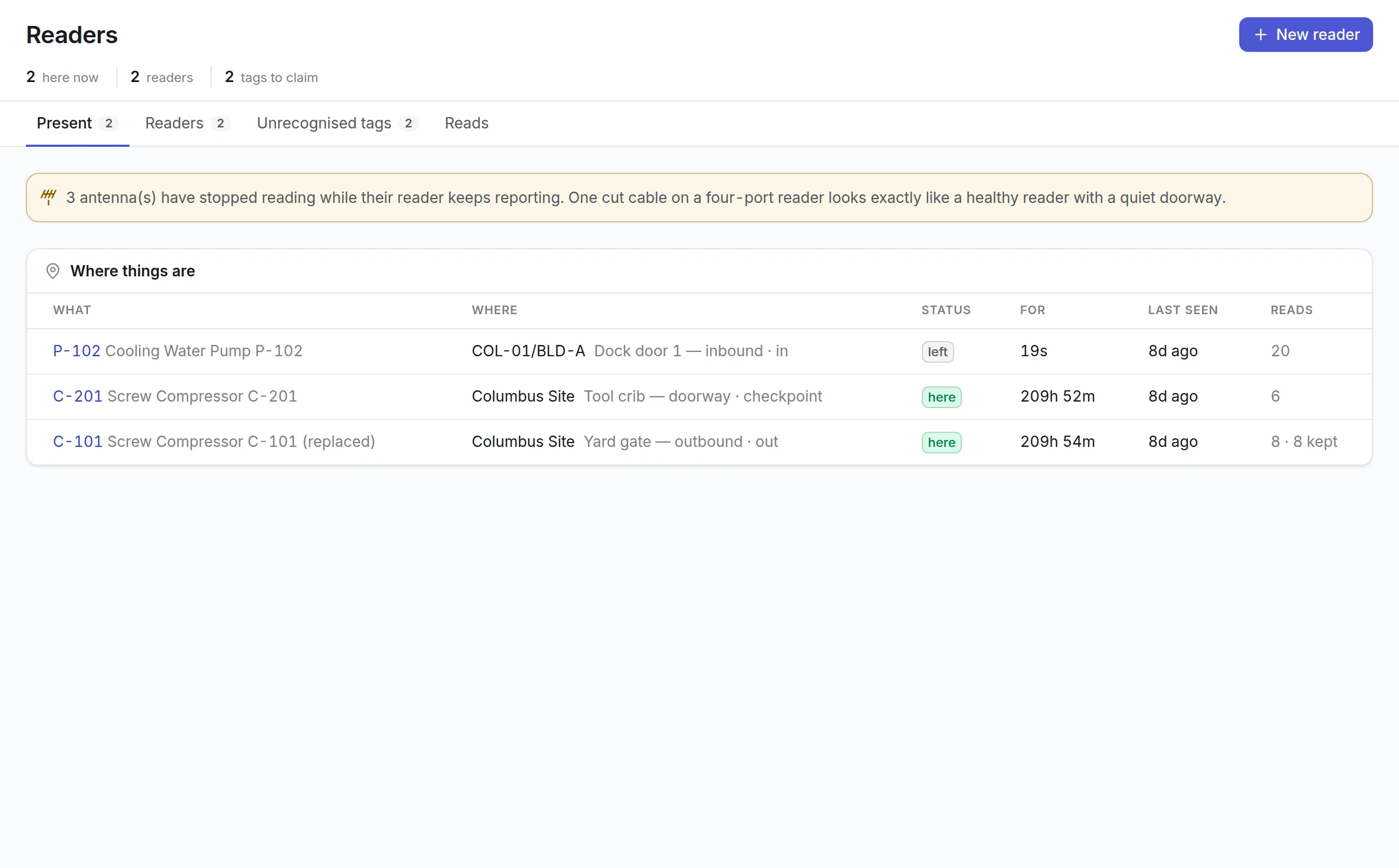
- Place readers at the doorways that matter.Each antenna on a fixed reader names the department or corridor it covers and whether it watches one side of a doorway or a room.
- Let the reads move the record.When a tag arrives or departs, a rule can move the asset to that location in the register, so its location follows it through the door without anyone scanning.
- Alert on the exits.A rule on an exit antenna can notify security or the department when a tagged device leaves, with the time and the doorway.
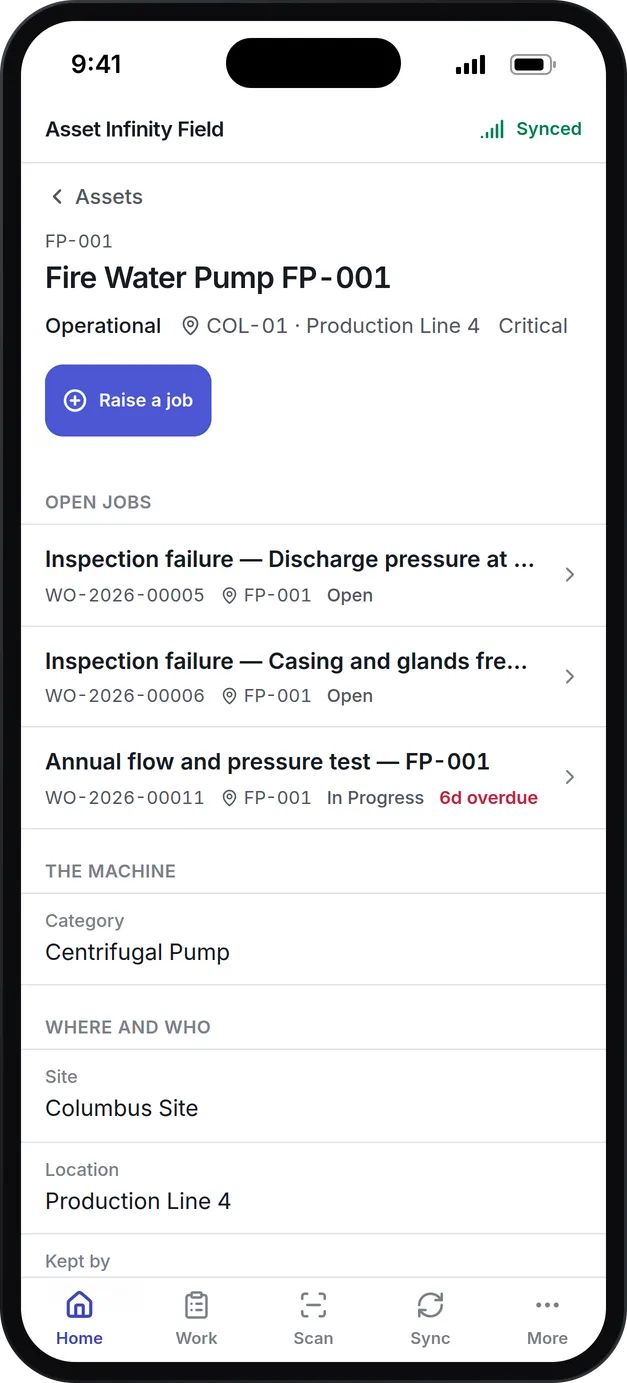
- Find the device on the floor.A technician follows a handheld RFID reader’s beep, or a phone’s distance bar to a Bluetooth tag, to the exact device.
- Service it from the same record.The device’s PM plans, safety tests, repairs and service contract are all on the asset, so finding it and fixing it are one workflow.
Readers are watched as closely as the devices. An antenna that stops reading while its reader keeps reporting is flagged, because a quiet doorway would otherwise look like an empty one. Unrecognized tags wait in their own list until someone says what they are on. The RFID asset tracking page covers readers, antennas and tags in depth.
Biomedical equipment maintenance on the same record
Finding a device is half the job. Clinical engineering also has to keep every device inside its manufacturer’s PM interval and show the history when a surveyor asks.
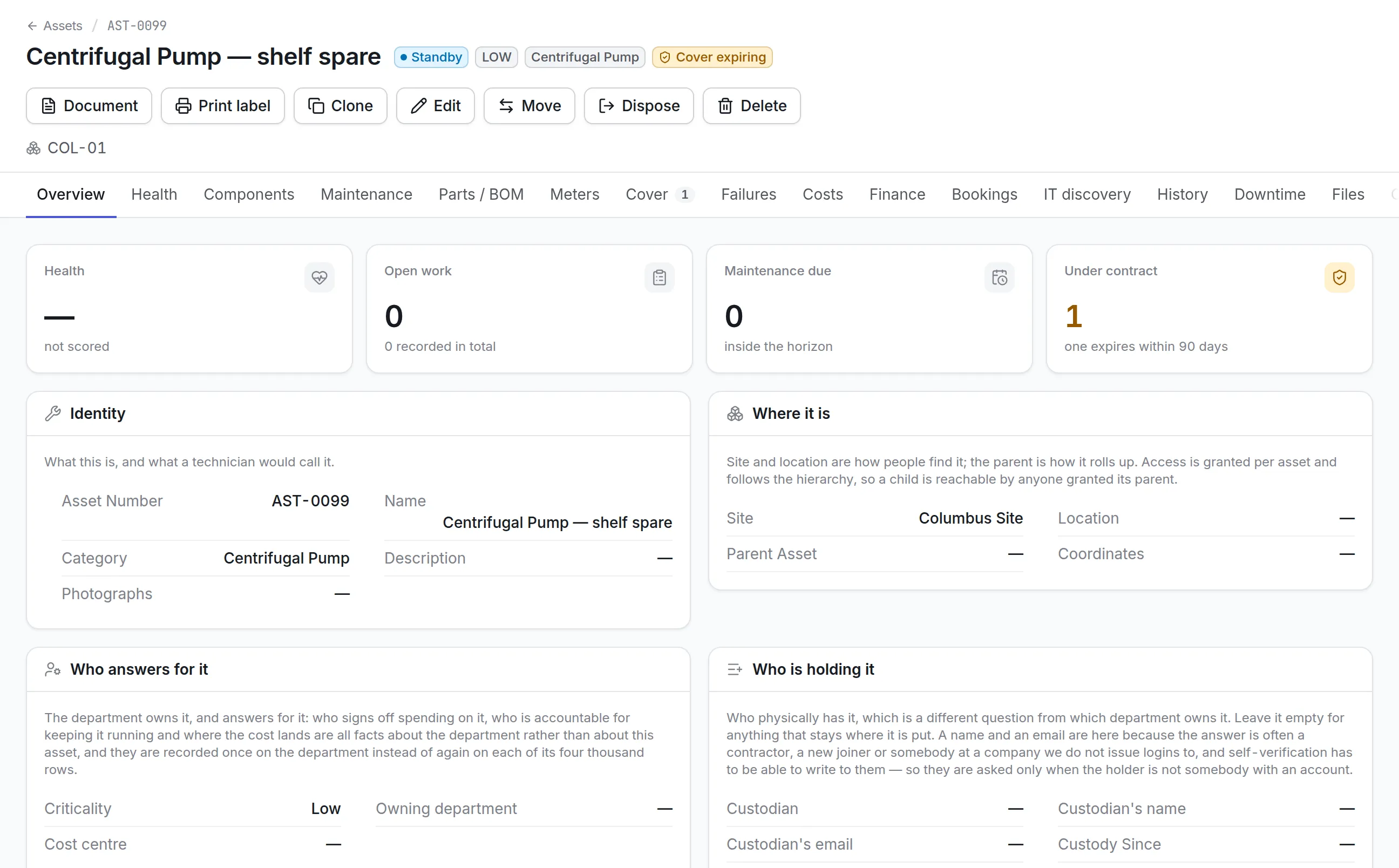
- Make, model, serial number, department and who holds it
- PM history, repairs and the failures closed with a failure code
- Meters such as autoclave cycles, so usage-based plans fall due on their own
- Warranty and OEM service contract, with cover flagged on each repair and an alert before renewal, kept with maintenance contract management
- A health score, so the weakest device in a department stands out
- Files: the service manual, safety test certificates and photographs
More detail
Each device record holds:
More detail
Plans follow the manufacturer’s interval. The hospitals trial includes six-monthly ventilator PM, a monthly defibrillator energy test, yearly infusion pump PM, yearly electrical safety testing and operating room air handler filter changes, each raising its own work order with its checklist. A plan can fall due by calendar, by a meter such as autoclave cycles, or by a date on the device itself, so fifty pumps that each had their last service on a different day each fall due on their own date. Preventive maintenance software explains the triggers in full.
PM compliance by department
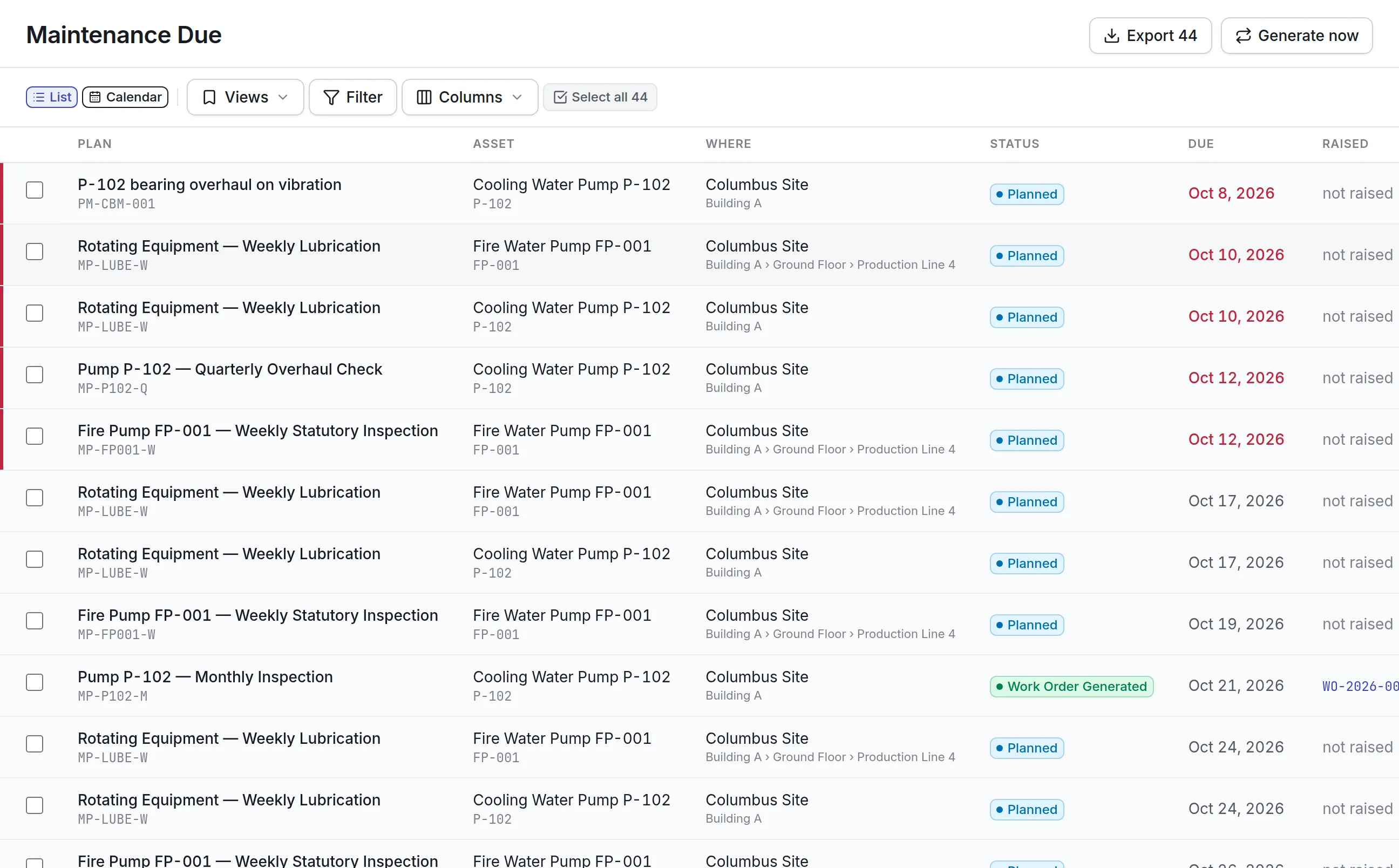
The Maintenance Due list shows every scheduled round that is coming up or overdue, as a list or a calendar, so a department that is falling behind shows before a survey does.
- Raise a round’s work order early, or defer it with a reason that stays on record
- Skip a round with a reason, so it is excluded from PM compliance knowingly
- Let an annual service stand down the monthly check it already includes
- Export the list for a department meeting or an accreditation file
More detail
What a biomed manager can do from it:
Environment of care rounds that stand up to a survey
Daily crash-cart and defibrillator checks, weekly medical gas pressures and monthly operating room air-change logs run as graded inspection rounds, each scored against its expected readings and answers.
- Every reading, answer, note, photograph and signature, frozen once submitted
- A corrective work order raised by itself for each failed critical check
- A second person’s sign-off on statutory rounds, with their name and the time
- The checklist version the round was asked, so later edits never rewrite evidence
- An audit trail of who changed what and when, across every record
More detail
What each round keeps for the next survey:
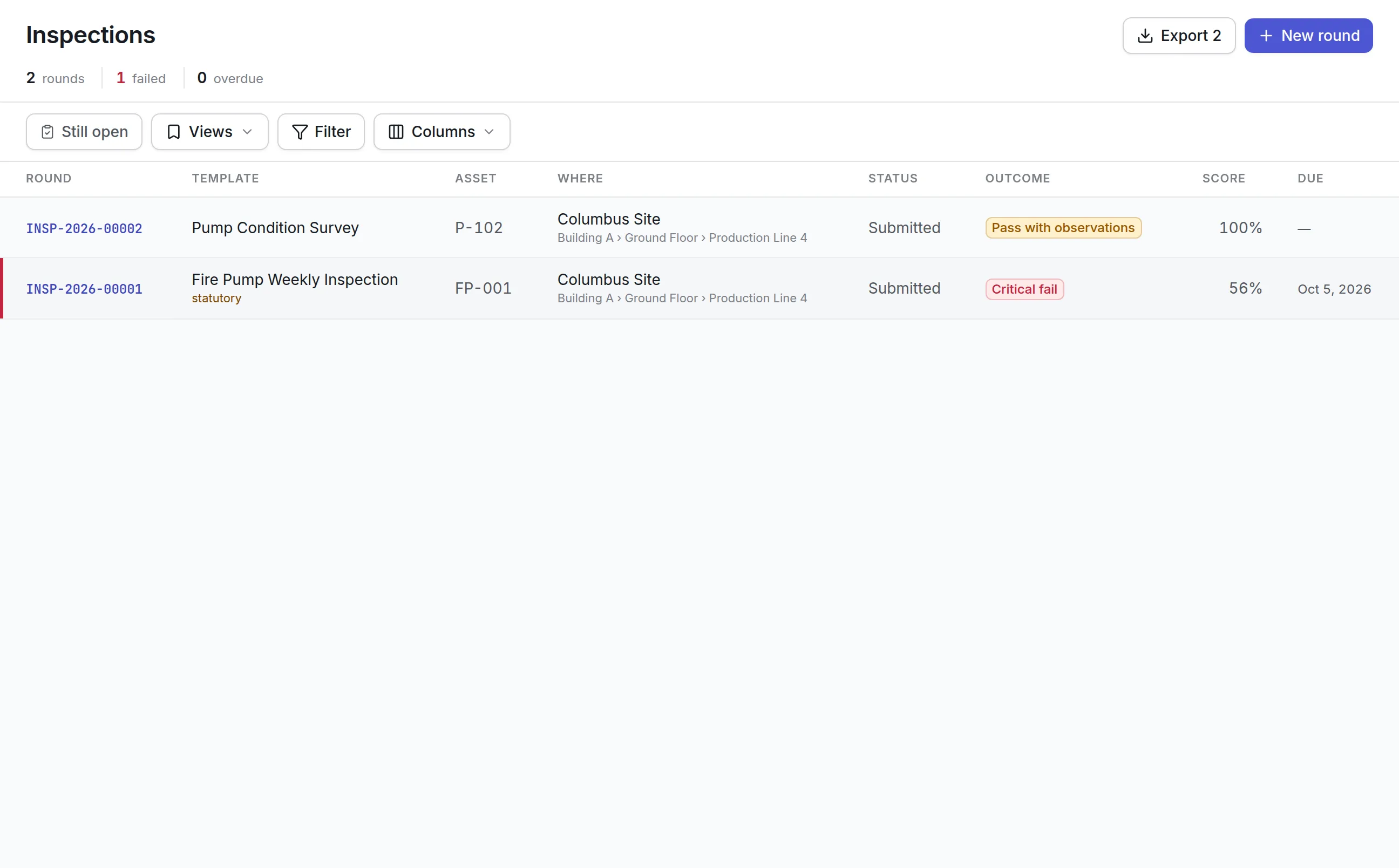
More detail
These are the records Joint Commission Environment of Care surveyors and NFPA 99 ask to see. Asset Infinity keeps them; it does not certify compliance. See inspection management software for how templates are built.
What to look for when choosing hospital asset tracking
Hospital asset tracking projects fail most often on the gap between knowing where a device is and doing anything about it. Compare products on both halves.
| Capability | Why it matters | In Asset Infinity |
|---|---|---|
| Doorway RFID reads | Records movement without anyone scanning | Fixed RFID readers with antennas mapped to departments and doorways |
| Indoor location | Some departments need room-level placement | BLE tags heard by gateways, shown and replayed on floor plans |
| Exit alerts | Devices leave through the same few doors | Rules on exit antennas notify the people you name |
| Reader health | A silent reader looks like an empty room | Silent antennas and failing readers flagged at the top |
| Handheld search | The last few meters are found on foot | Handheld RFID sweep and Bluetooth tag finder in the mobile app |
| Biomedical PM | Tracking without maintenance does not satisfy a survey | Manufacturer intervals by date, hours or cycles on the same record |
| Environment of care rounds | Surveyors ask for evidence | Graded rounds, critical checks and second-person sign-off |
| OEM contracts | Covered repairs should not be paid twice | Coverage, response times and renewal notice on each contract |
| Equipment counts | Capital equipment has to be verified | Verification rounds by department, with missing and damaged items listed |
| Access by facility | A health system has many hospitals | Each hospital’s team works on its own facility |
See it on your own assets, or price it in two minutes.
Hospital asset tracking by team and facility type
Biomedical engineering
Clinical engineering owns the device register, the manufacturer PM schedule and the OEM contracts. It sets plans by device type, records electrical safety tests, closes repairs with failure codes and watches PM compliance by department. Reader history shows where each device was last seen before a technician sets out to find it for its PM.
Facilities and plant
The facilities team maintains generators, UPS units, medical gas manifolds and operating room air handlers on the same register. Weekly medical gas pressure rounds and generator run hours sit beside the building work, and sensors on critical rooms open a job when a reading passes its limit. Operating room air handler filter changes run on their own plan.
Multi-hospital health system
Each hospital is a facility with its own blocks, floors and departments, and its team sees only its own building. System leaders see open work, PM compliance and contract renewals for every campus, and reliability rankings compare devices across every site. Each hospital keeps its own storerooms and technicians, and each contract names the site it covers.
Outpatient clinic or surgery center
A smaller site often starts without readers: QR labels, a device register, manufacturer PM and a yearly count. Readers or BLE tags can be added later for the devices that wander. Requests come from clinical staff through the portal, and OEM contracts flag covered repairs so the clinic does not pay twice for one fix.
What hospital asset tracking costs with Asset Infinity
The asset register starts at $130 a month for up to 500 assets, with unlimited users. Fixed RFID readers are $670 per reader a year with the reader hardware included, and BLE tags for indoor location are $1 per tag a month. Maintenance is $25 per user per month, and contracts are $100 a month for the organization. Build a quote with your device count and doorways. The hospitals trial opens with ventilators, defibrillators, infusion pumps, patient monitors, an autoclave and a medical gas manifold already loaded, plus three OEM service contracts and the daily, weekly and monthly rounds described above.
Getting started
Start with the devices people search for most, then widen:
To see it with your own floor plan, book a demo.
What teams in this industry use most
Common questions
What is hospital asset tracking?
Hospital asset tracking records where mobile medical equipment is, such as infusion pumps, monitors, beds and surgical kits. RFID tags and readers at doorways update each device's location as it moves, so staff stop searching and fewer devices go missing.
Is Asset Infinity healthcare asset management software or a CMMS?
Both. The same register tracks where a device is and holds its preventive maintenance, safety tests, repairs, service contracts and costs.
Can it manage biomedical equipment maintenance?
Yes. Clinical engineering can schedule manufacturer PM, electrical safety tests and checks by date or usage, record each repair against the device and track OEM service contracts.
Does it help with Joint Commission surveys?
It keeps the records surveyors ask for, including completed rounds, PM history, certificates and a full audit trail of who changed what and when. Asset Infinity does not certify compliance.
Does hospital asset tracking need RFID, or can it use Bluetooth?
Both work. Fixed RFID readers record tags passing doorways, and Bluetooth (BLE) tags heard by gateways place assets indoors on a floor plan. Technicians can also scan a QR label or sweep with a handheld RFID reader.
How much does hospital asset tracking cost?
The asset register starts at $130 a month for up to 500 assets with unlimited users. Fixed RFID readers are $670 per reader a year with the hardware included, and BLE tags are $1 per tag a month.
See it with your own assets
A demo run on an example from your industry. Or start the trial and look around on your own.