





Fixed asset management software that keeps the books and the plant on one register
Our fixed asset management software depreciates the same assets your technicians maintain. Run book and tax depreciation side by side, plan capital spend and hold work to budgets.

What our fixed asset management software does for finance
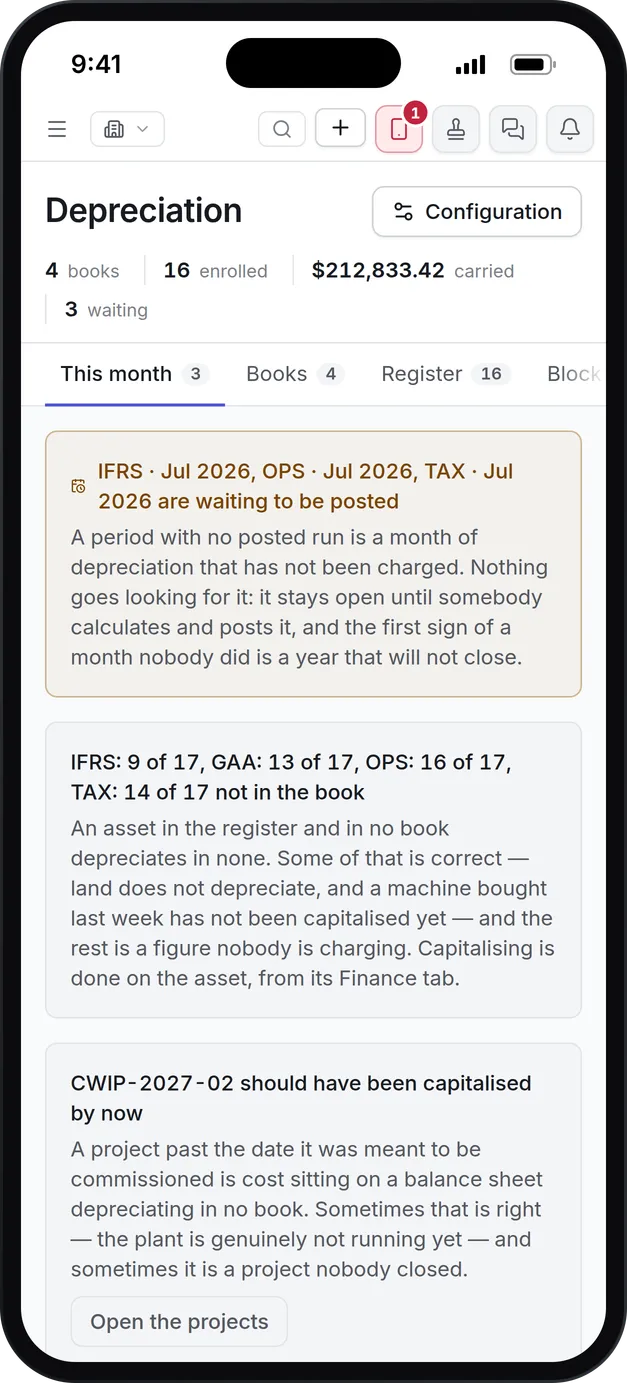
Book and tax, side by side
Keep a book for your financial statements and one for federal tax on the same assets. Each book has its own policies, calendar and posted months.
The methods you file with
Straight line, declining balance with a switch to straight line, units of production from a meter, and published rate tables including MACRS GDS and ADS.
Journals for your ledger
A posted month produces one debit and one credit per account and cost center, ready to download. A mistake is reversed with an opposite entry, never deleted.
Disposals and projects
Record a sale or scrapping per book with its gain or loss. Construction in progress holds its costs until it is commissioned and becomes assets.
Budgets and capital plans
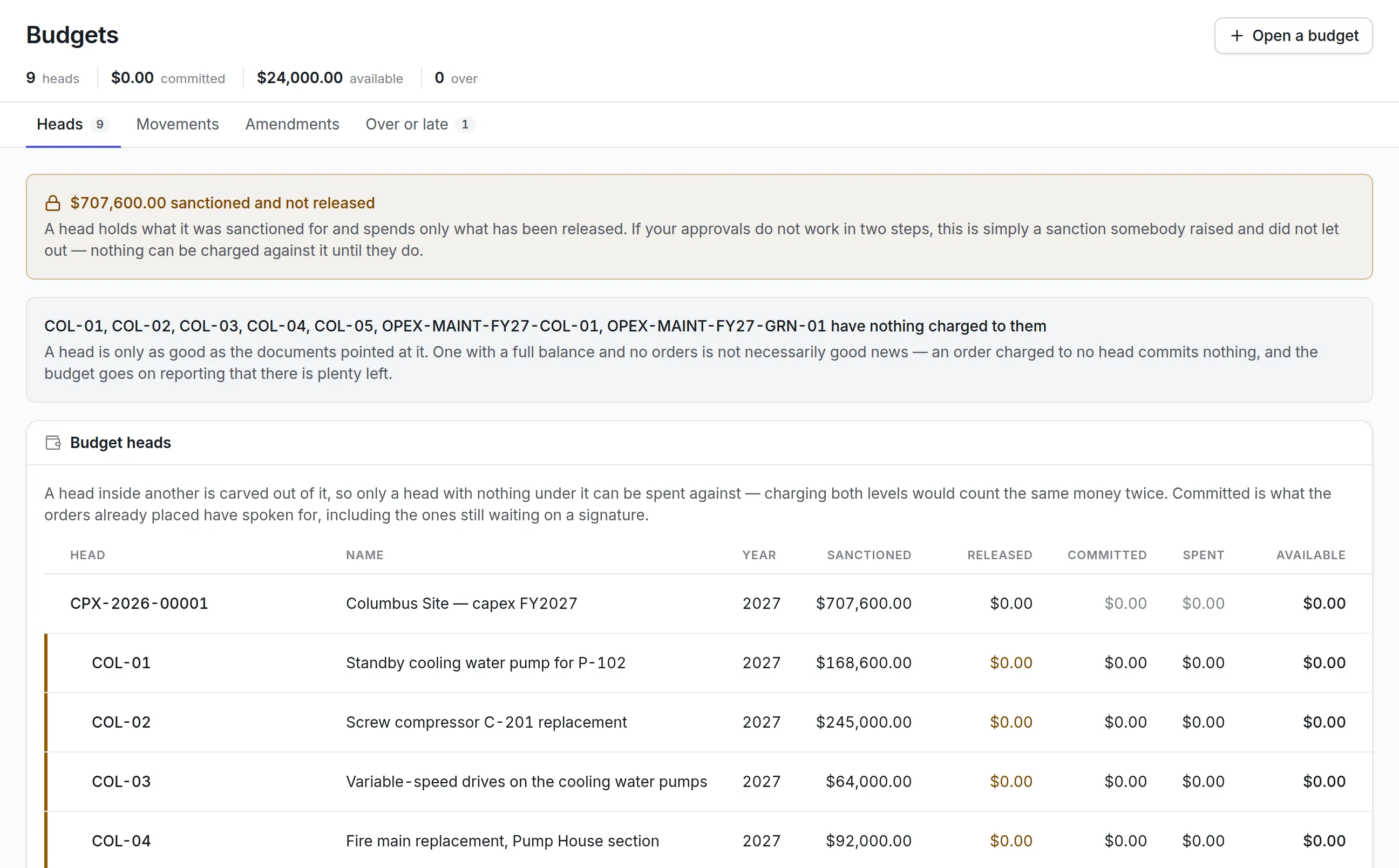
Plan next year's capital spend scheme by scheme, then charge orders and projects to budget heads that warn or block when money runs out.
Energy and reports
See what each site and asset uses and costs to run, and send the figures to the people who need them on a schedule.
What is fixed asset management software?
Fixed asset management software keeps the register of the equipment, vehicles, buildings and computers a company owns and works out what each one is worth over time. It records cost, in-service date, useful life and depreciation method, posts each period’s depreciation, records disposals with their gain or loss, and produces the journal entries the general ledger needs.
Companies buy it when two lists of the same assets stop agreeing: maintenance keeps one in its CMMS, finance keeps another in a spreadsheet or the ERP, and every year-end audit spends weeks reconciling them.
One register for maintenance and finance
Asset Infinity keeps one register for both teams. The pump a technician repaired is the pump the controller depreciates, so a transfer, a breakdown, a replacement or a disposal shows up for maintenance and finance at the same moment. That removes the problems a separate fixed asset list creates:
How fixed asset management software works in Asset Infinity
Here is the job from first setup to a posted month, as a US manufacturer would run it. The screens and buttons named below are the ones in the product, and the depreciation documentation has every field.
- Install the United States setup.A company with no book yet is offered a country setup. The US one creates two books on one fiscal calendar: Book (GAAP), the primary book under ASC 360, and Federal tax (MACRS GDS). It adds five asset classes: plant and machinery, electrical and building systems, furniture and fixtures, vehicles and light trucks, and computers and office machinery. You add your own ledger accounts and map them before either book can hand anything over.
- Set policies and rules.A policy holds the method, the life or rate, the residual and the first-period convention. Methods are straight line, declining balance (with a factor such as 2 for 200% and an optional switch to straight line), a published rate table, and units of production from a meter such as running hours. A policy rule says which policy each class follows in each book, from a start date, and never recalculates a period already run.
- Paste opening balances.For assets coming from another system, paste rows from your spreadsheet: asset number, in-service date, cost, depreciation already charged, class, currency, life and a reference. Check the lines writes nothing and names every row it cannot place.
- Capitalize from the asset record.Each asset’s Finance tab shows its carrying amount in every book side by side, with Capitalize, revalue, revise and Dispose beside it.
- Calculate and review the month.Calculate works the period into a draft. The draft lists what was not charged and why: nothing capitalized yet, no rule for its class, not yet in service, already at its residual, suspended by hand, or a meter reading lower than last time.
- Post, or reverse.Post closes the period and produces the journal, through an approval first if your company wants one. Reverse undoes the last run with an opposite entry, and both entries stay on the record.
- Send the journal to your general ledger.A posted run produces one debit and one credit per account and cost center. Send hands the batch over through a configured connector, and Download saves it for you to load yourself.
MACRS, book and tax depreciation side by side
Most US companies keep at least two books, and the books are expected to disagree. A machine can be ten-year straight line in the accounts and seven-year MACRS property for tax in the same month. The product does not pick a winner: an enrolled asset is depreciated in every book it belongs to, each on its own policies, and each book is posted on its own.
More detail
The MACRS tables ship with the product, so nobody types percentages in by hand:
Disposals, construction in progress and budgets
A disposal is recorded once, at the top of the form: why the asset left, who took it, the reference and, for a sale, the buyer, invoice and price. Each book then gets its own gain or loss, and a disposal journal of four lines. Recording a disposal ends depreciation everywhere but leaves the asset record in place, so its maintenance history is not lost.
More detail
Projects under construction hold the cost of something being built, such as a new production line, without depreciating it. Costs are added as invoices arrive and charged to a budget head, and on commissioning the total is split across the assets the project became. Budget heads show what was sanctioned, released, committed and spent, and a head set to block refuses an order once its money runs out. Capital requests start in a yearly planning round, covered on the capital planning software page.
What to look for when choosing fixed asset management software
These are the questions worth asking every vendor on your shortlist.
| Capability | Why it matters | In Asset Infinity |
|---|---|---|
| Several books per asset | Book and tax depreciation disagree by design | Any number of books, each with its own calendar, currency, policies and posted periods |
| MACRS tables built in | Typed-in percentages are how year four goes wrong | GDS 3 to 20 year and ADS 5 and 10 year tables shipped |
| Units of production | Some equipment wears by use, not by calendar | Depreciation driven by the meters maintenance already reads |
| Draft before posting | A charge should be reviewed before it is final | Calculate into a draft, read the exceptions, then post |
| Reversal with a trail | Auditors want corrections visible | An opposite entry, and the original run is never deleted |
| Journals for your ledger | The general ledger stays the system of record | Balanced batches per account and cost center, sent or downloaded |
| Disposals per book | Gain or loss differs between book and tax | One disposal record, a result in every book |
| Construction in progress | Capital work should not depreciate before it is in service | Projects collect cost and are capitalized on commissioning |
| Shared register | Two lists drift apart | One asset record for maintenance, audits and finance |
| Physical verification | The register must match the floor | Full, sample, targeted and custodian self-verification rounds |
See it on your own assets, or price it in two minutes.
Physical audits that keep the register honest
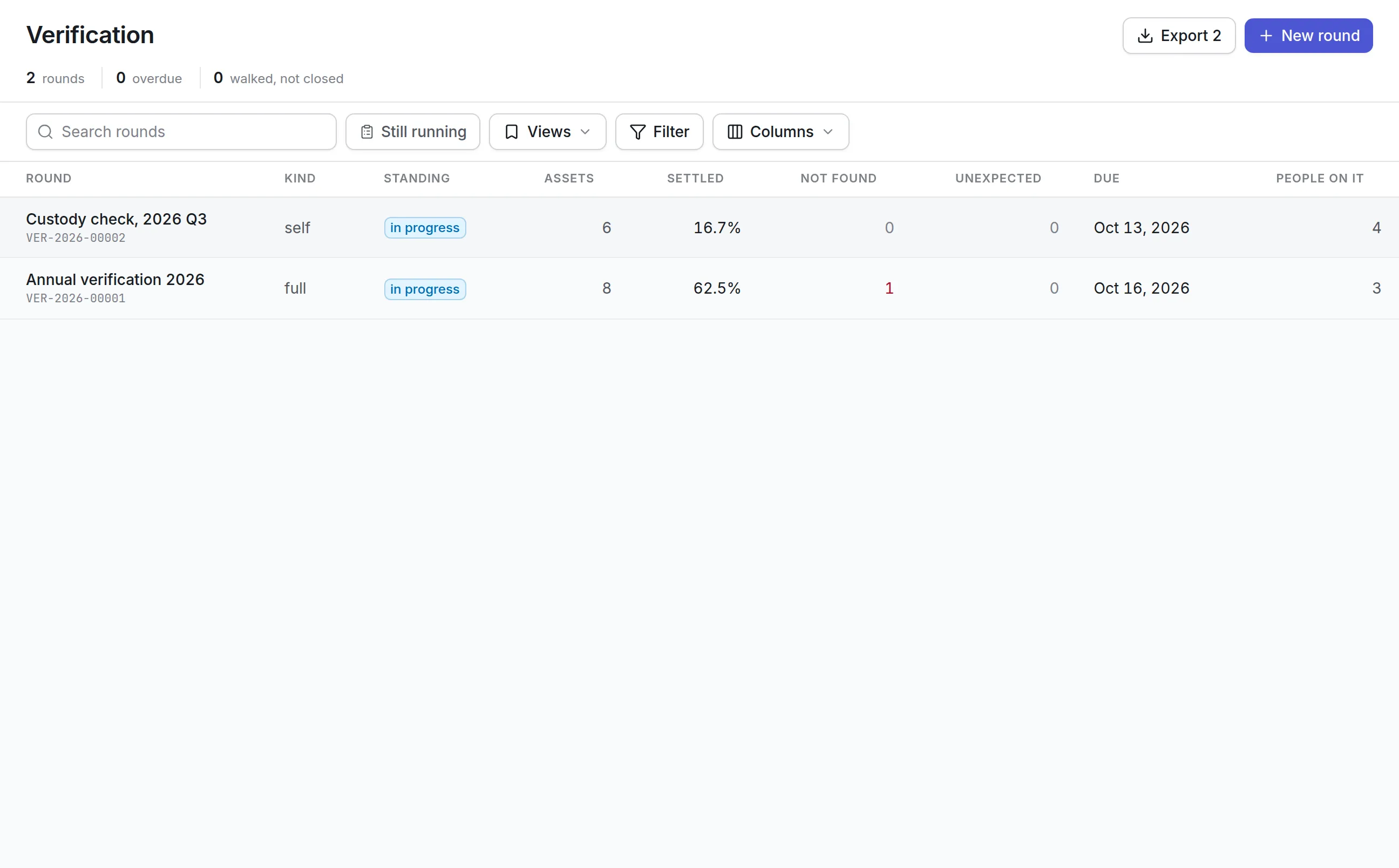
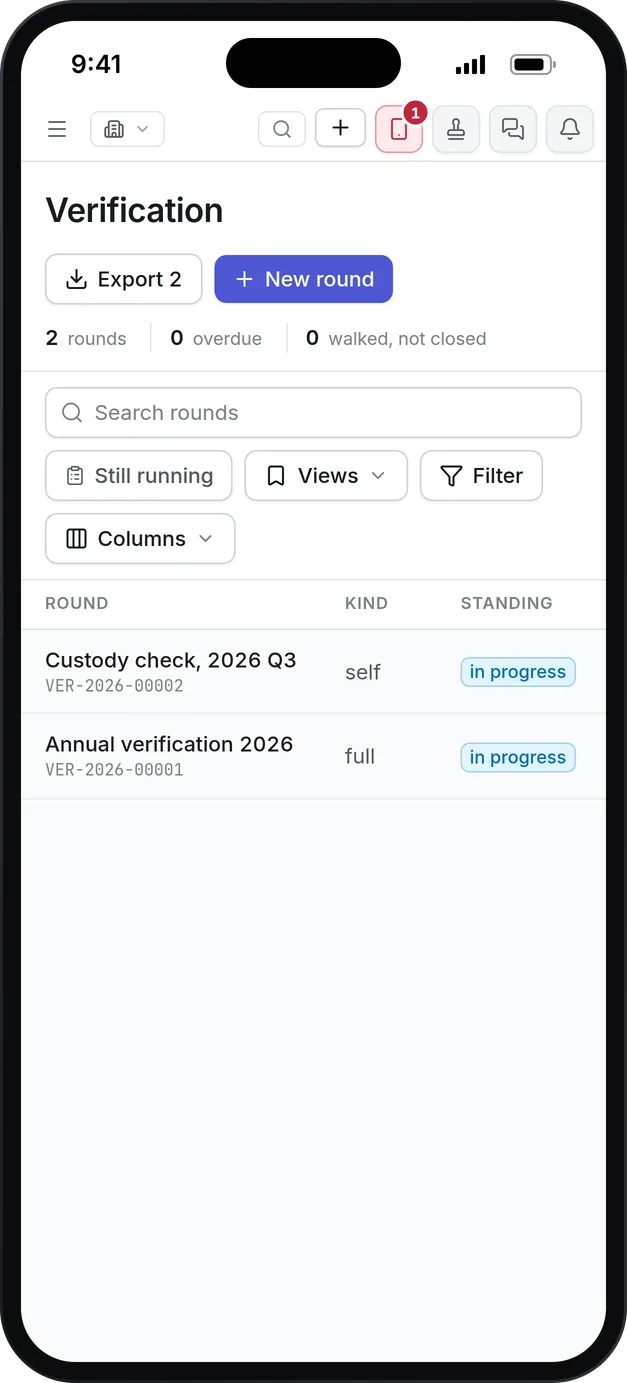
A depreciation schedule is only as good as the list behind it. Verification rounds prove the register matches the floor, and the list is fixed when a round is published, so “not found” means something.
More detail
A round can count everything in its scope, a random sample whose draw is recorded for an auditor, a targeted list such as last year’s missing items, or ask custodians to confirm by email without an account. It closes with a report of what was verified, moved, damaged or missing. The same work is described on our asset inventory software page, and it runs on the asset register every module shares.
Fixed asset management software by industry
The setup is the same everywhere. What changes is which classes, methods and controls matter most.
A manufacturing plant
Most of a plant’s value is in plant and machinery. Presses and CNC machines that run extra shifts wear faster, so the controller can depreciate them by units of production from the hour meters maintenance already reads. A new line is a project under construction, funded from a capital budget head and capitalized into its machines at commissioning. See how this fits maintenance in manufacturing.
A hospital or health system
Imaging systems, infusion pumps and patient monitors are capitalized assets that biomedical engineering also maintains. The hospital keeps book and tax depreciation on the same records the biomed team inspects, and runs sample verification rounds to show auditors that what is on the register is in the building.
A school district or campus
Furniture, laptops and lab equipment sit in hundreds of rooms, held by named staff. Self-verification rounds email each custodian the list recorded against them, and they confirm it from the email. Computers fall into five-year property for tax and furniture into seven-year property.
A water utility
Pumps, treatment equipment and electrical systems last decades and are replaced through capital programs. The utility plans replacements in a yearly capital round, opens approved schemes as budget heads, charges projects against them and capitalizes the new assets when they go into service.
What fixed asset management software costs in Asset Infinity
The asset register starts at $130 a month for up to 500 assets, with unlimited users. Depreciation books are part of the Finance bundle at $30 a month for each user who runs them. Budgets are a flat $150 a month and capital planning a flat $200 a month. Running on your own servers is twice the cloud price, with a minimum of $18,000 a year. You can build a quote for your asset count and team in a few minutes. Running costs by site and asset come from energy management software, and the figures reach managers through the maintenance KPI dashboard.
Getting started in the first week
Most companies can go live in their first week:
Everything in Account
Common questions
What is fixed asset management software?
Fixed asset management software keeps the register of what a company owns and calculates its depreciation. It records cost, useful life, method and disposals, and produces the journal entries your general ledger needs.
Does it support MACRS depreciation?
Yes. The United States setup installs a book for your financial statements and a federal tax book that depreciates from the MACRS GDS tables, with the half-year convention already in the percentages. ADS tables are included too.
Can we keep book and tax depreciation at the same time?
Yes. One asset can be enrolled in several books, each with its own method and life, and each book is calculated and posted month by month on its own.
Is it a replacement for our accounting system?
No. It is the fixed asset subledger. It works out depreciation and disposals and hands the journal to your general ledger.
How do we bring over our existing fixed asset register?
Import the assets themselves from a spreadsheet, then paste each book's opening balances with the cost and the depreciation already charged. Every line is checked against your asset numbers, classes and rules before anything is written.
How much does fixed asset management software cost?
The asset register starts at $130 a month for up to 500 assets with unlimited users. The Finance bundle, which includes depreciation books, is $30 a month per user who needs it, and budgets and capital planning are flat add-ons.
See it with your own assets
A demo run on an example from your industry. Or start the trial and look around on your own.