






Oil and gas asset management software from the lease to the refinery
Our oil and gas asset management software gives wells, compressors, exchangers and field equipment one record each. Permits, operator rounds, turnarounds and repeat failures run on the same register your crews use on their phones.
- OSHA 29 CFR 1910.119 (process safety management)
- OSHA 29 CFR 1910.147 (lockout/tagout)
- PHMSA 49 CFR Parts 192 and 195 (pipeline safety)
- API 510 and API 570 (pressure vessel and piping inspection)
What our oil and gas asset management software does in the field and the plant
Permits before work starts
Hot work, lockout, confined space, excavation and lifting permits record each isolation, precaution and signature. A job that needs a permit cannot start without one in force.
Operator rounds against limits
Rounds record readings against their limits, and a critical failure opens a corrective job. The checklist version each round used is kept with it.
Repeat failures traced
When an exchanger leaks for the third time, five-whys root cause analysis keeps the evidence for each answer and checks that the corrective action worked.
Turnarounds that fit the window
A shutdown holds its work package, milestones and critical path. Readiness shows which parts, permits and people are still missing weeks before the stop.
Field equipment found
RFID readers at gates and GPS trackers on trucks record where rental tools, safety equipment and vehicles went, and when.
Works without signal
The iOS and Android app keeps a technician's jobs, rounds and readings on the phone at a remote lease, and syncs when it is back in range.
What is oil and gas asset management software?
Oil and gas asset management software is a system that keeps one record for every well, compressor, separator, tank, exchanger and pipeline asset an operator runs, and records the maintenance, inspections, permits and cost of each over its life. It plans preventive and turnaround work, controls hazardous jobs and keeps the evidence that process safety audits ask for.
Operators buy it because equipment is spread across leases, gathering systems and plants, crews work far from an office, and a missed relief valve test or an open permit is a safety problem before it is a paperwork one.
How oil and gas asset management software works in Asset Infinity
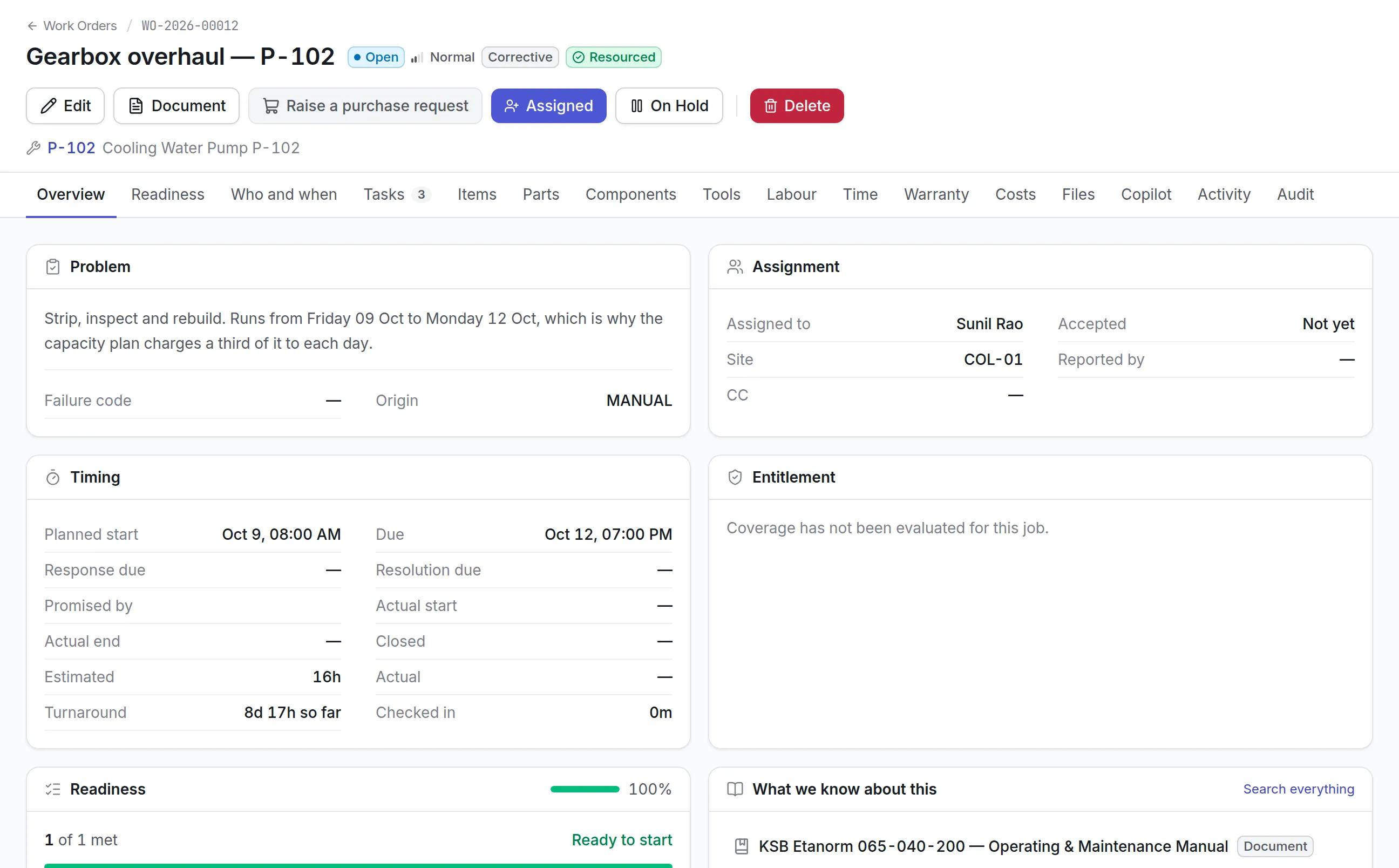
Production equipment, contractors, parts and people sit on one register, with a site for each lease, station or unit. The work order is where readiness, permits, warranty cover, labor, parts and cost meet, and work order software covers every tab on a job.
A job moves through it in six steps:
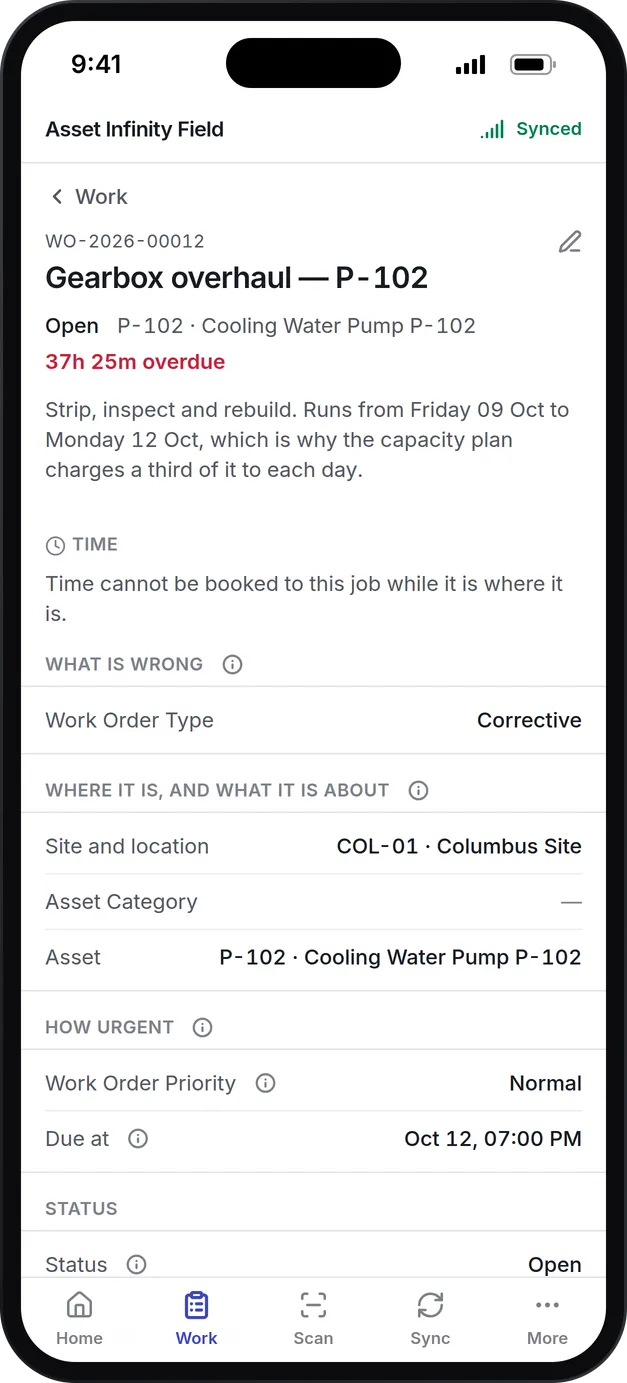
- Find the problem.An operator round fails a critical check on a tank battery, a sensor crosses its limit on a compressor, or a technician raises a breakdown from the mobile app at the wellhead with no signal.
- Check readiness.The work order shows whether its parts, tools, skills, contractor and permit are in hand before anyone drives out.
- Issue the permit.Hot work, lockout, confined space, excavation and lifting permits list the isolations and precautions, and the job cannot start until one is issued and accepted.
- Do the work.The technician works the checklist on the phone, records readings, parts and time, and closes the job with a failure code.
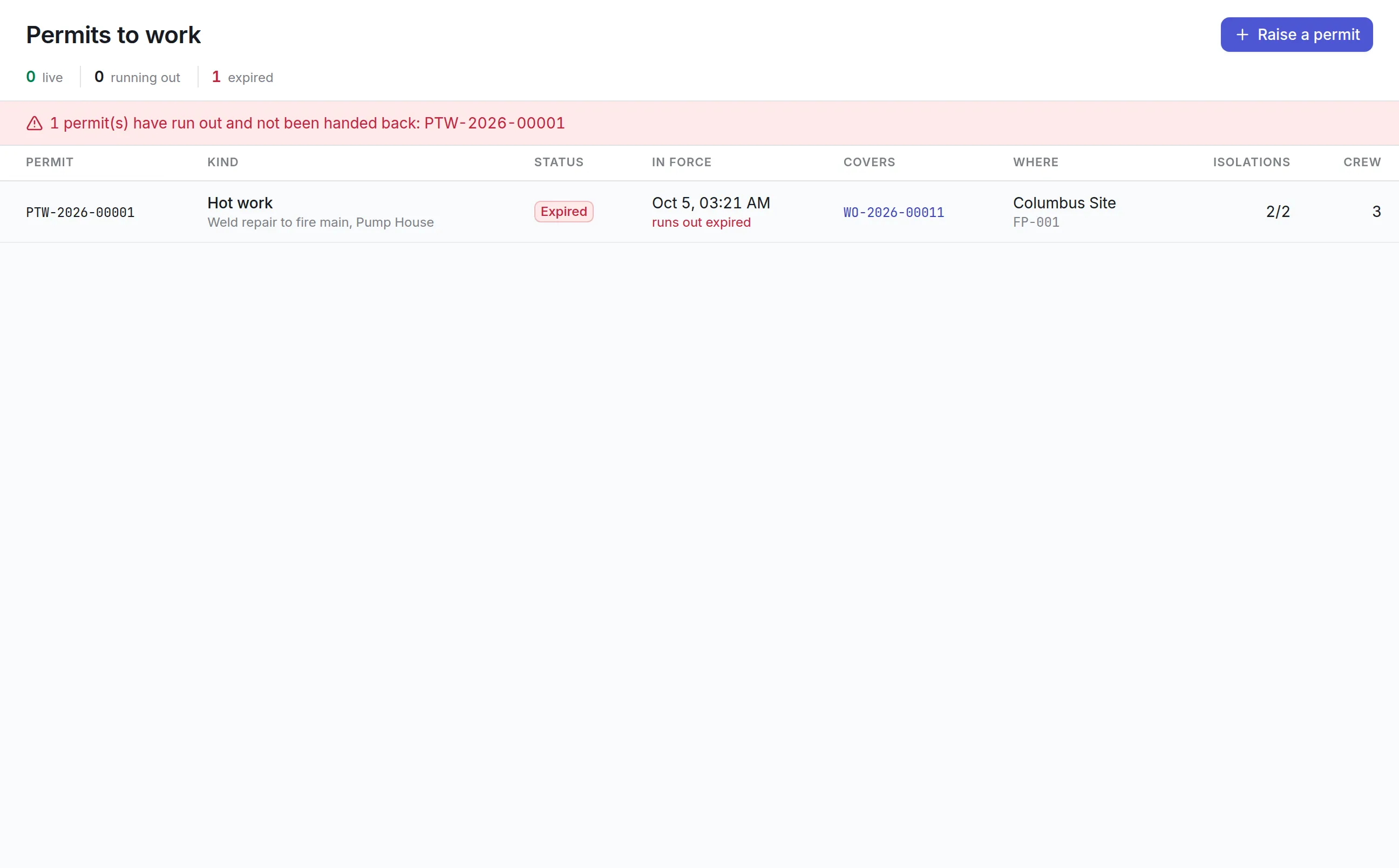
- Hand back.The permit is closed with the state the area was left in, and a permit that runs past its window without being handed back is named in red.
- Learn from it.Failures roll up into reliability rankings, and a repeat fault opens a root cause investigation with its history attached.
Permits to work with a real custody chain
A permit is the one record with a clock genuinely running against it, so the register leads with what is live and how long each permit has left. Each step in a permit’s life is its own button, because two people at two moments each signed for something real:
More detail
A permit with two hours or less left shows as running out, and one past its window that has not been handed back is named in a red banner. Lockout tagout software covers isolation records in more depth.
Turnarounds and shutdowns that fit the window
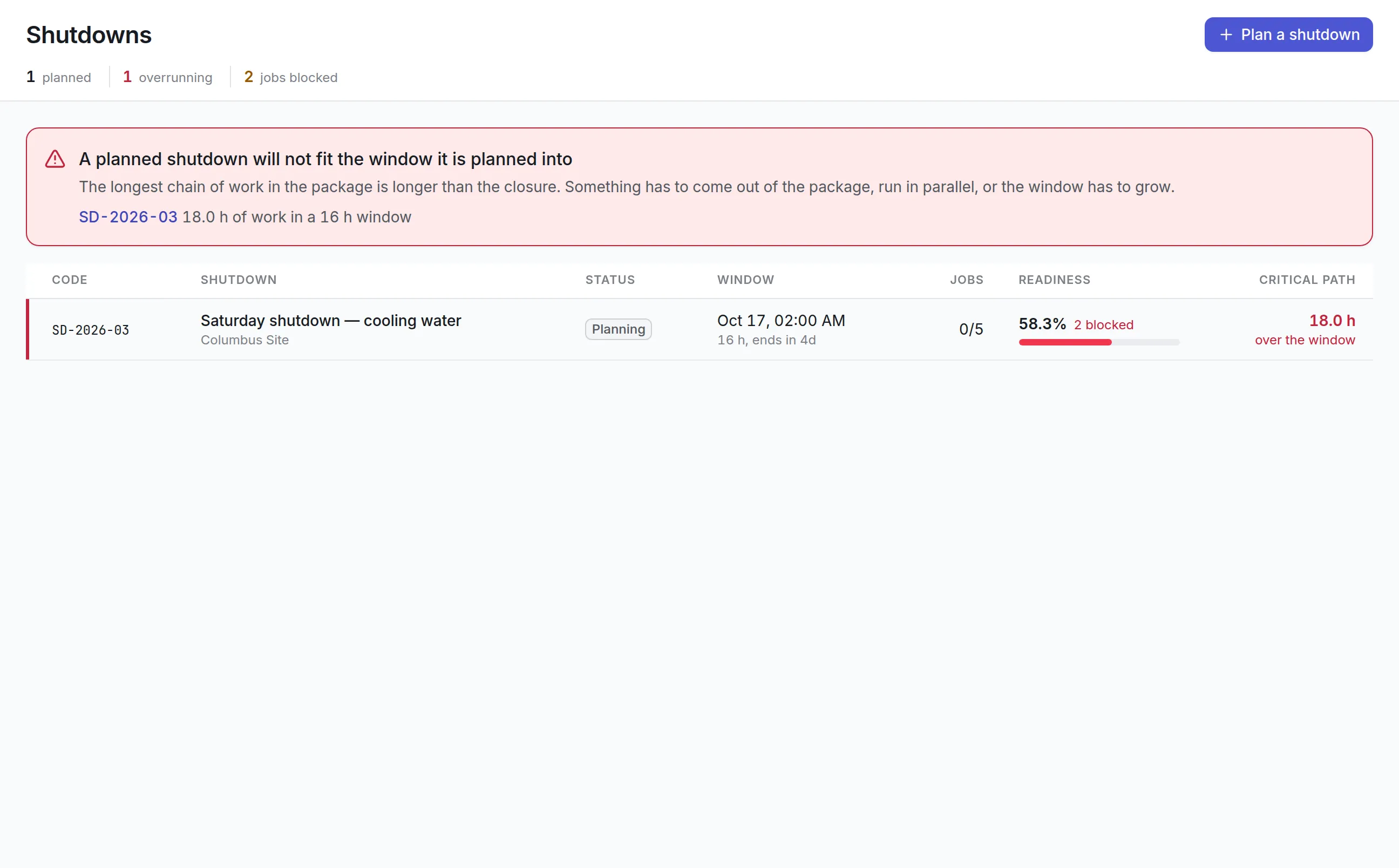
A turnaround is the most expensive week of a refinery’s year, and it is planned months ahead. Shutdown planning holds the work package, the window and the milestones, and answers the two questions asked every morning: will it be ready, and does it fit.
- Readiness by parts, tools, permits, vendors, labor, skills, certifications and documents
- The critical path, in red when it runs longer than the window
- A scope freeze, after which every added job is recorded as a late addition
- Permits that cover a whole shutdown, so every job in it is covered
- Plant stopped and back on line stamped as they happen, against the plan
More detail
What a turnaround planner sees:
More detail
Maintenance scheduling software covers the capacity plan that shows whether the crews you have can absorb the work.
Repeat failures traced with root cause analysis
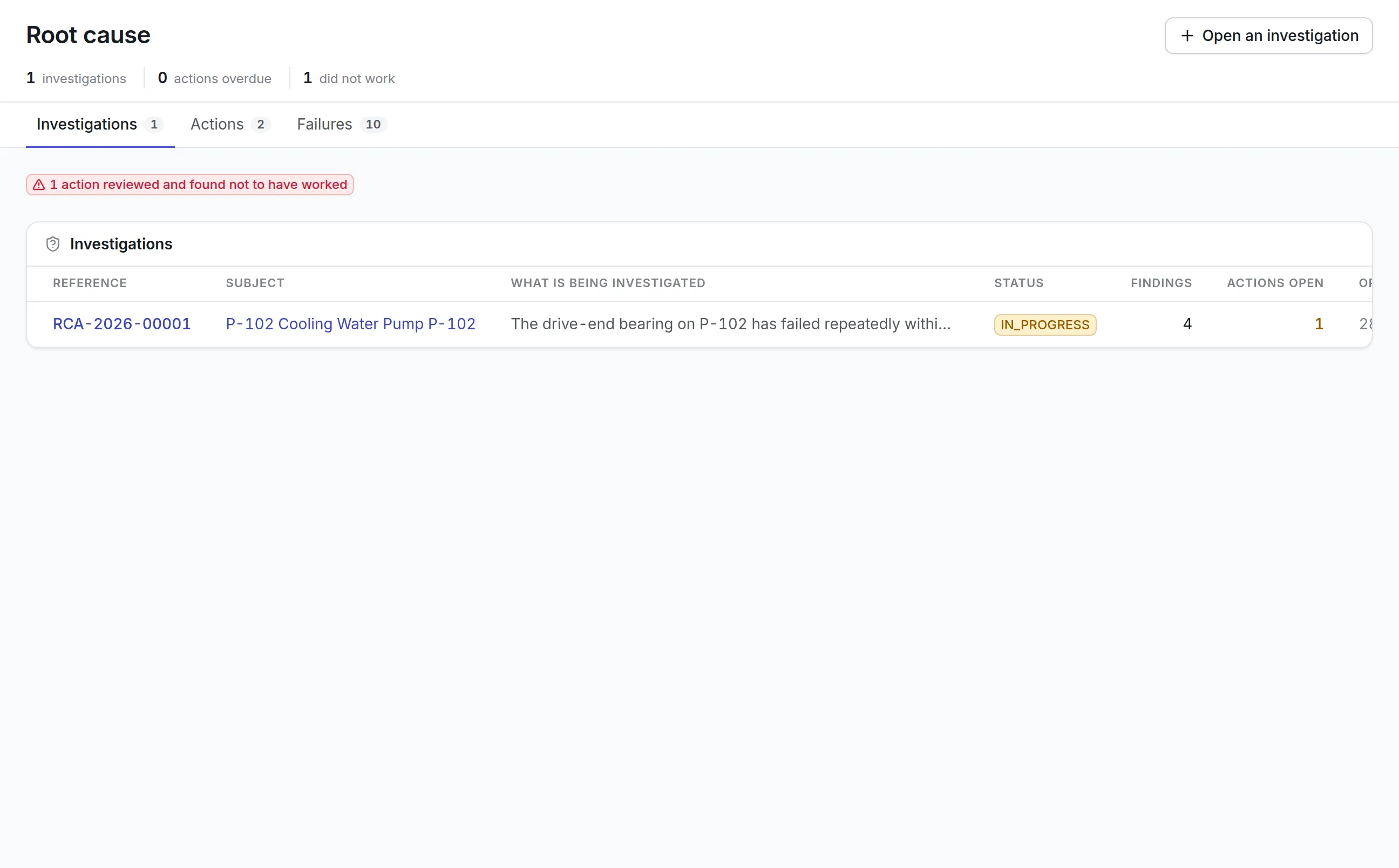
When a condenser leaks for the third time in a year, the reliability engineer opens an investigation with the earlier failures already linked as evidence.
- Five Whys, Fishbone and Fault tree methods
- Findings marked as root causes, with corrective and preventive actions assigned
- Actions verified, then reviewed for whether they worked
- A warning when a reviewed action did not work, because the diagnosis was wrong
More detail
The root cause analysis software page covers investigations and actions in full.
Records for process safety and mechanical integrity
Mechanical integrity work under OSHA 1910.119 is mostly scheduled inspection and testing: relief valves, pressure vessels, piping and the instruments that protect them. In Asset Infinity these run as maintenance plans and graded inspection rounds, with critical checks that raise corrective work by themselves, a second person’s sign-off on statutory rounds, and an audit trail of every change. That gives a PSM auditor or an API 510 inspector the history they ask for. Asset Infinity keeps the records; it does not certify compliance. See inspection management software.
What to look for when choosing oil and gas asset management software
| Capability | Why it matters | In Asset Infinity |
|---|---|---|
| Permits to work | Hot work and isolation errors cause the worst incidents | Ten permit kinds, isolations, two signatures and a hard stop on the job |
| Turnaround planning | The window is fixed and expensive | Work packages, readiness, critical path, scope freeze and late additions |
| Operator rounds | Field checks are the first line of defense | Graded rounds with limits and automatic corrective jobs |
| Root cause analysis | Repeat failures cost production | Investigations with actions verified and reviewed for effect |
| Sensor and SCADA input | Alarms should raise work by themselves | Readings over HTTPS or MQTT with limits per sensor |
| Run-hour maintenance | Compressors and engines wear by hours | Meter and calendar triggers, whichever comes first |
| Field equipment location | Rental tools and vehicles go missing | GPS trackers and RFID readers at gates |
| Contractor agreements | Service companies do much of the work | Contracts with coverage, visits and renewal notice |
| Offline mobile app | Leases and stations have no signal | iOS and Android app that syncs when back in range |
| Audit trail | Auditors ask who changed what | Every change recorded with its previous value |
See it on your own assets, or price it in two minutes.
Oil and gas asset management software by operation
Upstream production
A production team runs pumper rounds on tank batteries and wellheads, compressor services by run hours, and repairs raised from the phone at the lease. The app holds the day’s rounds and jobs, so a pumper with no signal at the far end of the field still records every reading and sends it when back in range. GPS trackers on service trucks and RFID asset tracking at yard gates show where rental tools and safety equipment went.
Midstream stations and gathering
Compressor stations carry engines, coolers and separators on hour-based plans, with SCADA alarms raising work on the right unit. Excavation and hot work permits cover contractors on the line, and contractor agreements sit on the contract register with their response times. Spares for engines and compressors are stocked by store against reorder points.
Refinery or gas plant
A plant runs operator rounds on every unit, plans its turnaround as a shutdown with a frozen scope, and investigates repeat exchanger and pump failures. Relief valve tests and pressure vessel inspections sit on the same schedule as routine PM. Rounds and inspections each record the template version they were asked, so a change to a checklist never rewrites the evidence from last year.
Reliability and integrity team
Reliability engineers read failure rankings across every site, start investigations from repeat-fault recommendations, and track corrective actions to a verdict on whether they worked. Replace recommendations flag equipment whose maintenance cost has passed its purchase price, which gives the capital case for a new pump its numbers. Failure codes come from your own taxonomy of modes, mechanisms and causes.
What oil and gas asset management software costs with Asset Infinity
The asset register starts at $130 a month for up to 500 assets, with unlimited users. Maintenance is $25 per user per month. Add-ons for field and plant work are flat per organization:
- Permits to work, $100 a month
- Reliability and root cause, $150 a month
- Contracts, $100 a month
- Sensors, $5 per connected sensor a month
- GPS trackers, priced with your tracker model
Build a quote for your sites. There is no oil and gas sample company yet, so the trial from this page starts with the general setup, which asks what you want to start with. Choosing safety-critical work switches on permits and shutdown planning, and choosing why things fail switches on reliability and root cause.
Getting started
To see it with your own equipment list, book a demo.
What teams in this industry use most
Common questions
What is oil and gas asset management software?
Oil and gas asset management software keeps a register of wells, compressors, pipelines, tanks and plant equipment, and records the maintenance, inspections and costs of each. It helps operators plan work, control permits and keep the evidence regulators ask for.
Does it support process safety management records?
It keeps the maintenance and inspection records PSM relies on, such as relief valve tests, mechanical integrity rounds and permits, with a full audit trail. Asset Infinity does not certify compliance.
Can it plan a refinery turnaround?
Yes. Shutdown planning holds the work package and milestones, computes the critical path, and shows readiness for parts, permits and people before the unit comes down.
Can it take data from SCADA or a DCS?
Yes. Sensors and control systems can send readings over HTTPS or MQTT. Each sensor has its own limits, and a crossed limit can raise an alert or a work order.
Is it oil and gas maintenance software as well?
Yes. The same register runs work orders, preventive maintenance by calendar or run hours, operator rounds, spare parts and contractor agreements, alongside permits, turnarounds and root cause analysis.
Does it work at remote leases with no signal?
Yes. The iOS and Android app holds a technician's jobs, rounds and meter readings on the phone and sends them when it next finds a signal.
See it with your own assets
A demo run on an example from your industry. Or start the trial and look around on your own.