






Maintenance inventory and procurement software that keeps the right spares on the shelf
Asset Infinity is procurement software for the people who keep equipment running. It counts the spares in every storeroom, says what to reorder and why, and takes each purchase from request to invoice.
What our procurement software does for maintenance buyers
Spares in every storeroom
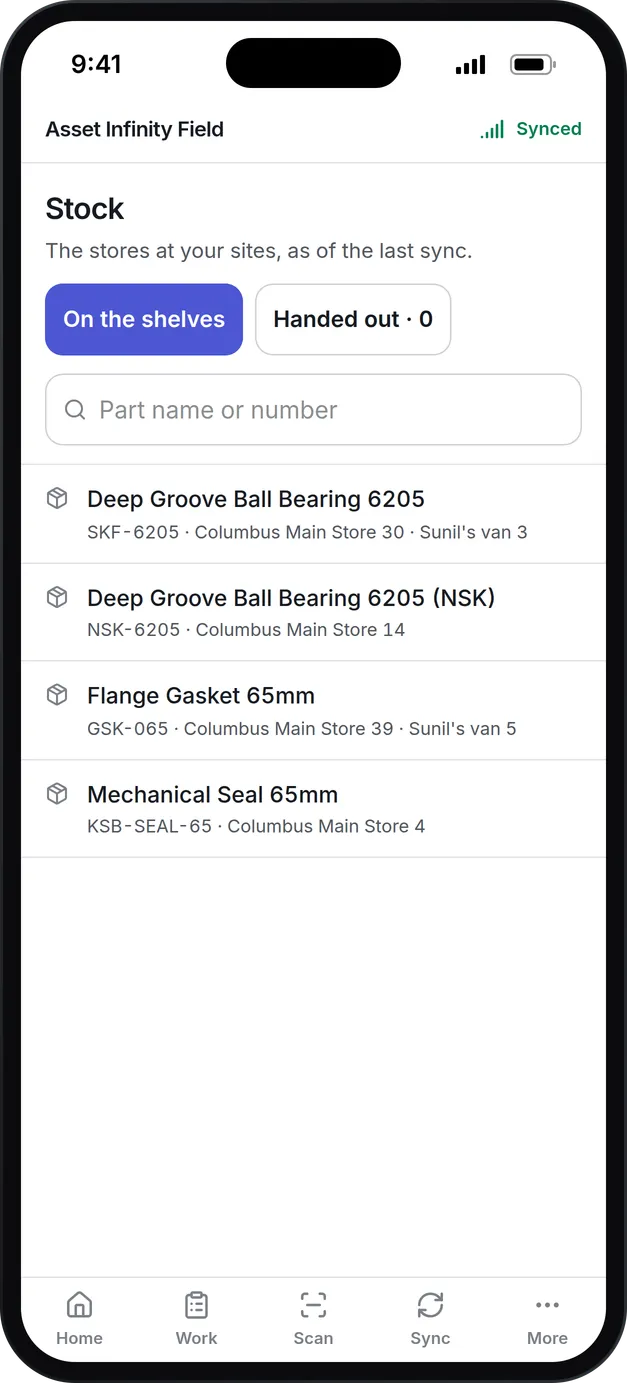
Main stores, satellite stores, technicians' vans and quarantine are all stores, with bins and shelves inside them. Stock is received, issued, transferred, adjusted and counted against each one.
Reorder with a reason
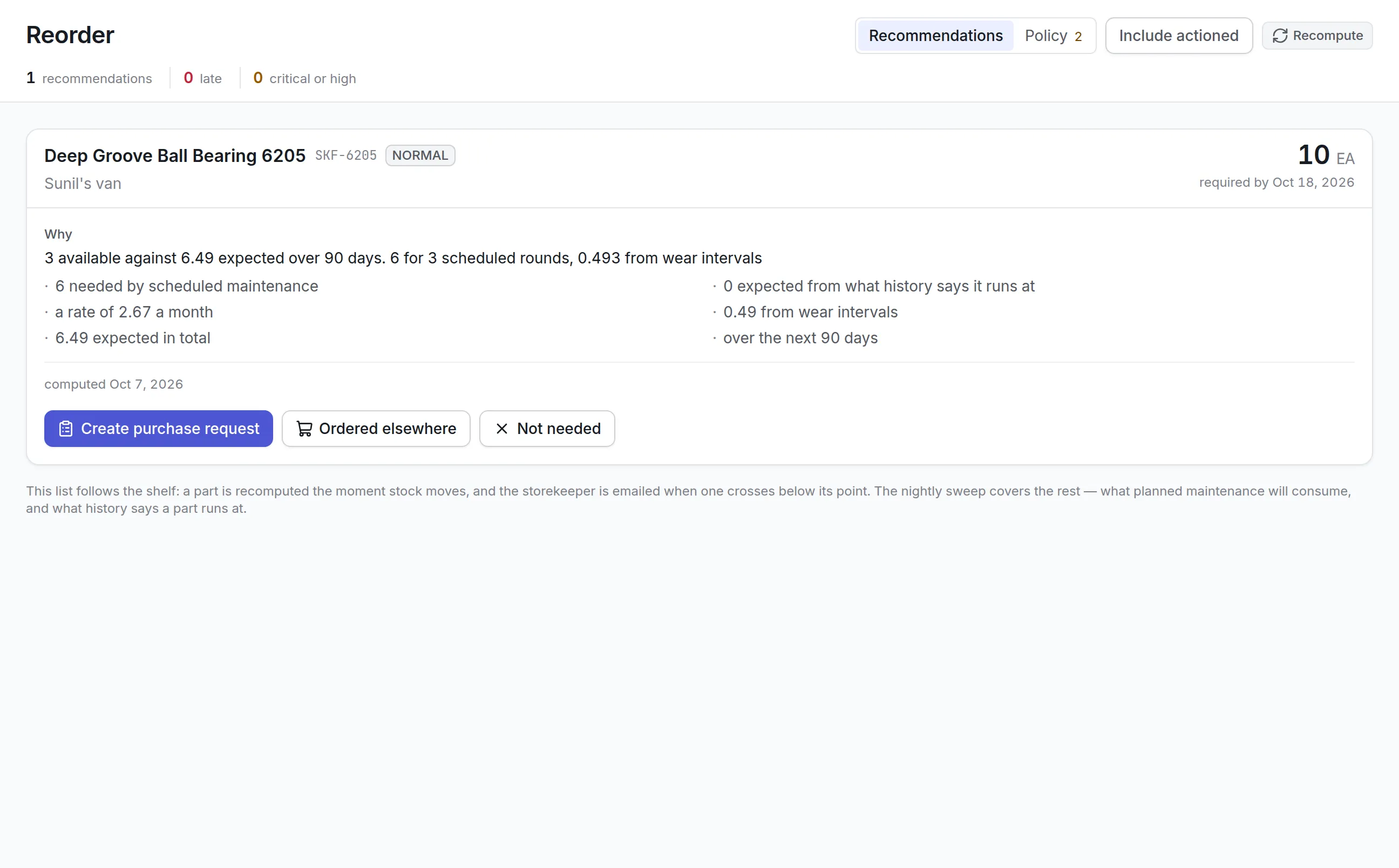
Recommendations weigh minimum stock, safety stock, parts that planned maintenance will use and what history says a part runs at. Each one shows the arithmetic.
Requests from where the need is
A purchase request can come from a reorder recommendation, a work order or someone typing it in. Approval chains follow the value of what is being bought.
Quotes you can defend
Ask several vendors for quotes on one request and record what each one offers. Awarding anything other than the cheapest asks for the reason.
Orders, deliveries and invoices
Purchase orders track the supplier's acknowledgement, partial deliveries and what is still owed. Supplier invoices are matched against the order and what arrived.
Vendors and contracts
Vendor compliance, SLAs, service contracts and warranties sit beside the purchasing, so you can see when a repair is already covered.
What is procurement software for maintenance teams?
Procurement software manages how an organization buys: it turns a need into an approved request, compares vendor quotes, issues purchase orders, receives the goods and checks each invoice against what was ordered and delivered. For maintenance teams it also tracks spare parts and starts purchases from stock levels and planned work.
General purchasing tools are built for office supplies and catalogs. Maintenance buys under pressure, for a pump that is down or an overhaul three weeks away, so every purchase needs the job and asset behind it.
Why maintenance needs its own procurement software
A maintenance storeroom fails in ways a purchasing department rarely sees. The bearing is in the building, but in the wrong store. The gasket was ordered, but the supplier never confirmed it. A contractor’s insurance lapsed last month and nobody noticed before giving them a job. Asset Infinity starts from the asset and the work order, so each of these is something the screens show:
How procurement software works in Asset Infinity, from shelf to invoice
Here is one bearing’s path through a plant, from the shelf running low to the supplier’s invoice being passed for payment. The purchasing documentation covers every field.
- Stock drops and the reorder list explains it.A part is recomputed the moment stock moves, and a nightly sweep adds what planned maintenance will consume and what history says the part runs at. The storekeeper is emailed when a part crosses below its point. Each recommendation names the store, the quantity, the required-by date and the arithmetic behind it.
- The recommendation becomes a purchase request.Create purchase request fills in the part, quantity, estimated cost, store and date. Requests also come from work orders or are typed in, with a priority of Low, Normal, High or Urgent and an approval chain that follows the value.
- The buyer sources each approved line.The sourcing queue shows every approved line not yet ordered, with what you already hold beside it. A line can be answered from stock, met with a spare asset on standby, ordered, or closed short with a reason.
- Vendors quote, and the award is explained.An RFQ invites the vendors you choose and compares their quotes side by side, with the lowest tagged cheapest. Awarding any other quote asks why, and the reason stays on the record. Raise the order creates the draft purchase order.
- The order is approved and issued.An order under every approval threshold skips approval. The supplier’s acknowledgement is recorded with their reference and promised date.
- Goods arrive and are received.A delivery takes the order to Partially Received or Received, and rejected goods are recorded with a reason, such as a deformed seal sent back on the truck.
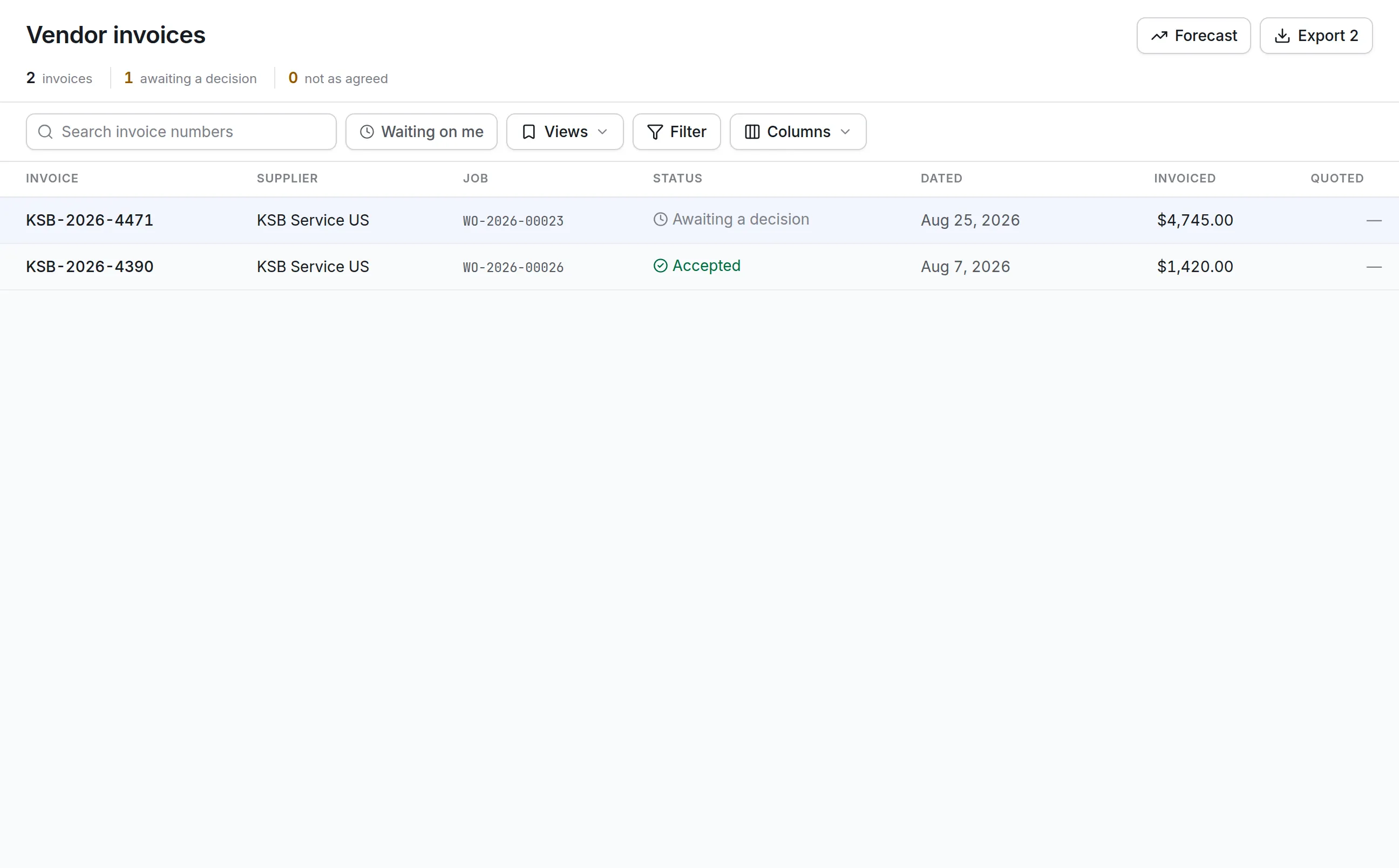
- The invoice is matched three ways.The supplier’s invoice is checked against the order and the receipts as it is recorded. A variance can be disputed, or passed for payment with a reason.
Spare parts and reorder recommendations
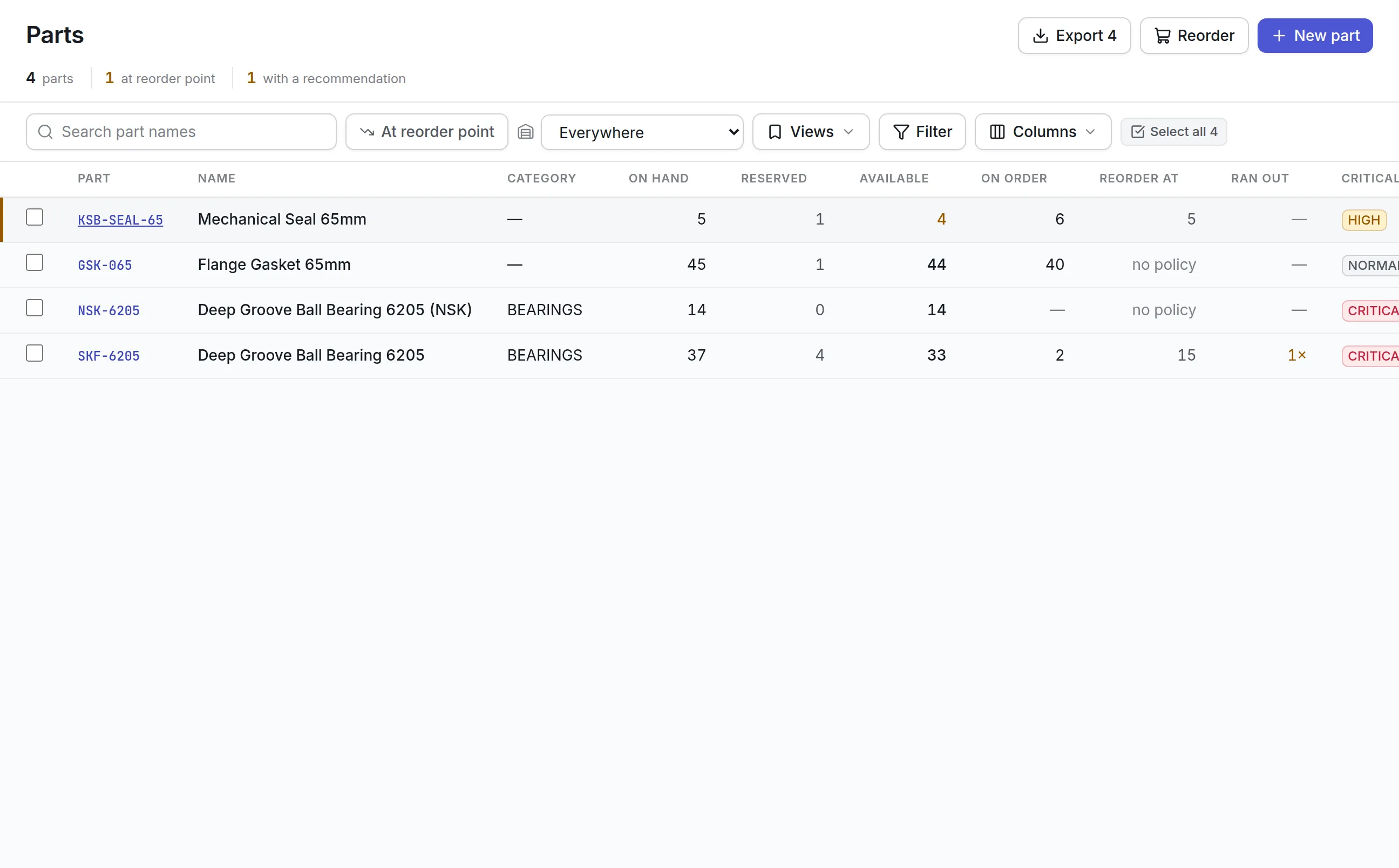
The part catalogue shows each part’s on-hand, reserved, available and on-order quantity, its reorder point, how often it ran out in the last 12 months, its criticality and its lead time. Choose one store to see that shelf alone, or Everywhere for the totals.
- Min/max refills to the maximum once stock reaches the minimum.
- Reorder point orders a fixed quantity when the point is reached.
- Forecast works from what planned work will consume.
- Safety stock and lead time are counted in every type.
- A red banner names any critical or high part that has no policy, because it will never be suggested.
More detail
A reorder policy can be set for one store or wherever the part is stocked, and its type decides how the quantity is worked out:
More detail
Each recommendation can become a purchase request, be marked Ordered elsewhere, or be dismissed with Not needed and a reason the next person will see. The detail is on our parts inventory management page.
Purchase orders, receiving and three-way matching
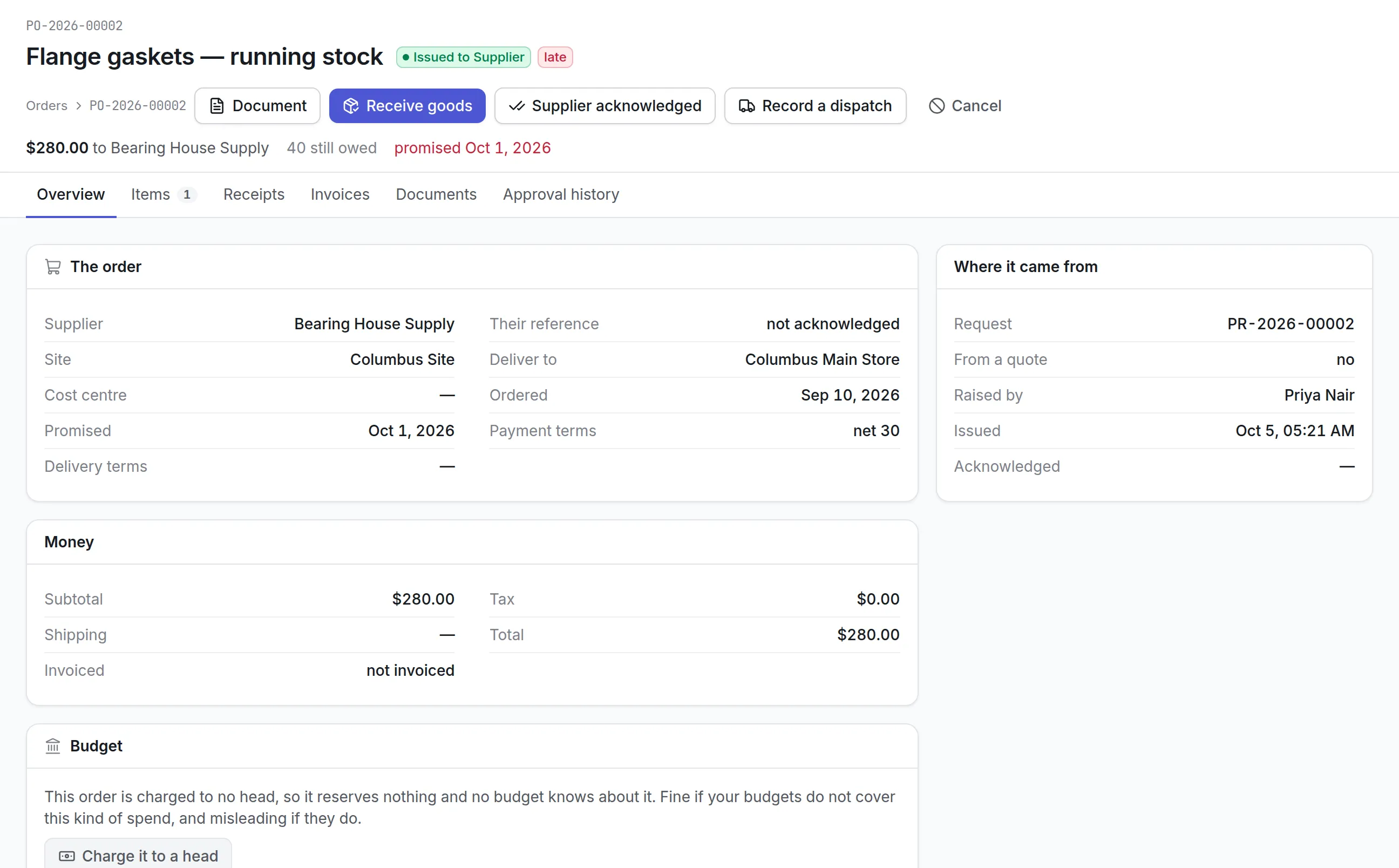
A purchase order moves through Draft, Pending Approval, Approved, Issued to Supplier, Acknowledged, Partially Received, Received and Closed. Receiving moves it on its own, and an order that is still owed past its promised date is marked late. Partial deliveries are normal, so an order can stay partly received until the rest arrives or is closed short.
More detail
Each order can be charged to a budget head, so its value is committed the moment it is submitted. When the invoice arrives it is matched against what was ordered and what was received, line by line. Nothing can be paid on a disputed invoice, and a payment short of the balance needs a reason from your own list. Requests, quotes, orders and receiving are covered in depth on our purchase order software page.
What to look for when choosing procurement software for maintenance
Use this table to compare products on what matters to a maintenance storeroom and buyer.
| Capability | Why it matters | In Asset Infinity |
|---|---|---|
| Stock per store | A shortage in one storeroom stops a job even when another has plenty | Every store, bin and van tracked on its own, with transfers between them |
| Reorder from planned work | Preventive rounds consume parts on a known schedule | Planned demand, history and wear intervals in every recommendation |
| Explained recommendations | An approver should see why, not trust a number | Each card shows the arithmetic and the evidence |
| Requests tied to jobs | Spend should trace to the asset it kept running | A request can name its work order, site and origin |
| Quote comparison | Paying more should be a decision on record | Side-by-side quotes, with a reason required to skip the cheapest |
| Order tracking | A missing confirmation is an early warning | Acknowledgement, promised date, partial delivery and still-owed quantities |
| Three-way match | Invoices should agree with orders and deliveries | Line-by-line match, dispute and pass for payment with a reason |
| Budget control | Overspend should show before an order is approved | Orders commit against budget heads that warn or block |
| Vendor compliance | A lapsed certificate is a risk on site | Vendors who cannot be assigned are counted and filtered |
| Supplier portal | Fewer emails and phone calls | Vendors confirm orders and submit invoices themselves |
See it on your own assets, or price it in two minutes.
Vendors, contracts and contractor invoices
The vendor directory starts with the question that matters first: may this vendor be used today? It counts vendors who cannot be assigned, because of their status or a lapsed compliance document, and those whose insurance, license or certificate is close to expiry.
More detail
Contractors bill for work as well as parts, so each vendor invoice can be tied to the job it was for. Service contracts record SLAs and coverage beside the purchasing, so a buyer can see when a repair is already covered before paying for it again. That side is covered on our maintenance contract management software page.
Procurement software by industry
The steps are the same everywhere. What each team sets up first differs.
A manufacturing plant
A plant runs a main store and line-side cabinets, with critical spares for presses and compressors set to min/max. Preventive rounds feed the forecast, so bearings and filters are bought before a planned overhaul. RFQs cover larger buys such as a pump rebuild kit. See how this fits maintenance in manufacturing.
A hospital
Biomedical and facilities teams keep separate stores for spare parts and building supplies. Every purchase names its work order and site, contractors confirm orders through the portal, and each service invoice is matched before payment. Vendors with a lapsed certificate cannot be given work.
A facilities team across many buildings
Each building or region holds a small store, and technicians’ vans are stores of their own. Reorder points are checked store by store, and stock moves by transfer before anyone buys more. Contractor invoices are checked against the job that was raised.
A fleet workshop
Filters, belts and brake parts are consumed on a known service schedule. Forecast policies read what planned services will use, so the workshop orders ahead of each service interval. Parts handed out can be recorded against the vehicle they went into.
What procurement software costs in Asset Infinity
Parts and stock is $20 a month for each user who needs it, and purchasing (requests, orders, vendors and contracts) is $25 a month per user. Reordering and receiving are flat add-ons at $75 a month each, quoting (RFQ) is $100 a month, and contracts are $100 a month. Every plan starts with the asset register, from $130 a month for up to 500 assets with unlimited users. You can build a quote with only the pieces your storeroom and buyers use.
Getting started in the first week
Most teams start their procurement software with the storeroom and add buying once stock is right:
Common questions
What is procurement software for maintenance?
It is software that buys what maintenance needs. It tracks spare parts, decides when to reorder, and runs requests, quotes, purchase orders, receiving and supplier invoices, tied to the jobs and assets the spending is for.
What is three-way matching?
Three-way matching compares a supplier's invoice with the purchase order and with what was actually received. Asset Infinity runs the match as the invoice is recorded, shows the difference line by line, and asks for a reason before an invoice with a variance is passed for payment.
Can it replace our ERP purchasing?
It covers purchasing up to a matched invoice and records what was paid against it. Payment runs and general ledger postings stay in your finance system.
Does it handle more than one storeroom?
Yes. Each part shows stock by store, and stock moves between stores with transfers. A technician's van can be a store of its own, and reorder points are checked store by store.
Can suppliers send quotes and invoices themselves?
Yes. A vendor contact can be invited to a portal login limited to their own company's purchase orders, jobs and messages, where they confirm orders and submit invoices.
How much does procurement software cost?
Parts and stock is $20 a month per user who needs it, and purchasing (requests, orders, vendors and contracts) is $25. Reordering, quoting and receiving are flat add-ons. See the pricing page for the full list.
See it with your own assets
A demo run on an example from your industry. Or start the trial and look around on your own.