






GMP asset management that keeps every instrument calibrated and on the record
Our GMP asset management gives balances, tablet presses, isolators and clean-room HVAC one record each, with calibration, checks and repairs on it. Controlled SOPs and certificates sit beside the equipment they govern, with every change in the audit trail.
- FDA 21 CFR Part 211 (cGMP equipment and calibration records)
- FDA 21 CFR Part 820 (medical device quality system)
- ISO 14644 (cleanroom monitoring)
What our GMP asset management does for quality and engineering
Calibration that falls due
Every instrument carries its calibration interval, last and next dates, and each calibration record keeps its certificate number and who issued it.
Equipment logs with limits
Daily balance checks, differential pressure logs and purified water sampling are recorded against limits. A critical failure opens a corrective job.
Controlled documents
SOPs, manuals and certificates move through draft, review, approved and superseded, with an approver, a review cycle and an expiry date.
Failures to root cause
A failure on a press is logged with its failure code. Five-whys root cause analysis keeps the evidence and checks that the corrective action worked.
Tooling and test equipment
Punch sets, dies and test equipment are issued and returned on record, with their condition and calibration status at each move.
Every change audited
Records on the equipment register keep a full audit trail of who changed what and when, and each inspection keeps the checklist version it was asked.
What is GMP asset management?
GMP asset management is the discipline of keeping the equipment used to make medicines, biologics and medical devices in a known, documented state. It records each instrument’s calibration, maintenance, checks and status, keeps the SOPs that govern it under revision control, and keeps an audit trail that shows the equipment was fit to use when a batch was made.
Plants buy software for it because paper logbooks and spreadsheets fail exactly where an inspector looks: a calibration that lapsed without anyone noticing, an SOP revision nobody approved, or a repair with no record of who did it.
How GMP asset management works in Asset Infinity
Each plant is set up as blocks, areas and rooms, with clean-room grades on the room records. Process equipment, HVAC, utilities and laboratory instruments each have one record. A typical failure and recovery runs like this:
- The daily check fails.A balance’s daily performance check reads outside its tolerance on the mobile app. The critical item fails the round and raises a corrective job by itself.
- The instrument is taken out of use.It is marked out for calibration, so it cannot be issued for a job until it is recalibrated, and the change is in the audit trail.
- Calibration is recorded.The calibration laboratory’s visit is recorded against the instrument with its certificate number and issuer, and the next due date moves on.
- The certificate is filed.The new certificate goes into the document library against the balance, as the next revision, with its expiry date.
- The instrument returns to use.The job closes with a signed checklist, and the instrument’s history shows the failure, the calibration and the return in order.
Planned work runs the same way. Calibration plans fall due on each instrument’s own calibration date, so one plan can cover fifty instruments that each fall due on a different day. See preventive maintenance software for date, meter and condition triggers. Meters work the same way: differential pressure across a HEPA bank or run hours on a tablet press can be recorded on the app or sent in by a sensor, and a plan raises the filter change or the press service when a reading says so.
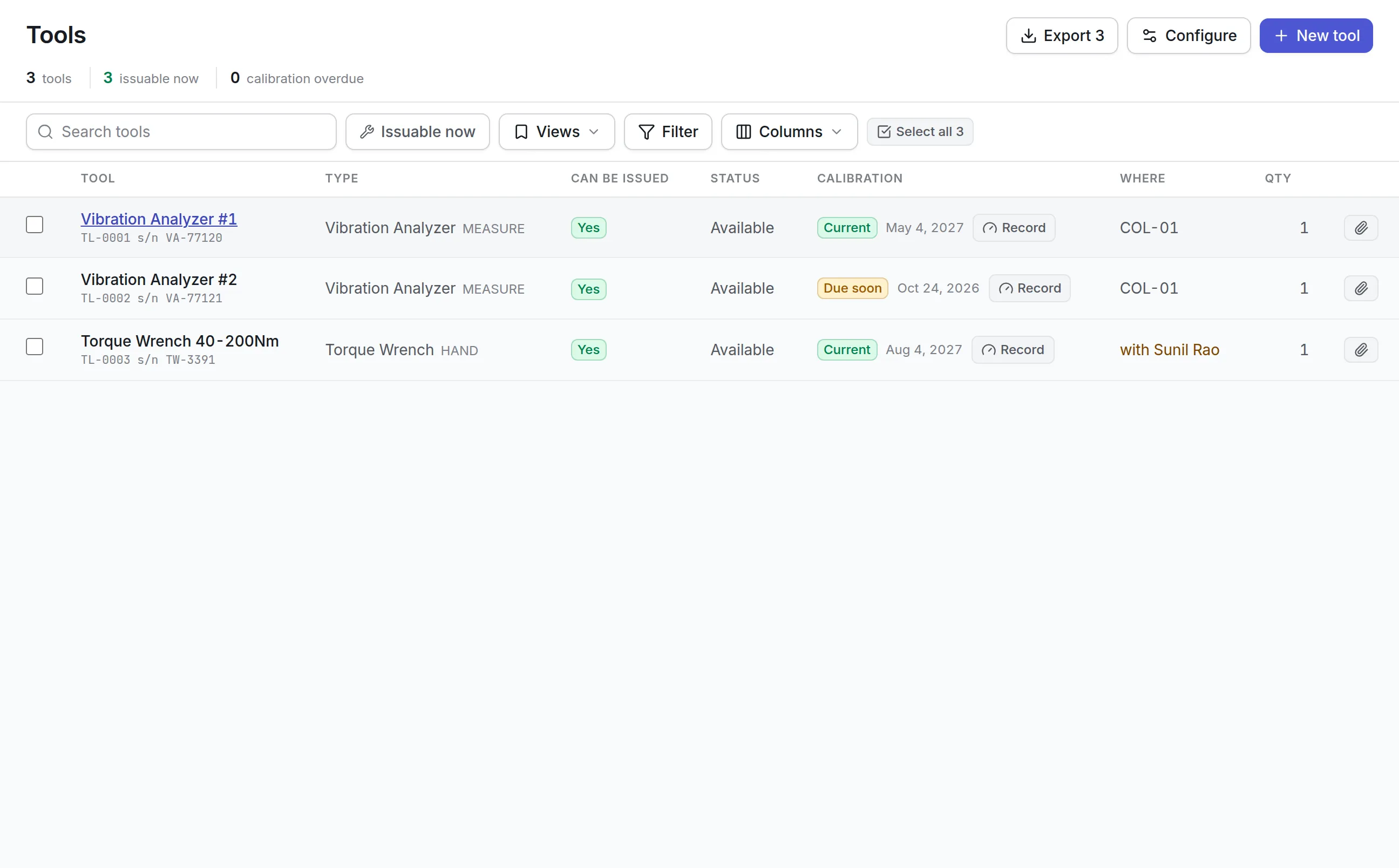
Calibration and test equipment on record
Test equipment, gauges, torque wrenches and punch sets are tools technicians take to a job and bring back. The tool register answers one question first: can this be issued right now?
More detail
Tool tracking software covers check-out, check-in and calibration in detail.
Equipment logs that grade themselves
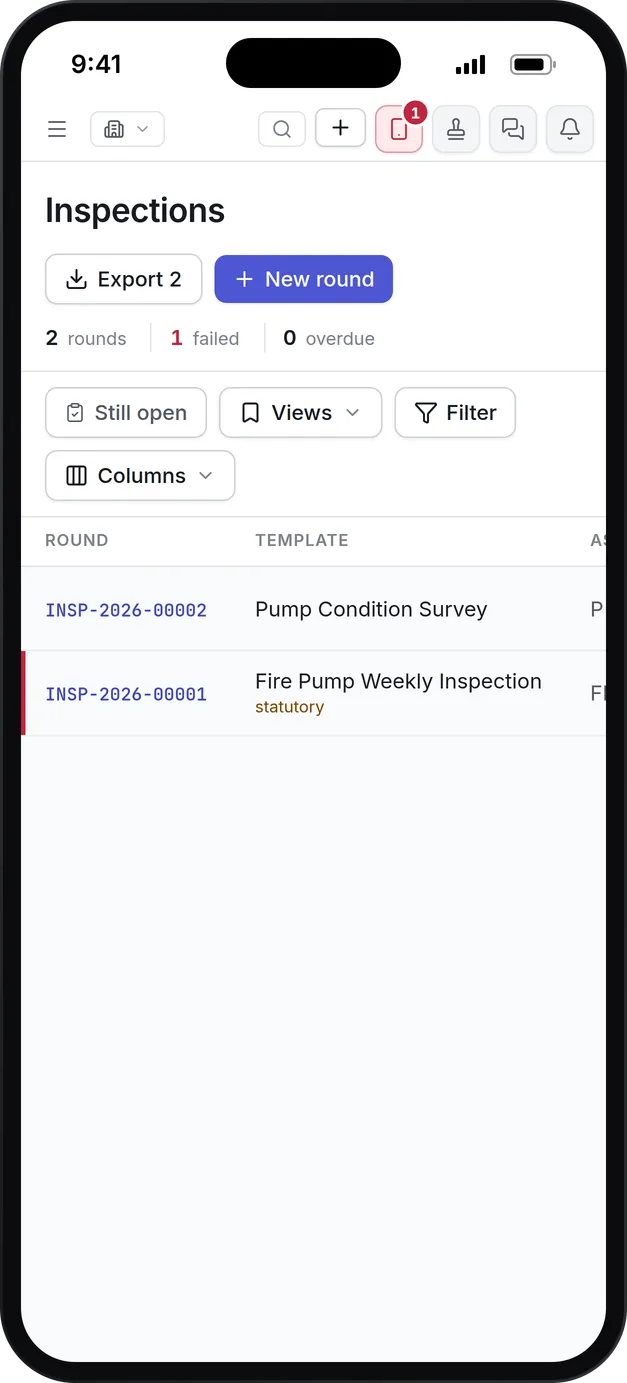
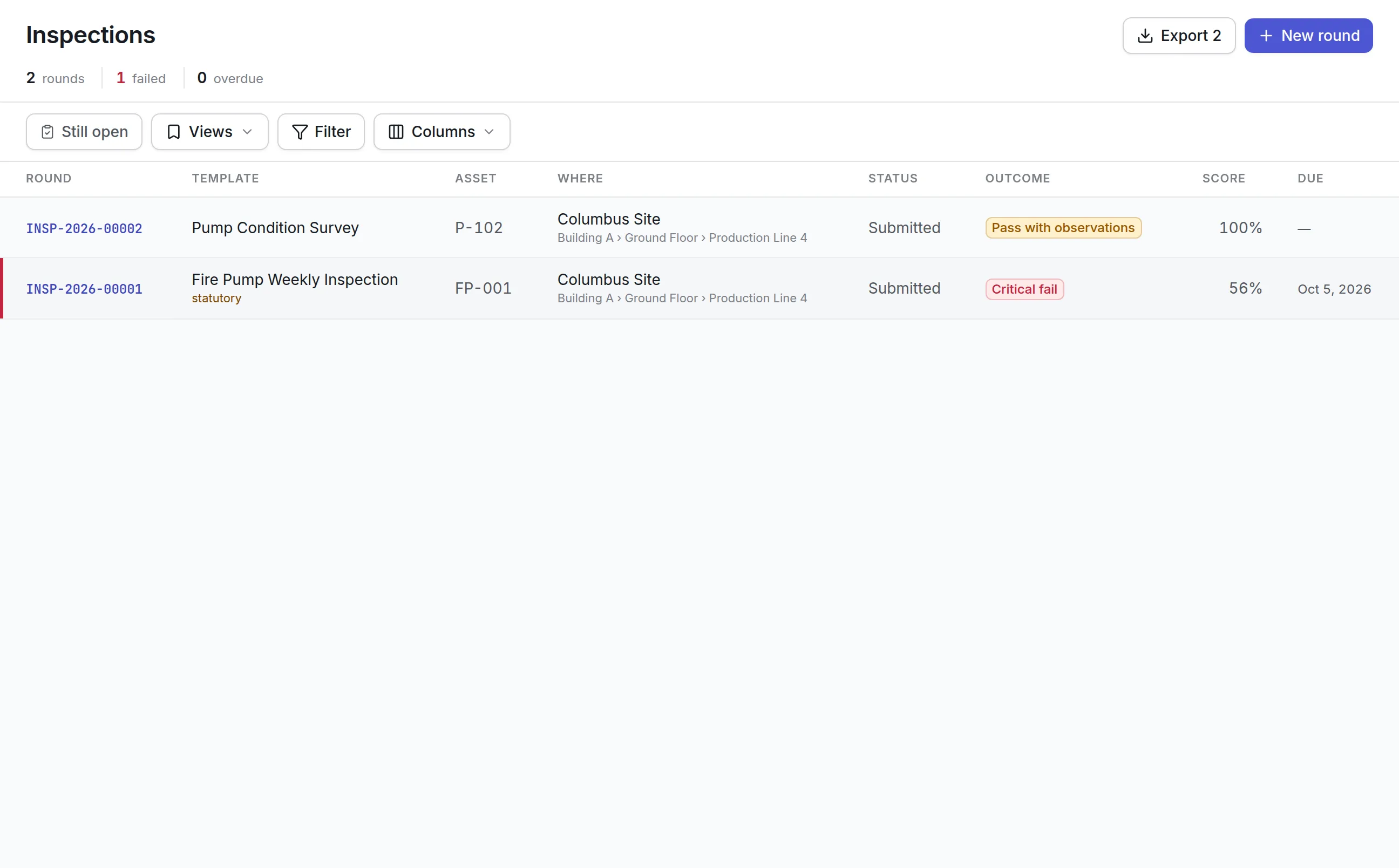
Daily clean-room differential pressure logs, weekly purified water sampling, equipment status-label checks and balance performance checks run as graded inspection rounds on the phone.
- Each reading against its expected range, with the person and time that recorded it
- Notes, photographs and signatures, frozen once the round is submitted
- A critical fail when any critical check fails, whatever the score
- A corrective work order raised for each failed critical check
- A reviewer’s sign-off, by someone other than the person who carried out the round
- The template version the round was asked, so a later edit never rewrites past evidence
More detail
What each round keeps:
More detail
Inspection management software explains templates, grading and findings.
Root cause analysis for equipment deviations
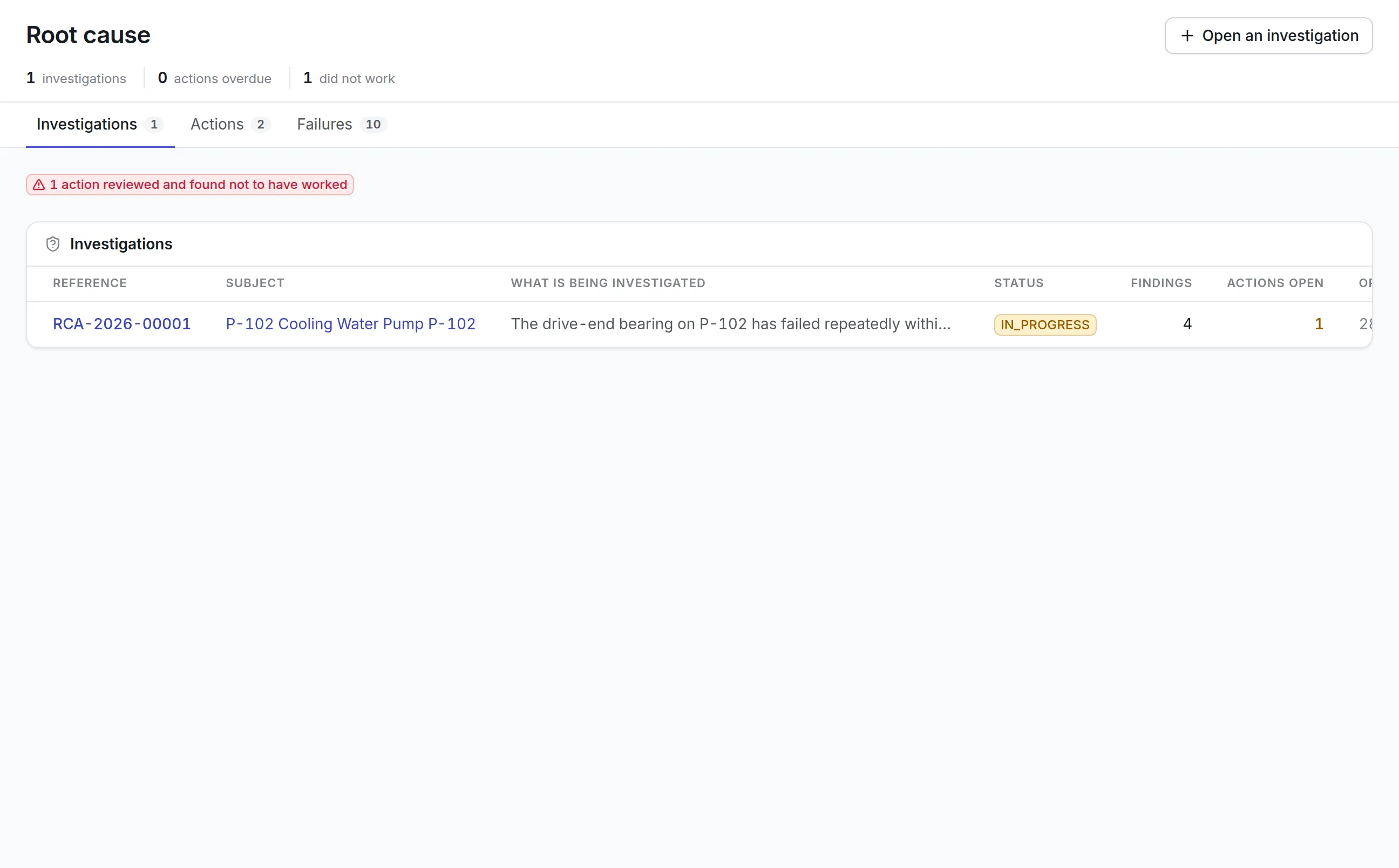
When a tablet press caps a batch for the second time, the engineering manager opens an investigation with the press’s earlier failures linked as evidence.
- Five Whys, Fishbone and Fault tree methods
- Corrective and preventive actions, each followed until it is done
- Each action verified, then reviewed for whether it worked
- Failures closed with codes from your own failure taxonomy
More detail
Your quality system still owns the deviation and the CAPA record. Asset Infinity keeps the equipment side of the investigation. See root cause analysis software.
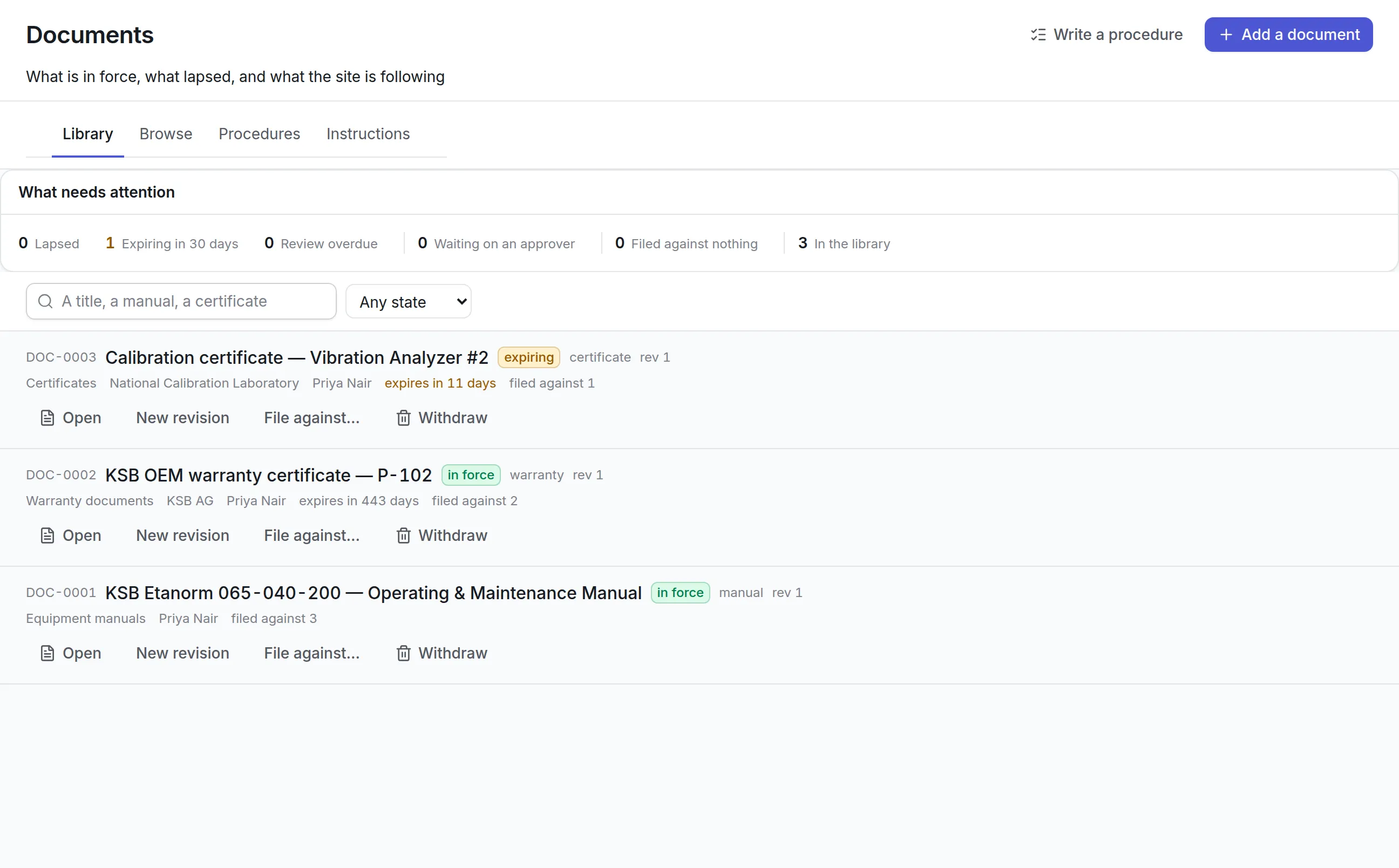
Controlled SOPs, certificates and the audit trail
The document library opens on what needs attention rather than an alphabetical list, because people come to it when something has lapsed or is waiting on them. A document’s state is worked out from its dates, so a certificate that lapsed at midnight reads as expired the next morning.
More detail
Maintenance in GMP areas still needs safe isolation. A job that needs a lockout permit cannot start until one has been issued and accepted, and the permit’s isolations and signatures stay with the job. See lockout tagout software.
What to look for when choosing GMP asset management
| Capability | Why it matters | In Asset Infinity |
|---|---|---|
| Calibration intervals per instrument | Every instrument falls due on its own date | Calibration interval, last and next dates, and plans triggered by each instrument’s date |
| Out-of-use status | A failed instrument must not be used | Status and condition that block issue until recalibration |
| Graded equipment logs | Logs with limits catch drift early | Rounds with ranges, critical checks and automatic corrective jobs |
| Controlled documents | Inspectors check the SOP revision in force | Draft, in review, approved, superseded, expired and withdrawn, with review dates |
| Audit trail | Who changed what, and from what | Every change across records, with the previous value |
| Second-person review | Records need an independent check | Submitted rounds reviewed by someone other than the inspector |
| Root cause analysis | Repeat failures are deviations waiting to happen | Investigations with verified, reviewed actions |
| Permits and lockout | Maintenance in GMP areas still needs isolation | Permits to work with isolations and signatures |
| Shutdown planning | Annual shutdowns bundle validation and maintenance | Work packages, readiness and critical path |
| Offline mobile app | Clean rooms and plant rooms have poor signal | iOS and Android app that syncs when back in range |
See it on your own assets, or price it in two minutes.
GMP asset management by team and site type
Engineering and maintenance
Engineering runs the tablet press preventive service, half-yearly AHU service and purified water loop sanitization on plans, and holds jobs in GMP areas until their lockout permit is issued. Every completed job keeps its signed checklist and the parts used on the equipment record. Shutdowns bundle the yearly HEPA integrity test with the maintenance that needs the area down.
Quality control laboratory
The lab keeps balances, pH meters, HPLC systems and stability chambers on calibration plans, records daily balance checks against tolerance, and files calibration certificates against each instrument so the one in force is always the one shown. Stability chambers and other instruments with service contracts show the calibration laboratory’s agreement and what it covers.
Quality assurance
QA approves SOP revisions in the document library, sees review-overdue and expiring documents counted at the top, and reads the audit trail and compliance reports when preparing for an inspection. Reviewers sign off submitted equipment logs, and their name and the time are recorded on each round. Superseded revisions stay readable, so the history of an SOP is never lost.
Medical device or contract manufacturer
A device maker or contract manufacturer runs the same register for production equipment and test fixtures, with tooling issued and returned on record and calibration status checked at each move. Fixtures and gauges that measure carry a calibration interval, and an overdue one is flagged on the register, because its readings no longer count as evidence.
What GMP asset management costs with Asset Infinity
The asset register starts at $130 a month for up to 500 assets, with unlimited users. Maintenance is $25 per user per month. Add-ons for a GMP site are flat per organization:
- Tools and calibration, $75 a month
- Controlled documents, $100 a month
- Permits to work, $100 a month
- Reliability and root cause, $150 a month
Build a quote for your plant. The pharmaceutical trial opens with process equipment, clean-room HVAC, purified water and laboratory instruments, half of them requiring calibration, plus controlled SOPs for the three most-maintained machines and a sample history in which a balance fails calibration and is taken out of use.
Getting started
To see it with your own instrument list, book a demo.
What teams in this industry use most
Common questions
What is GMP asset management?
GMP asset management keeps the equipment used to make medicines and medical devices in a known, documented state. It records each instrument's calibration, maintenance, cleaning and use, so a batch record can show the equipment was fit to use.
Does Asset Infinity manage calibration?
Yes. Each instrument carries a calibration interval and next due date, overdue calibration is flagged, and each calibration record holds its certificate number and issuing laboratory.
Can it control SOPs and other documents?
Yes. Documents move through draft, review, approval and supersession, with review cycles and expiry dates, and each one can be filed against the equipment it covers.
Is Asset Infinity validated for GMP use?
Asset Infinity keeps the records and audit trail a GMP site relies on. Validation for your intended use is done by your quality team, and the product does not certify compliance.
What is the difference between GMP asset management and GMP maintenance software?
They overlap. GMP maintenance software runs work orders and planned maintenance; GMP asset management adds calibration, equipment status, controlled documents and the history that shows each instrument was fit to use. Asset Infinity does both on one register.
Can it take an instrument out of use when calibration fails?
Yes. A failed check raises a corrective job, and the instrument can be marked out for calibration, or its condition set to damaged, so it cannot be issued until it is recalibrated.
See it with your own assets
A demo run on an example from your industry. Or start the trial and look around on your own.