






RFID and barcode technology are two techniques frequently used for asset tracking and inventory tracking. They are used in many industries, such as retail, transportation, clothing and manufacturing.
Every day an organization takes several decisions in order to decrease the cost and increase productivity. So, choosing technology that works efficiently and effectively in your organization is very crucial.
Knowing the major differences between RFID and barcode helps you run the business successfully and improve your return on investment (ROI).
What is Barcode?
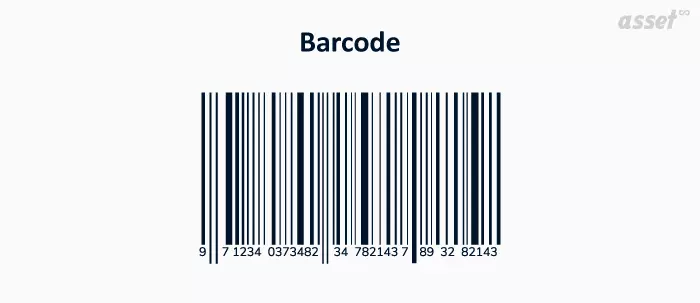
A barcode is a representation of data in a code that machines and scanners can read. A traditional barcode is a rectangle of black and white parallel lines with a few numbers written right below them. It is used for asset tracking and inventory tracking, and the data can be read by smartphones too. Barcodes come in one-dimensional (1D) and two-dimensional (2D) forms.
1D barcodes are simple and store a short code, such as a product number. 2D barcodes are more complex and can hold more information, such as price, quantity or a web address.
More businesses are adopting 2D barcode scanners for inventory control and for gathering business data.
What is RFID?

RFID stands for radio-frequency identification. A tag is attached to an item, and radio waves are used to read the tag. An RFID system has three parts: the reader, the antenna and the transponder (the tag).
The antenna sends a radio-frequency signal that lets the reader communicate with the RFID tag. When the tag passes through the antenna’s field, it detects the activation signal and sends back its data for the antenna to pick up.
Also Read: RFID vs NFC: How They are Different in Terms of Asset Tracking?
What Are the Advantages & Disadvantages of Barcode?
Advantages of the barcode
- They are cost-effective
- Barcode is very accurate
- Barcode is a universal technology
- It is vastly used in Inventory Tracking
- It greatly reduces the chance of human error
- Barcodes can be read by a barcode scanner anywhere in the world
- Barcode is easy to use technology as you can see it on almost every product and item
Disadvantages of the barcode
- It needs to be scanned in a straight line
- If the barcode is damaged, there is no other way to scan the product
- Barcode only stores a small amount of data
- Barcode scanner needs to stay close to the product in order to scan the barcode
What Are the Advantages & Disadvantages of RFID?
Advantages of RFID
- RFID automatically collects data reducing human effort and error
- It does not need a line of sight to read data
- It increases efficiency as it can read multiple tags at the same time
- RFID can read data from long distance
- Some tags support passwords and encryption, which improves security
- Many RFID tags are durable and can be reused
Disadvantages of RFID
- Materials such as liquid and metal can interfere with the signal
- It can sometimes read tags by accident
- RFID tags cost much more than barcodes because each tag has a built-in chip
- RFID Implementation is time-consuming
What Are the Similarities Between Barcode And RFID?
There are several similarities between them such as:
- Both technologies are used for asset tracking & inventory tracking.
- RFID and barcode are both asset tracking methods for gathering information
- Stored information on both are retrieved via another device (scanner or reader)
What Are the Differences Between Barcode And RFID?
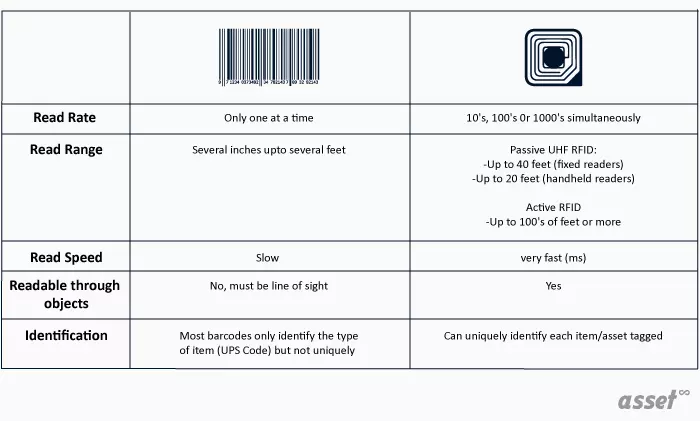
Here are a few differences:
- RFID does not need a line of sight, while a barcode must be scanned directly
- Barcodes are very cost-efficient compared to RFID
- RFID can read data from a greater distance than a barcode, which is read from a few inches to a few feet away
- In many cases; barcode precision has been said to be the equivalent or surprisingly better than RFID tags
- RFID Tags quickly read data compared to the barcode
- Barcode is very simple to use as it is much smaller and lighter than RFID
- RFID can read and write data, but barcode can only read data
- Barcode can’t scan multiple items, so it provides accuracy and reliability. Hence, you don’t have to worry about accidental scan
- RFID can also maintain a product’s history of maintenance, expiry date, etc.
Also Read: How is Asset Tracking Using NFC Different from Other Technologies?
Choosing Between RFID and Barcode Comes Down to Your Operation
Both asset tracking technologies have their own benefits and drawbacks. It is up to you to figure out which technology suits your products and your work.
For instance, in a small store, barcodes work efficiently for inventory tracking. If that small store used RFID instead, it would cost a lot more.
It is important for organizations to use an asset tracking technology, whether barcode or RFID. Using tags with RFID asset tracking software gives you an extra edge.
How? These asset tracking methods provide crucial data that helps the team with maintenance management, work orders and maintenance scheduling, and asset history provides analytics for informed decisions.
Because these methods are built for tracking and monitoring assets, your productivity will increase and asset optimization will improve.
Frequently Asked Questions (FAQs)

1. Can RFID replace barcodes?
The barcode has been around for a long time and works well in many companies, so we don’t think it will be replaced. It has evolved into the QR code, and in the future we may see other updated versions of the barcode.
2. Is RFID cheaper than a barcode?
No, at least not in terms of tag price. An RFID tag costs many times more than a printed barcode label.
3. Can RFID readers read barcodes?
Some scanners support both RFID and barcodes, so you can upgrade at your own pace.
4. Is barcode better than RFID?
RFID has more advantages than barcodes, but as we said earlier, you first have to understand your business requirements. Only then can you figure out which technology is best for your business process.