






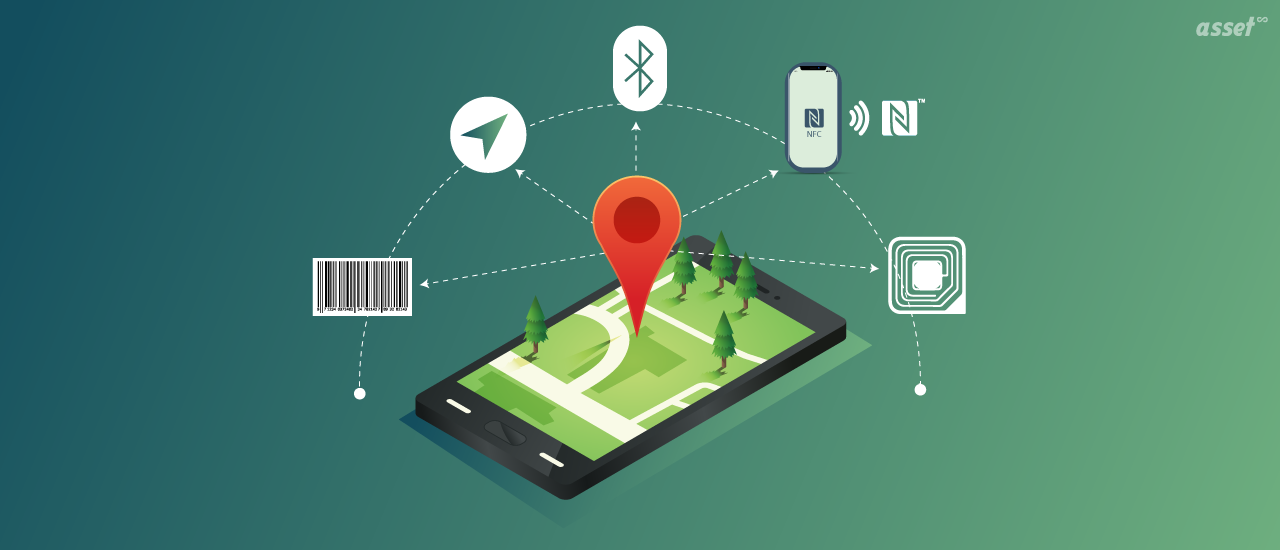
Asset tracking methods range from a clipboard to a satellite tracker, and the right one depends on what you need to know about an asset: who has it, which room it is in, whether it left the building, or where it is on the highway. Most organizations end up with two or three methods, chosen by asset type, on one register.
This guide compares the common asset tracking methods and technologies (pen and paper, spreadsheets, barcodes, QR codes, RFID, NFC, Bluetooth Low Energy, GPS and IoT sensors), with what each one tells you, what it costs you in effort, and where it fits. It ends with a way to choose and a table you can take into a buying meeting.
What Are Asset Tracking Methods?
Asset tracking methods are the ways an organization identifies its physical assets and records their location, holder and condition. A method combines an identifier on the asset, such as a label, tag or tracker, with a way of reading it, such as a phone camera, an RFID reader or a GPS network, and a register where each read is stored.
The identifier decides how much work tracking takes. A barcode only updates the register when a person scans it. An RFID reader at a doorway updates it every time a tagged asset passes. A GPS tracker updates it every few minutes without anyone involved. More automation costs more per asset, so the question is which assets justify it.
Asset Tracking Methods at a Glance
| Method | How it is read | Range | Updates on its own? | Best for |
|---|---|---|---|---|
| Pen and paper | By eye | None | No | A handful of items, temporarily |
| Spreadsheet | By eye, typed in | None | No | Under about 100 assets in one place |
| Barcode | Scanner or phone camera, line of sight | Close range | No | Low-cost labeling of most assets |
| QR code | Phone camera, line of sight | Close range | No | Equipment people walk up to |
| RFID (passive) | RFID reader, no line of sight | Up to several meters | Yes, at fixed readers | Counts, doorways, tool cribs |
| NFC | Phone tap | A few centimeters | No | Tamper-resistant tags read with a phone |
| BLE | Gateways or phones | Room scale | Yes | Which room a mobile asset is in |
| GPS | Satellites, sent over cellular | Anywhere outdoors | Yes | Vehicles and plant that move between sites |
| IoT sensors | Network connection | Depends on network | Yes | Condition: temperature, vibration, runtime |
Manual Asset Tracking: Pen, Paper and Spreadsheets
Pen and Paper
The oldest method is a list in a logbook. It costs nothing and needs no training. It also cannot be searched, shared or checked, and it has no history when someone asks who had the projector last month.
Spreadsheets
A spreadsheet is a searchable list, and for a small office with one person in charge it can be enough. It breaks as soon as several people edit it: copies diverge, formulas get overwritten, and nobody can say who changed a location or when. A spreadsheet also does not know when an asset moves; somebody has to remember to type it in.
Barcode Asset Tracking
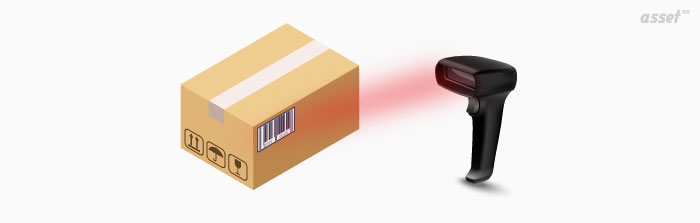
A barcode encodes the asset number as a pattern of bars that a scanner or phone camera reads. It was the first technology to make asset tracking reliable, and it is still the cheapest way to label everything you own.
- Pros: very low cost per label, read by any phone or scanner, simple to print and replace.
- Cons: needs line of sight and one scan per asset, labels can scuff or fade, and the register only updates when someone scans.
Barcodes suit offices, IT equipment, furniture and stores where people already handle each item. You can make one with our free barcode generator.
QR Code Asset Tracking
A QR code is a two-dimensional code that holds far more data than a linear barcode and stays readable when part of it is damaged, because it carries error correction. It was created in 1994 for tracking automotive parts. Every smartphone camera reads it, so anyone, including a contractor or a visitor reporting a fault, can scan it to open the asset’s record.
- Pros: read with any phone, tolerant of damage, can hold a link to the asset.
- Cons: the same line-of-sight and one-at-a-time limits as barcodes.
Try the QR code generator to see what a label looks like.
RFID Asset Tracking

RFID tags hold a chip and an antenna. A reader sends a radio signal, and every tag in range replies with its number, without line of sight. Passive UHF tags, the usual choice for assets, read from several meters away; active tags with batteries read much farther.
- Pros: reads many tags at once, records movement automatically at doorways, makes counts a walk through each room.
- Cons: tags and readers cost more, metal and liquids interfere unless you use on-metal tags, and readers need tuning so they do not hear the next room.
Our RFID asset tracking guide covers tags, frequencies and rollout in detail.
NFC Asset Tracking
NFC (near field communication) is a short-range form of high-frequency RFID that most smartphones can read. A technician taps the phone on the tag and the asset opens. The range is only a few centimeters, which is a feature when you want proof that someone stood at the asset, such as on an inspection round.
- Pros: read by phones without extra hardware, hard to copy, works when the label is dirty.
- Cons: one tag at a time at very short range, and tags cost more than printed labels.
NFC vs RFID: NFC is for a deliberate tap on one asset. UHF RFID is for reading many assets at a distance.
Bluetooth Low Energy (BLE) Asset Tracking

BLE tags are small battery beacons that broadcast continuously. Gateways on the ceiling, or phones, hear them and estimate which room they are in. That makes BLE the method for “where is the infusion pump right now?” inside a building.
- Pros: continuous indoor location, tags last a long time on a battery, phones can read them.
- Cons: batteries eventually need replacing, gateways need power and a network, and accuracy is to the room.
GPS Asset Tracking

A GPS tracker works out its position from satellites and sends it over a cellular network. It started with fleets and now covers excavators, generators, trailers and anything that moves between sites.
- Pros: location anywhere outdoors, trips and history, alerts when an asset leaves an area.
- Cons: each tracker needs power and a data plan, and GPS signals do not reach well indoors.
BLE vs GPS: BLE answers which room an asset is in; GPS answers where it is outdoors. A site with both indoor equipment and mobile plant usually needs both.
IoT Sensors
IoT sensors report condition rather than location: temperature in a freezer, vibration on a pump, hours on a compressor. They turn tracking into maintenance, because a reading past a limit can start a work order. They work best on top of one of the identification methods above, attached to the same asset record.
How to Choose the Right Asset Tracking Method
- List your asset types. Separate fixed equipment, portable items, IT devices, tools and vehicles.
- Write the question for each. “Who has it?”, “Is it still here?”, “Which room?” or “Where on the road?” each point to a different method.
- Price the effort, not only the tag. A cheap barcode that needs a person to scan it may cost more over a year than an RFID tag read at a doorway.
- Check the environment. Metal, liquids, heat, outdoor exposure and indoor signal all rule methods in or out.
- Keep one register. Every method should write to the same asset record, so maintenance, finance and IT see one history.
- Pilot one site. Prove the method on one building or one asset class before buying for all of them.
Asset Tracking Methods by Industry
Manufacturing
QR codes on machines for technicians, RFID at tool cribs and dock doors, and IoT sensors on critical pumps and motors.
Hospitals
BLE for mobile medical devices that move between wards, and QR labels for scanning at the bedside.
Construction and Fleets
GPS trackers on vehicles and plant, with barcodes or RFID on the smaller tools that travel with them.
Offices and Campuses
Barcodes or QR codes on laptops, furniture and AV equipment, with an RFID handheld for the annual count.
How Asset Infinity Supports Every Method
Asset Infinity keeps one register for all of these methods. Each asset can carry several identifiers at once: QR, barcode, NFC, RFID, BLE, a plate number and external IDs. In practice:
- Labels: the label designer prints QR, barcode and RFID labels as ZPL for thermal printers or as PDF, and can write the RFID tag as it prints. See asset tags.
- Scanning: the iOS and Android app reads QR codes and barcodes with the camera and works offline. Zebra, TSL and Chainway RFID handhelds pair with the Android app.
- RFID readers: fixed readers turn reads into arrivals and departures, with rules that move the asset or notify someone. See RFID asset tracking.
- BLE: gateways place tagged assets on scaled floor plans, with presets for HPE Aruba access points, Kontakt.io and Minew gateways.
- GPS: trackers report trips and feed odometer and engine hours into the asset’s meters. See GPS asset tracking.
- Counts: verification rounds record each asset as verified, moved, not found or damaged.
The asset tracking software page shows how these fit together.
Frequently Asked Questions
What is the most common asset tracking method?
Barcodes and QR codes, because labels are cheap and any phone can read them. Larger organizations add RFID, BLE or GPS for the assets where automatic updates are worth the cost.
Which asset tracking method is best?
There is no single best method. GPS is best outdoors, BLE for finding equipment inside a building, RFID for counts and doorways, and barcodes or QR codes for low-cost labeling of everything else.
What is the difference between barcode and RFID?
A barcode needs line of sight and is read one at a time. RFID reads many tags at once through materials, and fixed readers can record movement without anyone scanning.
Can I use more than one asset tracking method?
Yes, and most organizations do. The important part is that every method writes to the same asset register, so one asset has one history.
How does asset tracking work?
Each asset gets a unique number carried by a label, tag or tracker. Reading it, by scan, reader or satellite, updates the asset’s record with where it was and when.