






RFID vs NFC is a choice between reading many tags from a distance and reading one tag at a touch. Both use radio waves to read a small tag on an asset without a printed code being in view, and NFC is in fact a specialized kind of RFID. What separates them for asset tracking is range, how many tags a reader can see at once, and what you read them with: a dedicated RFID reader, or the phone already in your pocket.
The practical way to decide between RFID or NFC is to name the job: counting a storeroom, watching a doorway, or confirming that an inspector stood next to a fire extinguisher. This guide explains how each works, compares NFC vs RFID side by side, and shows where each one earns its place.
What Is the Difference Between RFID and NFC?
RFID (radio frequency identification) is a family of technologies that identify tags by radio, across low, high and ultra-high frequency bands, with read ranges from a few centimeters to several meters. NFC (near field communication) is a subset of high-frequency RFID at 13.56 MHz, designed for deliberate, one-at-a-time reads within a few centimeters, typically by a smartphone.
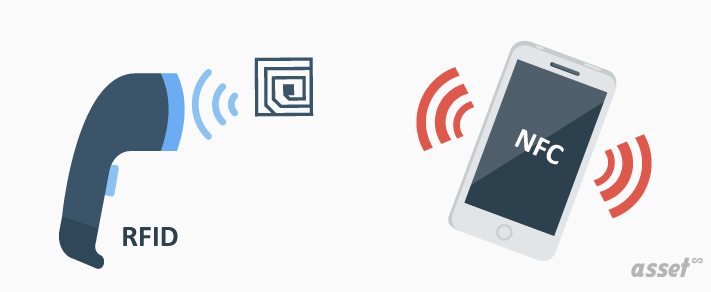
In practice, “RFID asset tracking” usually means passive UHF RFID: cheap tags read in bulk by handheld or fixed readers. “NFC asset tracking” usually means stickers or tokens that a phone taps to open an asset’s record.
RFID vs NFC at a Glance
| RFID (passive UHF, the usual choice for asset tracking) | NFC | |
|---|---|---|
| Frequency | 860 to 960 MHz (UHF); RFID also has LF and HF bands | 13.56 MHz (HF) |
| Typical read range | Several meters with a handheld or fixed reader | A few centimeters |
| Tags read at once | Many, in one sweep | One at a time |
| Reader | Dedicated handheld or fixed reader | Most smartphones, or a small NFC reader |
| Line of sight | Not needed | Not needed, but the phone must touch or nearly touch the tag |
| Best at | Counting rooms and racks; recording assets passing a doorway | Deliberate check-ins, inspections and identifying one item |
| Infrastructure | Readers, and antennas for fixed points | None beyond phones |
| Sensitivity | Signal is absorbed by liquids and reflected by metal, so tags for metal need on-metal designs | Short range makes it less affected by surroundings, though metal still needs suitable tags |
How RFID Asset Tracking Works
An RFID system has three parts: a tag on the asset, an antenna, and a reader that powers the tag and decodes its reply. Passive tags have no battery. The reader’s signal powers them, which keeps them small and inexpensive. Active tags carry a battery and broadcast, which gives longer range at higher cost.
Teams use RFID in two ways:
- Handheld readers for counts. An auditor walks a room and the reader picks up every tag in range, so a count of a rack of servers or a shelf of tools takes a walk rather than a scan per item.
- Fixed readers at chokepoints. Antennas at dock doors, tool cribs and yard gates record each tagged asset passing, so the record shows when an asset arrived and when it left.
For tag types and range in more depth, see active vs passive RFID and types of RFID tags.
How NFC Asset Tracking Works
An NFC tag is a small chip and antenna, often in a sticker, card or hard token. A phone held within a few centimeters powers the tag and reads its identifier, and an app looks up the asset that identifier belongs to.
The short range is the point. Because the phone has to be right next to the tag, an NFC read is good evidence that a person was at that asset at that moment. That suits:
- Inspections and rounds, where a tap proves the inspector reached each extinguisher, valve or panel.
- Check-in and check-out, where a tap identifies one item at a counter without picking up its neighbors.
- Assets where a printed label wears off, since a tag can sit under a protective cover.
The NFC for asset tracking guide covers NFC use cases in more detail.
RFID or NFC: Which Should You Choose?
Start from the job you need done.
| If you need to | Choose | Why |
|---|---|---|
| Count hundreds of assets in a room quickly | RFID | Reads many tags in one sweep without line of sight |
| Know when assets pass a doorway or gate | RFID (fixed readers) | Records movement without anyone scanning |
| Prove an inspector visited each asset | NFC | A read happens only within a few centimeters |
| Identify one item among many on a counter | NFC | It will not read the item next to it |
| Track with phones only, no new hardware | NFC, or QR codes | Most phones read NFC; every phone camera reads QR |
| Find which room an asset is in | Neither; use BLE | BLE gateways locate tags continuously indoors |
Many organizations combine them. A label can carry a QR code for anyone with a phone and an RFID inlay for fast counts, and NFC tokens can sit at inspection points.
Example: a hospital
Biomedical engineering puts RFID labels on infusion pumps and monitors so a handheld count of a ward takes minutes. NFC tokens on fire doors and extinguishers let the safety team prove each was checked on its round.
Example: a manufacturing plant
A fixed RFID reader on the tool crib doorway records gauges going out and coming back. Operators tap NFC tags at machines to start their pre-shift checklist on the right asset.
Example: an IT department
IT tags laptops and servers with labels that carry a barcode and an RFID inlay. The yearly count is a walk with a handheld, while the help desk scans the barcode when a laptop comes in for repair.
Where QR Codes and BLE Fit
RFID and NFC are not the only options. QR codes and barcodes cost almost nothing, and any phone camera reads them, so they suit most assets that people walk up to. BLE tags carry batteries and are heard continuously by gateways, so they can place an asset on a floor plan. The RFID vs BLE comparison covers that trade-off.
How Asset Infinity Handles RFID and NFC Tags
Asset Infinity records QR, barcode, NFC, RFID, BLE, plate and external IDs as identifiers on an asset, so one asset can carry several kinds of tag and any of them leads back to the same record.
- RFID labels printed and encoded together. The label designer writes the asset’s number to the RFID tag as the label prints, by default the same number as the barcode, so a reader and a person report the same thing. See asset tags.
- Handheld RFID readers. Zebra, TSL and Chainway handhelds pair with the Android app to scan tags, write an asset’s number onto a blank tag, and follow a rising beep to a missing item.
- Fixed readers at doorways. Readers connect over MQTT or HTTPS, each antenna points at a named place, and reads become visits with an arrival and a departure. See RFID asset tracking.
- Counts that use any tag. Verification rounds are walked with the mobile app, and a connected reader works in every scan box, including counts in asset inventory software.
Frequently Asked Questions
Is NFC the same as RFID?
NFC is a type of RFID. It uses the 13.56 MHz high-frequency band and is designed for reads within a few centimeters, while RFID as a whole covers several bands and much longer ranges.
Which is better for asset tracking, RFID or NFC?
RFID is better for counting many assets quickly and for recording movement through doorways. NFC is better for deliberate one-item reads with a phone, such as inspections and check-ins.
Can a phone read RFID tags?
Most smartphones can read NFC tags, which are a kind of HF RFID. They cannot read UHF RFID tags, which need a dedicated handheld or fixed reader.
Is NFC faster than RFID?
For a single tag, both read almost instantly. For many tags, RFID is much faster, because a UHF reader can read a whole room of tags in one sweep while NFC reads one tag at a time.
Can one asset carry both an RFID tag and an NFC tag?
Yes. Many teams put an RFID inlay and a QR code on the same label, and add an NFC tag where a tap-based check-in or inspection is needed.