






Finding the right solution for asset tracking can be daunting. There are many technologies available for tracking assets.
Common Asset Tracking Technologies
Most of the debate centers on the following asset tracking techniques:
- Barcode
- QR Code
- Radio Frequency Identification (RFID)
- Near Field Communication (NFC)
- Global Positioning System (GPS)
- Bluetooth Low Energy (BLE)
- Internet of Things (IoT)
RFID and Bluetooth Low Energy (BLE) stand out from the other methods because of their features. Here we compare RFID and BLE for asset tracking, along with their benefits.
Origin of RFID
An early forerunner of RFID was created in the 1940s by the Russian physicist Leon Theremin. RFID combines radar and radio broadcast technology.
From the medical industry to fashion, from tracking children to creating bills, all kinds of activities rely on RFID technology. It is no wonder RFID has succeeded across industries and taken the business world by storm.
Functionalities or specifications of RFID
- Reads multiple tags at a time
- RFID tags can be combined with sensors and GPS technology
- It uses three frequency ranges:
- Low frequency (LF), 125 to 134 kHz, with a very short read range
- High frequency (HF), 13.56 MHz, with a short read range
- Ultra-high frequency (UHF), 860 to 960 MHz, with the longest read range
- Connects almost instantly
- RFID readers have a long read range, so tags can be read quickly in batches
Origin of BLE
Compared with RFID, Bluetooth Low Energy (BLE) is very new. It was introduced with Bluetooth version 4.0 and was marketed for a time as Bluetooth Smart.
Being newer, it was designed around the needs of industry users and comes with all the necessary functions.
Functionalities or specifications of Bluetooth Low Energy (BLE)
- Low-power wireless technology
- Designed for short-range communication
- Lets devices communicate with each other
- Ideal where battery life matters more than high data transfer speed
- Almost all smartphones and tablets are BLE compatible
- Used for sensor data, device control and low-bandwidth applications
What is RFID?
RFID is a technology that captures and reads digital data encoded in RFID tags (smart labels) using radio waves.
In RFID, a reader device captures the data from a tag and transfers it to a database.
Following are three components of RFID:
-
RFID reader: The RFID reader is the brain of the RFID system, and the system needs it to perform any function. The reader transmits and receives radio waves to exchange information with RFID tags.
-
Antenna: An RFID antenna converts the reader’s signal into radio waves sent to RFID tags. Antennas receive their power directly from the reader. Whether integrated or standalone, without an antenna the reader cannot send and receive signals to and from RFID tags.
-
Transponders (RFID Tags): Transponders make RFID easy to use and accurate. In its simplest form, an RFID tag transmits and receives signals and stores the tag’s ID with other information.
Passive RFID tags have no battery. Instead, they draw energy from the radio waves generated by the RFID reader.
There are three types of RFID tags:
- Active: An active RFID tag has its own power source and a long broadcast range. It is ideal for locating materials.
- Passive: A passive RFID tag has no power source and is powered by the reader. Its read range runs from near contact to several meters.
- Semi-passive: A semi-passive RFID tag has a battery but does not transmit active signals. These tags monitor things like climate conditions and security breaches in containers.
What is BLE?
Bluetooth Low Energy (BLE), also known as Bluetooth Smart, is a wireless personal area network technology designed to use less power and cost less than Classic Bluetooth while keeping a similar communication range.
BLE makes devices smarter while keeping them compact, affordable and simple.
BLE exchanges small amounts of data at regular intervals. With BLE beacons (or tags) and receivers (or smartphones), you can track and monitor your assets outdoors as well as indoors.
BLE also saves energy and can run for a long time.
Also Read: RFID vs Barcodes: Which One is Better for Asset Tracking?
What is RFID Asset Tracking?
With an RFID reader connected to a computer system, you can scan more than one asset without seeing them.
RFID readers can get accurate scans from a distance.
With this technology, a person can get dozens of scans in a few seconds.
An RFID tag can store maintenance information and sensor data that a field technician can read and write.
Multiple advantages of RFID asset tracking system are:
- RFID collects data automatically, reducing human effort and error
- It does not need line of sight to read data
- It increases efficiency because it reads multiple tags at the same time
- RFID can read data from a distance
- Tags can be password-protected and data secured, which provides good security
- RFID tags are reusable because they are covered in plastic
What is BLE Asset Tracking?
BLE asset tracking is designed to give organizations a sound way to track and manage their assets.
Asset tracking with BLE uses Bluetooth gateways and Bluetooth tags, which can report location and detect nearby Bluetooth signals.
BLE beacons and tags are attached to high-value assets. BLE asset tracking is an affordable solution for assets of high or low value.
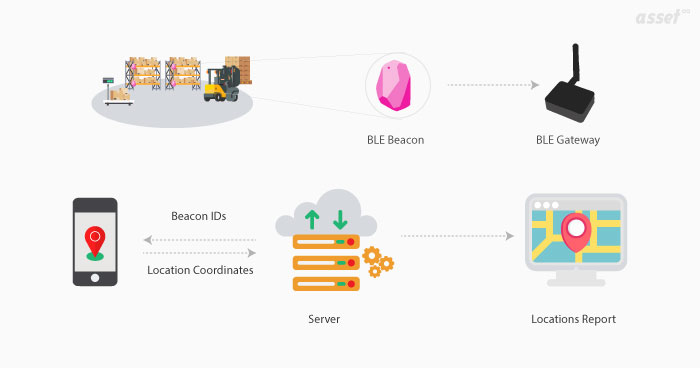
Characteristics of BLE asset tracking are:
- Cost-Effective
- High Coverage Range
- Versatile Tags
- High Broadcast Capacity
- Low Power Consumption
- Fast Data Transfer
Also Read: RFID Technology Benefits & Drawbacks: Active, Semi-Passive & Passive
Comparison of RFID and BLE Technique for Asset Tracking Solution
RFID Technique for Asset Tracking
RFID asset tracking works with tags: a tag is attached to an item, and radio waves track the tag.
The RFID technique has three parts: the reader, the antenna and the transponder (tag).
The antenna sends a radio-frequency signal that provides a way to communicate with the RFID tag. When the RFID tag passes through the field of the scanning antenna, it detects the activation signal and sends its data to be picked up by the antenna.
Advantages:
- Reads multiple tags at a time
- Tags can be combined with sensors and GPS technology
- Better asset security through alerts and alarms
- Less time spent on inventory information
- Important service information can be stored on the asset itself
- RFID collects data automatically, reducing human effort and error
- Does not need line of sight to read data
- RFID can read data from a distance
- Tags can be password-protected and data secured, which provides good security
- RFID tags are reusable because they are covered in plastic
BLE Technique for Asset Tracking
BLE exchanges small amounts of data at regular intervals. With BLE beacons, tags, receivers or mobile devices, you can track and monitor assets outdoors as well as indoors.
BLE is less expensive than RFID. It saves energy and can run for a long time. BLE is a separate technology from Classic Bluetooth, focused more on the Internet of Things (IoT).
Advantages:
- Easy to implement
- No cost of wiring and installation
- Scan with smartphones
- Cost-effective
- Reads assets quickly
- No individual scanning of assets required
- Real-time tracking
- Tracks both users and assets without additional hardware
- Minimal battery drain
Choosing Between RFID and Bluetooth
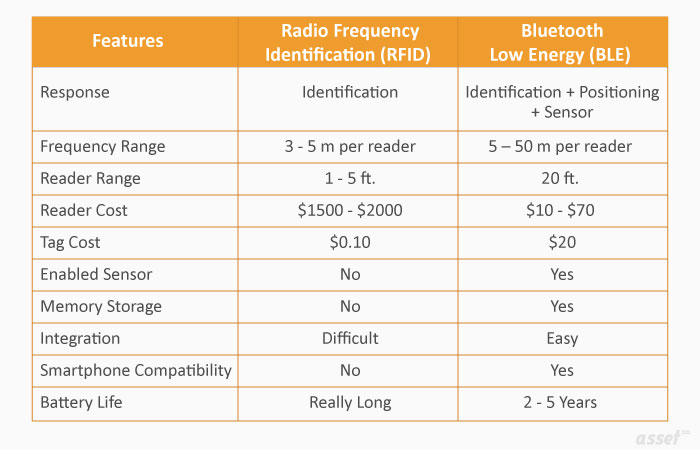
RFID needs several hardware components, such as tags, readers, antennas and application software. BLE needs fewer hardware components, which makes it easier for managers and teams to keep the system in check.
They also differ in their frequency ranges and cost. BLE may be less widely used, but it delivers a great user experience for asset tracking. Whichever you choose, Asset Infinity supports both RFID asset tracking and BLE tags.