






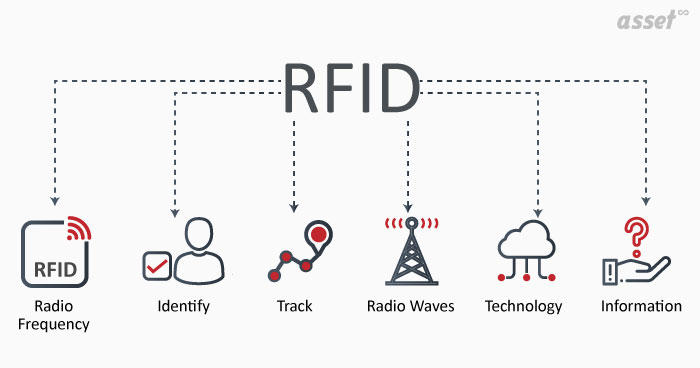
RFID technology has been around for a long time, and it has proven very successful for asset tracking. But what exactly is RFID? RFID is a technology in which digital data encoded in RFID tags (smart labels) is captured and read through radio waves.
What Are the Components of RFID Technology?
RFID technology has 3 main components: the reader, the antenna and the transponder (also known as a tag). Let us look at each one.
1. Reader
RFID readers fall into two categories:
Mobile RFID - A mobile device interacts with RFID tags to get their information. Mobile devices with built-in micro RFID readers can read RFID tags wherever they go.
Fixed RFID - As the name suggests, fixed readers are mounted at a stationary point, such as a tollbooth or the entry and exit points of a mall.
2. Antenna
An RFID antenna consists of a coil with at least one winding and a matching network. It radiates the electromagnetic waves generated by the reader and picks up the radio signals from the transponder. An RFID system can be designed so that the electromagnetic field is generated continuously or only when a sensor triggers it.
3. Transponders
Transponders make RFID technology easy to use and accurate. They are inexpensive to make, and they can be made small enough to fit on almost any item.
There are four types of RFID tags: active, semi-active, semi-passive and passive. Active and semi-active transponders run on batteries.
Battery-powered tags can be read from much farther away, so they are mostly used on costly items. Passive tags have no power source and a shorter read range, and they are economical compared to other tags.
What Are the Types of RFID Tags?
The three types of RFID tag compared in this post are:
Active tag - An active RFID tag has its own power source and the longest broadcast range. It is ideal for locating materials.
Passive tag - A passive RFID tag has no power source and is powered by the reader. Its read range runs from near contact to several meters, depending on the frequency.
Semi-passive tag - A semi-passive tag has a battery but communicates with the reader using backscatter, like a passive tag. That gives it a longer read range than ordinary passive tags.
What Is Active RFID Technology?
Active RFID uses battery-powered tags that broadcast their own signal continuously. Active RFID tags are commonly used to track the location of assets precisely as they move.
They work well for assets on the move and in high-speed settings such as tolling. Active tags have a longer read range than passive tags, but they also cost more.
What Are the Benefits of Active RFID Technology?
Some of the most common benefits of active RFID:
Longer reading distance - Active tags have the longest range of any RFID tag, well beyond that of semi-passive tags.
Real-time tracking - Active tags are popular because they report asset information as it happens.
Low-power readers - Because the active tag powers its own transmission, it does not depend on the reader for energy.
What Are the Drawbacks of Active RFID Technology?
Some of the most common drawbacks of active RFID:
Expensive - Active tags cost far more per tag than passive tags.
Limited life - The tag works only as long as its battery does. When the battery runs out, the tag stops working.
Size - Active tags are bulky, because the battery takes up a lot of space. If you are tagging books, for example, active tags will not fit.
Also Read: Which Industries are using RFID for Asset Tracking?
What Is Semi-Passive RFID Technology?
Semi-passive RFID works much like a passive tag: the reader’s signal triggers a response from the tag. The difference from an active tag is that its battery is not used to generate a response. The battery usually powers a sensor and runs the circuitry on the chip.
The sensor reading is included in the tag’s return signal along with its serial number. Semi-passive tags share some of the disadvantages of passive tags, such as slower read speeds and shorter read distances than active tags, and they cost more than passive tags.
What Are the Benefits of Semi-Passive RFID Technology?
Some of the most common benefits of semi-passive RFID:
Low noise - The tag does not broadcast a signal of its own, so it adds little radio noise.
Cost - Semi-passive tags are much cheaper than active tags, though they cost more than passive tags.
Medium range - Semi-passive tags can be read from farther away than passive tags.
What Are the Drawbacks of Semi-Passive RFID Technology?
Some of the most common drawbacks of semi-passive RFID:
Limited life - The battery limits the life of the tag.
Size - The tag is larger than a passive tag because of the battery.
What Is Passive RFID Technology?
Passive RFID tags have no internal power source, so they use the electromagnetic energy transmitted by an RFID reader. Passive RFID tags are used for applications such as file tracking, supply chain management and access control.
Because passive tags are inexpensive, they suit many industries, and they are the most widely used type.
What Are the Benefits of Passive RFID Technology?
Some of the most common benefits of passive RFID:
Economical - Passive RFID is the most economical of all RFID tag types.
Smaller - Passive tags are small and light, and they stick easily onto any equipment or asset.
Long life - With no battery to run down, passive tags can work for many years in the right environment.
Low noise - Like semi-passive tags, passive tags do not broadcast a signal of their own, so they add little radio noise.
What Are the Drawbacks of Passive RFID Technology?
Some of the most common drawbacks of passive RFID:
Short range - Because they rely on energy from the reader, passive tags have the shortest read range of the three types.
Reader required - Passive tags need a reader with enough power to switch them on.
Also Read: Barcode vs QR Code vs RFID vs NFC vs BLE vs GPS: Which One Is Better?
Choosing the Right RFID Tag for Your Assets
Active, passive and semi-passive RFID technologies each have their own benefits and drawbacks. With the knowledge above, you can put RFID technology to work on your own project.
The options can feel overwhelming, so it is important to work out which technology fits your project best.