






RFID is a modern tagging technology that lets you keep track of items and products in any industry.
New inventions and discoveries appear all the time, and RFID technology is one of them, built on digital and engineering advances.
Look closely at RFID technology and you find it used in almost every sector and industry to increase productivity and efficiency.
Components of RFID
RFID is a technology in which digital data encoded in RFID tags (smart labels) is captured and read through radio waves.
An RFID system has three components:
1. RFID Reader
The RFID reader is the brain of the RFID system, and the system cannot work without it. The reader transmits and receives radio waves to exchange information with RFID tags.
There are two types of readers:
- Mobile RFID - Mobile readers are handheld devices that read RFID tags wherever you take them and pass the data to a host computer or device.
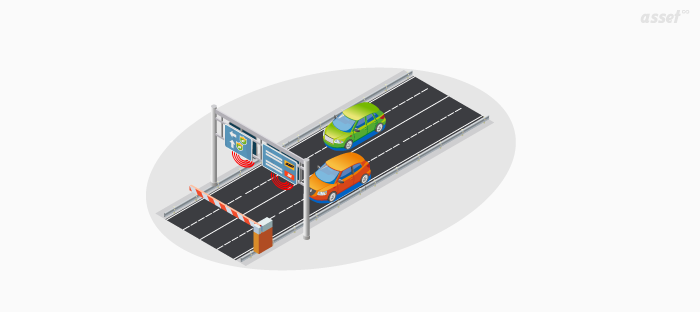
- Fixed RFID - As the name suggests, fixed readers are mounted at a stationary point, such as a tollbooth or the entry and exit points of a mall.
2. Antenna
An RFID antenna converts the RFID reader signal into radio waves that reach the RFID tags. Antennas get their power directly from the reader.
Without an antenna, whether built in or separate, the reader cannot send signals to RFID tags or receive them properly.
Also Read: How RFID transformed asset tracking in oil and gas industry?
3. Transponders (RFID Tags)
Transponders make RFID technology easy to use and accurate. In its simplest form, an RFID tag has two parts:
- Antenna - for transmitting and receiving signals
- RFID chip - for storing the tag’s ID and other information
Passive RFID tags have no battery. They draw their energy from the radio waves generated by the RFID reader.
RFID works in three frequency ranges:
- Low frequency (LF) - 125-134 kHz; range of a few centimeters
- High frequency (HF) - 13.56 MHz; range of up to about a foot
- Ultra-high frequency (UHF) - 860-960 MHz; the longest range, measured in meters
There are three types of RFID tags:
- Active - An active RFID tag has its own power source and the longest broadcast range. It is ideal for locating materials.
- Passive - A passive RFID tag has no power source and is powered by the reader. Its read range runs from near contact to several meters, depending on the frequency.
- Semi-passive - A semi-passive RFID tag has a battery but does not transmit signals of its own. These tags monitor things like climate and security breaches in a container.
Note:
According to data from the NHTSA (National Highway Traffic Safety Administration), U.S. Department of Transportation:
1. Reported Crashes by Crash Severity (2006-2015)
| Year | Fatal | Injury | Property Damage | Total |
|---|---|---|---|---|
| 2006 | 38,648 | 1,746,000 | 4,189,000 | 5,973,000 |
| 2015 | 32,166 | 1,715,000 | 4,548,000 | 6,296,000 |
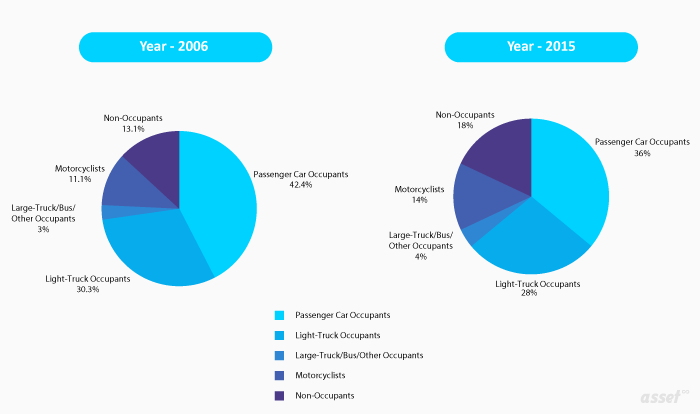
2. Fatalities by Person Type (2006-2015)
| Type | 2006 | 2015 |
|---|---|---|
| Passenger car occupants | 42% | 36% |
| Light-truck occupants | 30% | 28% |
| Large-truck/bus/other occupants | 3% | 4% |
| Motorcyclists | 11% | 14% |
| Non-occupants | 13% | 18% |
3. Types of Crashes Based on Driver Behavior
The same 2015 data shows two main driver behaviors behind recorded crashes:
- Alcohol-impaired driving - 10,265
- Speeding - 9,557
How Is RFID Technology Used as an RFID System on Roads?
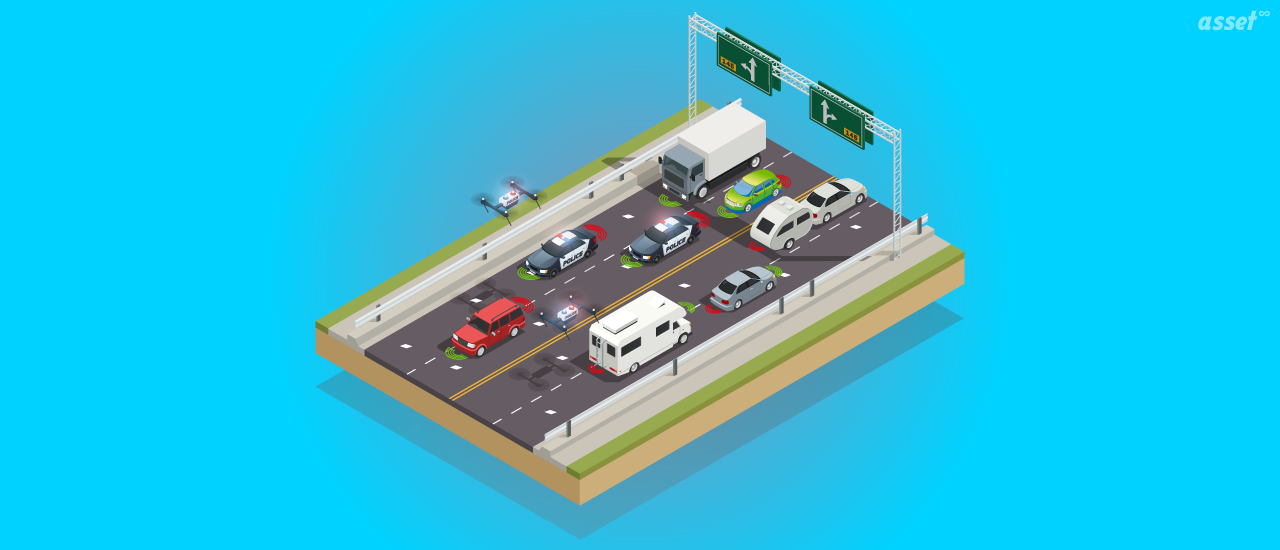
An RFID system on roads uses RFID tags installed in the road and RFID readers installed in vehicles. It is likely to be an essential part of future transportation systems.
An RFID system on roads offers features that did not exist before, such as:
- Lane-level position
- Road traffic control information
- Vehicle distance estimation
- Real-time driving behavior analysis
Also Read: 7 Major Sectors Using RFID Technology for Asset Management
Applications of RFID Systems on Roads
Almost all applications of RFID systems on roads are designed around the road crashes observed in previous years.
1. Navigation System
RFID tags are fixed on the road surface and know their own location. A vehicle works out its position by reading the position of a tag as it passes over it.
The RFID tag gives the driver a wealth of information, such as:
- Traffic direction
- Speed limit
- Lane regulation, lane number, lane destination, lane condition and other details about that lane
- Event notifications
Drivers get live, lane-level navigation that ordinary GPS could not provide, because GPS position accuracy is too low to tell lanes apart.
2. Electrical Traffic Control System
According to the report mentioned above, failures of traffic control were also a major cause of road crashes. Traffic control contributed to crashes for these reasons:
- Failed traffic lights
- No line of sight
- Misleading traffic signs
To overcome this, an electrical traffic control system provides accurate, near real-time traffic control data. Its central database has two parts:
- Dynamic database - It temporarily stores records of vehicles currently crossing the RFID tags.
- Permanent database - It stores the records of all vehicles that have crossed the RFID tags.
Advantages of an Intelligent Traffic Control System
- Traffic signals operate according to the current volume of traffic, which the system calculates.
- Vehicles can be given priorities, such as: - Unrestricted passage - ambulances, fire trucks and VIP vehicles - Higher priority during office and school hours - scooters and cars - Higher priority at night - heavy vehicles
- Electronic tolling of vehicles
- Stolen vehicles can be tracked from the recorded time and direction of travel
- Traffic data can be generated for statistical purposes
3. Unmanned Patrol System
Many careless drivers commit violations that happen often but are never recorded, because no patrol is there to see them. Ideally, patrols would cover every site and detect every violation.
Traffic cameras and patrol systems could not deliver that level of surveillance. Unmanned patrol systems strengthen the enforcement of traffic regulations by monitoring around the clock.
In an unmanned patrol system, the RFID reader sends the collected information to the On-Board Patrol (OBP) device. Authorities such as police officers monitor the OBP, which judges from the information it receives whether the driver has broken any rules.
Violations the OBP can detect:
- Speeding
- Turning violations
- Failing to stop
- Passing violations
4. Unmanned Ground Vehicles
The unmanned ground vehicle is an idea people have dreamed about for years. Many governments, universities, technology companies and automakers have worked on driverless vehicles.
Here is why an RFID system on roads is an excellent way to support driverless vehicles:
- An RFID system on roads costs less than other ways of providing the same positioning.
- Tag programming is flexible.
- It scales well and is easy to deploy and redeploy.
- It supports other systems, such as navigation, traffic signs, parking, access control and distance estimation.
5. Vehicle Distance Estimation
Vehicles need to keep a safe distance from each other on the road. This important factor in safe driving often goes unnoticed.
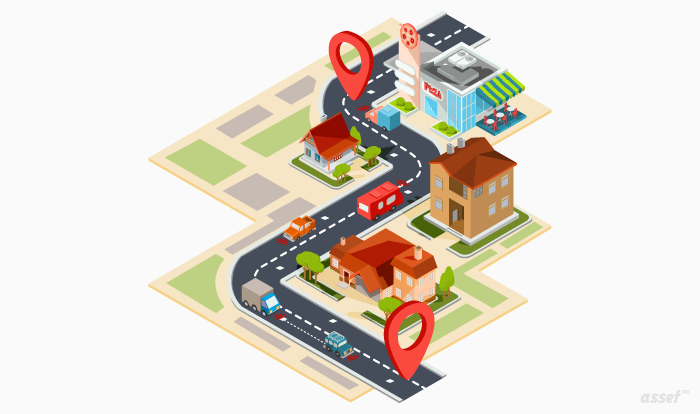
Drivers need to know the live distance to other vehicles on the road, so they can keep a safe distance and act in time when needed.
People usually estimate the distance to another vehicle by sight and experience, so their estimate suffers when visibility is poor.
Vehicle distance estimation depends on time synchronization between vehicles and fast RFID read and write operations.
Why RFID Suits the Road Network
RFID (Radio Frequency Identification) technology uses radio waves to read and capture data stored on a tag. RFID tags can be attached to almost any object, such as clothes, electronic gadgets, everyday items, inventory and fleet vehicles. Reading tags across a large fleet can still be a challenge.
The most attractive feature of RFID technology is that a tag does not need a direct line of sight to the reader to be detected.