







Many organizations pay little attention to their assets and equipment, who is using them and where they are. These are important questions, but they are often ignored, and as a result assets go missing and cannot be found when they are needed. Employees waste time looking for the assets and equipment they need, and production work is delayed. Overall, both revenue and profit suffer. To avoid this, industrial asset monitoring and asset tracking are essential.
What Are Asset Tracking and Asset Monitoring?
Asset monitoring is also known as asset tracking. Asset monitoring keeps track of the location and status of every asset the organization owns.
You can see crucial information such as an asset’s name and type, when it was last maintained, its maintenance schedule and so on.
For effective asset tracking, organizations use asset tracking software, because it records where each asset is. With GPS trackers, the software can also alert you when a tracked asset leaves a site.
When you hold a lot of inventory, this software shows where items are within large warehouses, which helps employees find them quickly and saves their time.
Assets that are costly and vital to an organization must be monitored often, and asset monitoring makes that possible. In the construction industry, for example, assets move from one place to another frequently. This software makes them easy to keep track of.
The software also shows who is using each asset and how often it is used. This information is extremely useful for making informed decisions.
Recommended Reading: How Does Asset Optimization Help Small Business?
This software also helps prevent asset theft and misplacement, which is a large problem in every industry. It also helps you find and remove ghost assets.
Ghost assets are assets listed in the accounting books that are not physically available. Ghost assets appear when assets are stolen or misplaced. Asset theft is a serious problem in every industry.
You can avoid it with asset monitoring and tracking software.
What Are the Best Practices of Asset Monitoring?
The best practices of asset monitoring are discussed below:
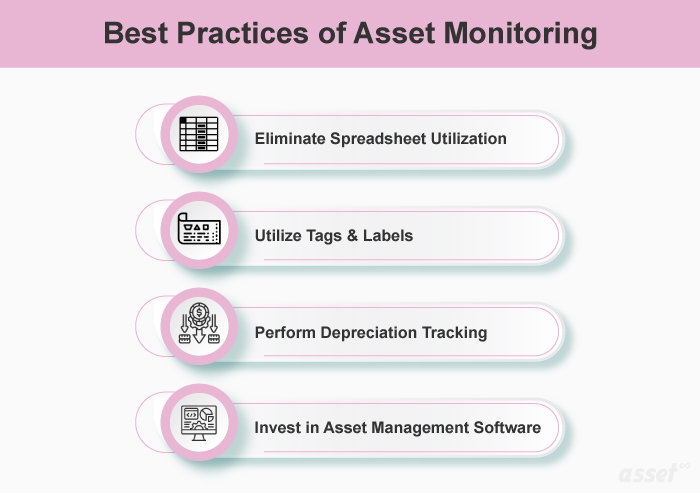
1. Stop Relying on Spreadsheets
Many organizations use spreadsheets for asset tracking and monitoring. Spreadsheets are not effective, because they are not accurate. For example, the inventory recorded in the spreadsheet does not match the actual inventory.
Similarly, the asset location in the spreadsheet does not match where the asset really is. The reason is that many people access spreadsheets and change the data without meaning to.
That is why you should not rely on spreadsheets for asset monitoring. Otherwise, your business will lose money.
Missed It? What Is Asset Management Compliance? - A Detailed Guide
2. Use Tags and Labels
One of the most important asset monitoring practices is to use asset tags. Asset tags help with asset tracking, monitoring and capturing crucial information. With this data, organizations can make informed, strategic business decisions.
You can record information such as asset name, model number, purchase date, purchase cost, depreciation, expected life, owner, condition, last maintenance date, next maintenance date, location and so on.
3. Perform Depreciation Tracking
Asset monitoring can also be used for depreciation tracking. Many organizations do not pay attention to depreciation tracking, yet it helps with tax planning.
When you track depreciation, you can make strategic, data-driven decisions that are more accurate and effective than decisions based on assumptions.
4. Invest in Asset Management Software
Asset management software solves several problems at once. It helps with asset tracking, helps maintain assets and improves the productivity of the organization and its employees.
With this software, employees can see exactly where an asset is located.
Where Asset Monitoring Pays Off Most
Asset monitoring is useful for asset-intensive organizations. If you need to keep track of shipments, industrial asset monitoring and tracking can be used for that too, since it helps you tell other organizations where a shipment is.
Asset tracking improves efficiency and saves an organization unnecessary expenses by protecting assets from theft and misplacement.
Also Read: A Complete Overview of Asset Labeling in the Asset Tracking Software
Frequently Asked Questions (FAQs)
Q.1 - What Are the Benefits of Asset Tracking?
Below, we have listed the benefits of asset tracking:
1. Reducing asset theft and misplacement
2. Improving business efficiency
3. Getting asset insights and making informed decisions
4. Removing ghost assets
5. Extending asset lifespan
Q.2 - What Asset Tracking Techniques Are Available?
Several asset tracking methods are available, such as barcodes, QR (Quick Response) codes, IoT (Internet of Things), RFID (Radio-Frequency Identification), GPS (Global Positioning System), NFC (Near Field Communication) and BLE (Bluetooth Low Energy). All of these help you record where each asset is and what is happening to it.
Q.3 - How Is Asset Tracking Done?
Asset tracking techniques come in the form of labels and tags. These labels or tags are attached to the asset, and each tag has a unique identification number that is stored in the asset software system. You get the best results when they are used with asset management software. Whenever the tag number is scanned, it fetches all the information related to that asset. Asset tracking gives you a lot of vital information that you can use for maintenance or for extending asset life.