







Strategic asset management is important for organizations, especially those that want to stay ahead of the curve. This post explains what strategic asset management is and what its benefits are.
What Is Strategic Asset Management?
Strategic asset management is a long-term approach to maintenance and operations built around a long-term plan. The plan might cover the next 5, 10 or 15 years. It sets out the company’s objectives, where it wants to be and what the role of asset management will be over those years.
Strategic asset management helps you set future goals. It shows you where you are now and where you want to be in 5 to 10 years.
To make strategic asset management work efficiently, asset management software suited to your needs is essential.
Also Read: Asset Management Strategies That Can Help Your Business
Effective software gives your team data-driven systems, scenario modeling and reporting tools that turn information into plans and objectives into results.
Effective asset management software uses your data to give you useful insight quickly. It helps you forecast the condition of your whole asset portfolio into the future and build live reports that tell the story behind the data to your stakeholders.
What Are the Benefits of Strategic Asset Management?
The benefits of strategic asset management are as follows:
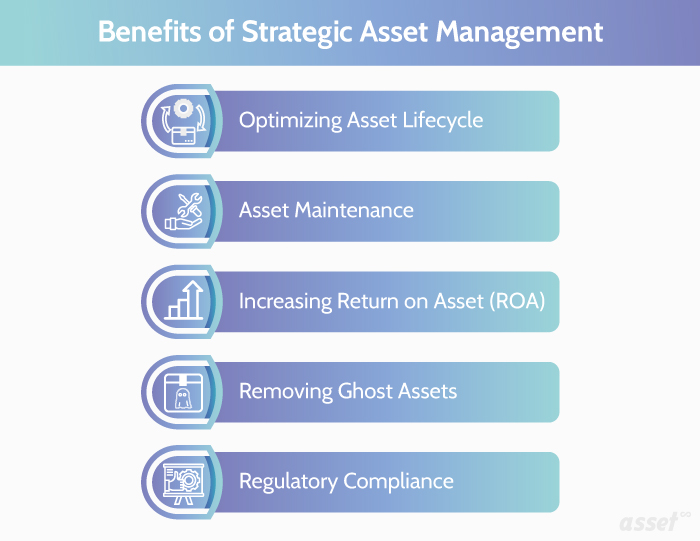
1. Optimizing the Asset Lifecycle
Many assets are not used to their full potential because they are not managed properly, and asset life suffers. With strategic asset management software, managers can manage assets and equipment efficiently and extend asset life.
With automated software, you know when each asset was purchased and how much productive life it has left, and you are alerted when it nears the end of its life. Maintenance, operations and finance all play crucial roles in extending asset life.
2. Asset Maintenance
Maintenance is very important when you plan for long-term goals. In strategic asset management, maintenance is one of the main areas of focus. It reduces overall downtime and increases uptime.
Most importantly, maintenance makes assets more reliable, and it also lowers maintenance costs over time.
To build an effective maintenance plan, your organization and managers must focus on proactive maintenance. Proactive maintenance is a critical part of strategic asset management success. Many businesses still spend most of their maintenance time reacting to problems instead of preventing them.
3. Increasing Return on Assets (ROA)
When planning for the long term, you want assets that need less maintenance and are more productive, so that the return on each asset increases. That requires keeping asset performance high by maintaining assets on time.
Automated software provides several indicators that help improve asset performance. To raise ROA, strategic asset management looks at each asset’s current condition, how long the equipment is needed for its purpose and asset optimization, which means maintaining assets properly and on time.
Also Read: Types of Assets Managed by Enterprise Asset Management in Different Industries
4. Removing Ghost Assets
Ghost assets can hurt your business in several ways. Ghost assets are assets listed in the accounting books that are not physically available. You are paying taxes on assets you are not using, and they create compliance issues as well.
If an audit finds that your records do not match your physical assets, the audit team will raise questions, and you may face penalties.
Strategic asset management software helps make sure ghost assets do not build up in the organization, and when they are found, it helps remove them from the accounting records correctly.
5. Regulatory Compliance
Compliance means following the rules, regulations and policies of your industry. If an organization breaks those rules or violates industry policies, legal action can be taken against it.
Compliance falls into two categories: internal and external. Rules made by the organization itself are internal compliance. Rules made by government authorities, which every organization in the industry must follow, are external compliance.
Strategic asset management software helps organizations follow both their own rules and those set by government authorities, by keeping the records, inspections and audits that show they comply.
In the long term, this is one of the essential goals of any organization, so that all transactions are clean and investors are confident investing in it.
Also Read: Boosting RoA & Efficiency for QSR Clients with Asset Infinity
Turning Strategic Asset Management Into Results
Choosing the right technology is only one step toward effective asset management. Strategic asset management needs detailed planning. It aims to improve daily operations, save time and keep maintenance on schedule, and it needs a commitment to realizing the value of good asset management.
Overall, strategic asset management aims to improve bottom-line performance by cutting unnecessary expenses, saving money, improving asset performance and making better decisions based on solid information instead of assumptions. None of this is possible without effective asset management software. If you want to grow your business, this software is essential.
Frequently Asked Questions (FAQs)
1. In which areas does asset management help?
Asset management helps with: 1. Regulatory compliance 2. Reducing risk from assets and equipment 3. Inventory management 4. Maintaining asset records 5. Tracking and managing assets 6. Complete asset visibility and control
2. What are the basic required fields for managing assets?
1. Asset ID number (UIN) 2. Asset manufacturer 3. Date of manufacture 4. Asset model number 5. Asset serial number 6. Location of asset 7. Acquisition date 8. Acquisition cost 9. Useful asset life 10. Depreciation value 11. Salvage value These are some essential requirements for managing assets.
3. How do asset tags help with asset tracking?
Asset tags are attached to assets and equipment, and each tag has a unique identification number. These tags usually carry a barcode, QR (Quick Response) code or RFID (Radio-Frequency Identification). When the tag is scanned, it pulls up all the important information, such as maintenance details. This helps organizations manage their assets better.