






Many organizations still rely on reactive maintenance, which is not an effective strategy. In a reactive strategy, assets are used until they break, and only then are they fixed. Is your organization doing the same?
If so, you should focus on asset performance management. Enterprise asset performance management can help organizations save money on maintenance and increase the performance and life of each asset.
What Is Asset Performance Management?
Gartner defines it this way: “Asset performance management (APM) encompasses the capabilities of data capture, integration, visualization and analytics tied together for the explicit purpose of improving the reliability and availability of physical assets. APM includes the concepts of condition monitoring, predictive forecasting, and reliability-centered maintenance (RCM).”
In simple words, asset performance management improves the performance of each asset. It makes the asset more reliable and reduces the risk of failure.
It focuses mainly on asset maintenance, and it also helps with reporting and data analysis. Overall, it gives a complete view of asset health, performance and quality.
As organizations pursue operational excellence, asset performance management (APM) plays a central part in meeting business objectives. It makes sure assets deliver value at the lowest cost while operating safely and with care for the environment.
From predictive and prescriptive analytics to asset reliability, process safety and integrity management programs, APM brings operations, engineering and maintenance together so the business can make decisions in a structured way.
What Are the Benefits of Asset Performance Management?
The benefits of asset performance management show up in many industries, from oil and gas to food and beverage manufacturing. Preventing equipment failure avoids costly repairs and lost production, teams spend less time looking for assets and equipment, and maintenance work is planned instead of rushed.
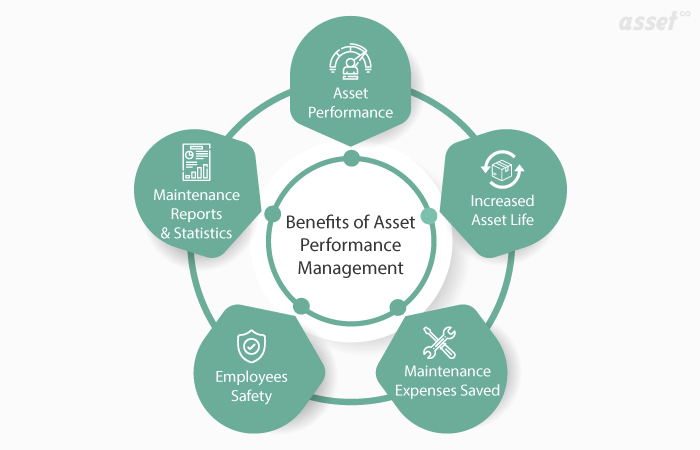
1. Asset Performance
As the name suggests, asset performance management improves asset performance. It helps make sure assets do not break down and keep working properly, and it supports calibration management too.
The main goal of asset performance management is to keep maintenance running smoothly and keep each asset in the best possible condition. Maintenance records and history support this.
2. Increased Asset Life
To do asset performance management well, you need to look at the whole asset lifecycle, from procurement to disposal. APM helps extend productive asset life at every stage. It keeps the asset maintained and makes it more effective.
It also keeps detailed records of every asset, so each one can be looked after properly. It gives you control over all the assets in operation.
Through asset management, you can find out which assets are not adding value to the organization. If an asset is not productive, it can be disposed of before it fails.
3. Maintenance Expenses Saved
Poor asset management leads to money wasted on maintenance and shortens the life of assets. During the operating phase of an asset’s lifecycle, a business can run into several maintenance problems, and those problems can hold back the organization’s growth.
Asset performance management (APM) does this work for you and keeps all the information on every asset. APM schedules maintenance activities and sends notifications and alerts so that no maintenance is missed. It supports business growth by identifying ineffective assets.
4. Employee Safety
Safety is always a concern in manufacturing firms and other organizations. It is a critical issue for assets as well as employees. That is why assets are inspected regularly, so that spills and leaks do not occur.
When maintenance is done on time, the asset is safer and performs better. Avoiding breakdowns keeps assets safe.
Finding potential issues early saves an organization a lot of money, because replacing a few parts of a machine costs less than replacing the whole machine. The workplace is also safer for employees.
5. Maintenance Reports and Statistics
With asset performance reports, managers gather useful insight for effective asset management. These reports show when an asset needs maintenance and when it should be disposed of.
Reports can be pulled within minutes when needed, and they show the performance of each asset. With asset management reports, you can spot potential issues, plan for the future and schedule maintenance accordingly.
Moving From Reactive to Proactive Maintenance
Saving money without cutting what the business needs is a good way to grow. Better asset performance also supports business expansion. Asset performance management has a positive effect on the key performance indicators (KPIs) that the maintenance team tracks.
The main reason behind large maintenance bills and lost productivity is reactive maintenance, where organizations wait for assets to break. This is poor practice, because small issues grow into big ones over time, and big problems are expensive to solve.
It is better to move from reactive to proactive maintenance, which is done regularly, reduces the chance of sudden breakdowns and costs less. Asset management software can be used to improve asset performance and reduce the chance of failure.
Frequently Asked Questions (FAQs)
1. What are management’s goals when it implements asset performance management?
Below are management’s major goals when it implements asset performance management: 1. Reducing operating cost 2. Generating more revenue 3. Increasing profit margin 4. Customer satisfaction 5. Risk management
2. What are the specific advantages of asset performance management?
In addition to the benefits mentioned above: 1. Improved asset performance 2. Informed decisions 3. Reduced risk 4. Better brand image and reputation 5. Increased sustainability
3. Which industries use asset performance management most?
1. Oil and gas industry 2. Solar energy industry 3. Food and beverage industry 4. Manufacturing industry These are the major industries that use asset performance management most.