







Buildings, real estate property, and heating, ventilation and air conditioning (HVAC) are just a few of the regular assets of a facility.
Besides these, a facility is where the regular activities of an entity take place, such as research, sports, military defense, shopping or medical production. The term facility itself has come to be used for any building, equipment or service that defines the particular activity of an organization.
What Asset Management Covers
Asset management is a process that helps track all the assets of an enterprise and maximize the return on those assets. An asset may include equipment, tools, vehicles and more.
Asset management is a systematic approach to operating, maintaining, upgrading and disposing of assets cost-effectively while monitoring cost, risk and performance.
Facility asset management software helps businesses run their operations more smoothly by storing all asset information in a central database and giving a big picture of the organization’s activity.
As such, the system covers all classes of assets:
- Passive Assets: Buildings and infrastructure
- Static Assets: Land
- Active Assets: Mechanical, electrical and office equipment, software and more
Asset management is the practical system of governing assets and realizing value from the assets that an organization holds and puts into operation over their whole life cycle.
Assets can be tangible (buildings or equipment) or intangible (human capital, intellectual property or financial assets).
A few factors influence the type of assets an organization requires to achieve its objectives:
- Nature and strategy of the organization
- Objectives of the organization
- Financial implications and the regulatory environment
- Needs and expectations of the organization and its stakeholders
What is an Asset?
An asset can be any item or entity that has the potential to provide value to an organization.
In other words, an asset is any resource with economic value that an organization owns with the expectation that it will provide a future benefit. These assets are reported on the organization’s balance sheet. This important statement shows the organization’s value and the benefits it derives from its assets.
Facility assets that need to be tracked and managed right away:
- Information Management Assets: Printers, copiers, desktop and laptop computers, IT equipment, software licenses
- Personnel Safety: Safety equipment, badges, mobile devices, radios, uniforms, keys, vehicles
- Facility Related Assets: HVAC equipment, furniture and fixtures, hardware, lighting, office equipment, appliances
Also Read: Asset Management System: A Crucial Management Tool for Any Business
Why is Asset Tracking Necessary?
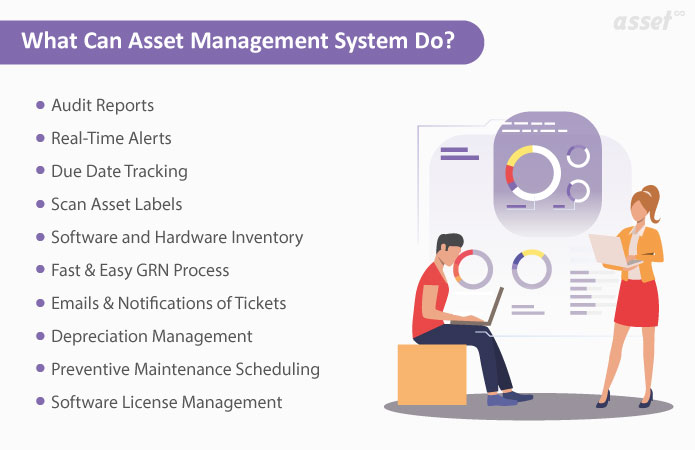
An asset management system supports the following activities to help operations:
- Asset inventory control
- Asset tracking
- Security
- Scalability
- Cost efficiency
- Operational convenience
- Integrity
- Controlled access
- Aesthetics and integrations
- Document tracking
- Asset and equipment maintenance
- Improved asset use
- Lower insurance premiums
- Increased efficiency
- Regulatory compliance
The common requirements of an asset management system are:
- Simple and easy asset addition
- Easy calculation of depreciation
- Simple financial asset management
- Automated asset lifecycle management
- Unique asset tagging and periodic scans for accuracy
- Scheduled preventive maintenance
- Asset performance reporting
- Audits and physical verification of assets
How Asset Management Balances Cost, Risk and Performance
The decision-makers, employees and other stakeholders of an organization all contribute to planning, monitoring and controlling policies, processes and actions, so the organization can make full use of its opportunities and reduce operational risks.
An asset management system helps balance costs, opportunities and risks against the performance of assets. It also helps the organization achieve its objectives.
Asset management covers an asset over its entire life cycle, from the moment it is needed until its disposal, with a view to getting the most from it.
Also Read: 5 Detailed Reports Expected from Asset Management Software
How Asset Management Helps the Facilities of an Organization
Here are four benefits of asset management for an organization’s facilities.
1. Strategy and Planning
For the facilities in an organization, objectives for managing them have to be put in place. To achieve those objectives, asset management activities have to be carried out in line with the organization’s priorities and goals.
This keeps the organization firmly on course to reach the desired bottom line, consistent with its plans and funding.
The asset management framework is therefore very important for any facility.
2. Better Decision Making
Any process or system implementation needs formal structure and documentation to create a standard decision-making process.
Business decisions are always made by considering the life cycle of an asset and the underlying capital investment. A key point is the asset’s total value at the end of its useful life, which depends on the asset’s operation, maintenance plan and resourcing.
This helps the organization make better decisions that balance an asset’s costs, risks, opportunities and performance.
3. Life-cycle Delivery
Life-cycle delivery is the formal process of evaluating the total cost of an asset. This includes everything from its procurement until its disposal.
The life cycle of an asset includes depreciation adjustments, repairs and the upgrades carried out on the asset.
Many accounting questions arise throughout the life of an asset, because accountants need to make decisions about how the asset’s value is reported.
Asset life cycle management is the process by which the organization accounts for, and maximizes, the value its assets generate throughout their life cycle.
Every organization needs to address all the stages of an asset’s life cycle, whatever its scope, scale or industry.
4. Accurate Information
Accurate information is at the heart of the asset management system’s objective and strategy. The system delivers exact information about the status of all business assets.
Reliable asset data helps an organization keep accurate records that meet facility asset management standards.
Also Read: 7 Best Tips for Increasing Productivity via Asset Management
Building Risk Management Into Facility Asset Management
Risk management is an essential part of the asset management system. Organizations need to build risk management processes into their asset management system to evaluate benefits, risks and opportunities and to put improvements in place.
An asset management system is essential for your organization because it helps manage all assets effectively. Combining facility management with asset tracking helps the organization achieve its business results.