






Every organization has assets. They can be tangible or intangible, and either way they need to be managed.
Managing these assets can be a hectic task, especially when your organization has a lot of them.
So here are seven tips for increasing productivity with asset management software.
Also Read: How Can Asset Tracking Software Boost Your Business Efficiency?
7 Tips That Will Increase Productivity with Asset Management
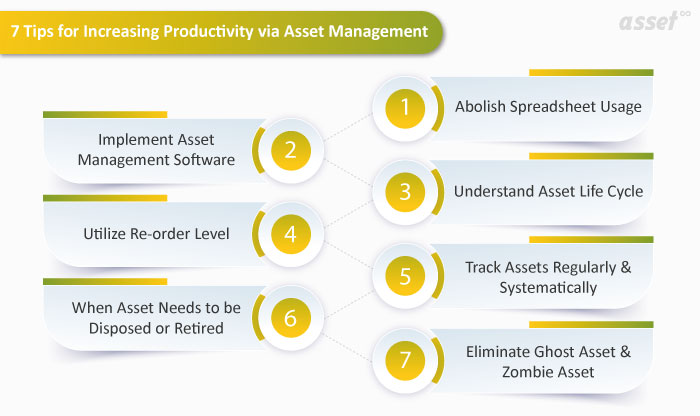
Tip 1: Stop Using Spreadsheets
The first and most important asset management tip is to stop using spreadsheets. Old, traditional methods of asset tracking can work in small companies with only a few assets. For medium and large companies, they stop being useful.
Why, you may ask?
Because spreadsheets are updated by hand, they are more likely to be inaccurate, which leads to asset loss and misplacement.
For instance, when many employees access a spreadsheet and enter information about the same asset, the data can get jumbled, and asset tracking becomes inefficient.
Here is another example. If a supervisor tracks devices, equipment and assets in a spreadsheet saved on their own work PC, other team members cannot get to the information they need.
A spreadsheet is far from a foolproof method for asset tracking; it is prone to errors. As a result, overall productivity drops.
That is why this practice is ineffective, especially when there are many assets to track.
| Other Asset Management Features We Provide to Our Clients | ||
|---|---|---|
| Enterprise Asset Management Software | Asset Tracking Software | CMMS Software |
| Inventory Management Software | Preventive Maintenance Software | Utility Management Software |
| Purchase Order Software | Helpdesk Ticketing System | Work Order Software |
Tip 2: Implement Asset Management Software
Instead of tracking by hand, implement asset tracking and management software in your organization. It is more accurate, and it reduces the chances of asset loss and misplacement.
It also helps you make better business decisions and achieve future goals and objectives.
Most importantly, it can reduce operating and maintenance expenses and improve compliance.
This is the most important tip for growing the business, because it can change how your whole organization operates.
Tip 3: Understand the Asset Life Cycle
Understanding the life cycle of an asset is very important for the business. Estimate how long you can use each asset efficiently.
This matters from the moment an asset is procured until it is disposed of. For example, a building has many valuable items that need maintenance, such as elevators and furniture.
The facility manager manages these assets, and when they need replacing, that is the asset manager’s responsibility. If maintenance and repairs are done regularly, they can extend the life and efficiency of an asset.
Also Read: 7 Best Asset Management Practices for Your Business
Tip 4: Use Reorder Levels
Inventory is one of the most important assets. A shortage of inventory hurts business, especially in peak season.
So it is crucial to keep the right level of stock in the right place. Good inventory management also saves you from overstocking.
Knowing when and how to reorder, and which warehouse location needs reordering, are the most basic things, yet many businesses fail to get them right. Asset management software lets you set a reorder level, so it notifies the responsible person whenever stock falls below it.
Tip 5: Track Assets Regularly and Systematically
If you do not track assets regularly, it can affect the company’s bottom line. Your company could be paying for assets it no longer needs.
Those costs can include insurance, taxes or maintenance. You may even end up paying taxes on assets that are already fully depreciated.
Asset tracking also matters when you have promised a client delivery by a specific date but cannot deliver because the assets needed to complete the work order are not available.
That hurts your company’s reputation. So it is very important to track assets at regular intervals and keep accurate records of each asset.
Tip 6: Know When an Asset Needs to Be Disposed of or Retired
Detecting unproductive assets can save organizations a lot of money. Every asset has a limited life. It might be 2 years or 20 years, depending on the asset and how it is used.
Some of the questions connected to asset life are:
How much is the asset used? How often does it need maintenance? How much does each maintenance visit cost?
You need these details to decide whether an asset should be retired, disposed of or donated.
Tip 7: Eliminate Ghost Assets and Zombie Assets
Ghost assets are missing or stolen assets, or assets that are recorded in your books but are not physically there. Zombie assets are physically there but not recorded in the books.
Both come from inefficient asset management practices, and both ghost assets and zombie assets affect taxation.
Why is a ghost asset a problem?
Because you are paying taxes on an asset you are not using.
When a work order arrives, you may find that the asset best suited to the job is missing, even if you have an alternative to fall back on.
Why is a zombie asset a problem?
Because an asset that is missing from your books is not depreciated, insured or maintained on schedule.
So how do you remove your ghost assets and zombie assets?
If you perform a physical asset audit on a regular basis, you will be able to identify both ghost assets and zombie assets.
Also Read: How Important Is It to Track Business Assets in Different Industries?
Putting These Asset Management Tips to Work
We hope these asset management tips help you manage and track your organization’s assets.
Asset tracking and management matter because they let a company monitor and manage its assets systematically.
The benefits of asset tracking and management include more productive and efficient assets, which ultimately puts a business in a better position to increase its return on investment.
Overall, these asset management tips support asset optimization and help you make the right decisions about your assets.