






For any business, managing its assets should be a top priority.
Organizations that implement an asset management system often see clear benefits and a better return on their assets.
For many years, asset management systems have helped companies and organizations save money and reduce administrative work.
Common Requirements of Asset Management System
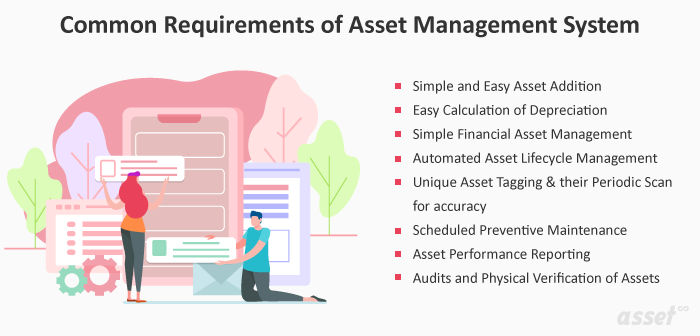
- Simple and Easy Asset Addition
- Easy Calculation of Depreciation
- Simple Financial Asset Management
- Automated Asset Lifecycle Management
- Unique Asset Tagging & their Periodic Scan for accuracy
- Scheduled Preventive Maintenance
- Asset Performance Reporting
- Audits and Physical Verification of Assets
Also Read: 8 Evergreen Asset Tracking Software Benefits That Helps Business
What Does the Asset Management System Do?
An asset management system helps with the following to make operations simple and easy:
- Asset Inventory Control
- Asset Tracking
- Security
- Scalability
- Cost Efficiency
- Operation and Activity Convenience
- Integrity
- Controlled Access
- Aesthetics and Integrations
- Document Tracking
- Asset and Equipment Maintenance
- Improved Asset Utilization
- Capitalize on Lower Insurance Premiums
- Increased Efficiency
- Ensure Regulatory Compliance
Why Would Any Business Require an Asset Management System?
An asset management system is a set of practices for the identification, discovery, procurement, management, monitoring and disposal of all the assets in an organization.
The feature most required in an asset management system is centralized data. With centralized data and the software’s mobile app, it is easy to check and update information from any place at any time.
Other Requirements of the Asset Management System Are:
Also Read: Asset Management Strategies That Can Help Your Business
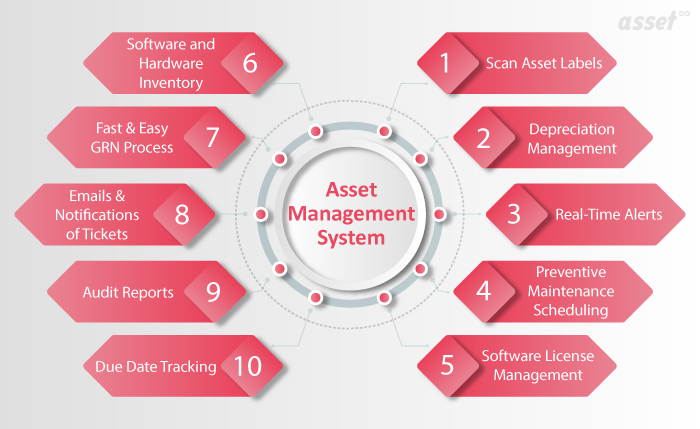
1. Scan Asset Labels
You need to see an asset’s details immediately, which is why all assets and equipment are tagged with unique asset tags or labels (barcode, QR code, NFC tag and so on), so they can be scanned any time, anywhere.
Whenever the asset or equipment’s unique ID (tag/label) is scanned, all its related information in the database will get displayed on your screen.
You can scan these tags/labels with handheld readers and mobile phones, to get the information in real-time.
Asset tags and scanning devices give you information such as:
- Asset’s Manufacturing Date
- Company’s name from which item was purchased
- Cost/Price of the asset
- The shelf life of the asset
- Allotted or assigned person of the asset
- Other important information regarding the item
2. Depreciation Management
Depreciation is an accounting process through which an organization calculates how the value of an asset declines over time.
Financial statements include depreciation expense, which spreads the cost of assets such as buildings, machines and equipment over the years they are used.
Depreciation Management counts on the following -
- Method and Rate of Depreciation
- Useful Life of an asset
- Scrap Value of an asset
3. Real-time Alerts
Real-time data is the information that is delivered immediately after it is collected. There is no kind of delay in the timeline of the provided information. This data is managed using real-time computing. It can also be saved or used for off-line data analysis.
Handling data in real time is common in modern software and mobile inventory apps.
It can give you real-time data of assets, whenever an asset is added, any change is made in its allotment, or it is discarded.
4. Preventive Maintenance Scheduling
Preventive maintenance is the activity done to prevent any potential failures & solve them as early as they are detected and avoid unexpected hindrance in the operations.
Preventive maintenance scheduling can give you the following benefits -
- Machine proficiency
- Unexpected hindrance or malfunctioning
- Timesaving
- Money-saving
5. Software License Management
Software license management lets you control and document the software used in the organization.
This information will include where and how the software products are running to ensure compliance with software licenses. Overall, software license management involves documenting, controlling and reducing total IT cost.
Benefits of software license management are -
- Money-saving
- Proper use of licenses
- Compliance with software licenses
- Reduced waste of precious resources
6. Software and Hardware Inventory
All the software and hardware items in the organization are managed and maintained with IT asset management software.
This management of software and hardware includes -
- Automated discovery and storage of IT assets
- Detection and tracking of configuration changes
- Track of asset’s lifecycle
- Track of asset’s expiry and renewal
- Track of asset’s licenses
7. Fast & Easy GRN Process
A goods received note (GRN) is a document raised when goods are physically received at the storage area or their destination.
The receipt is recorded with all the details of the items and goods. It is an important document for payment support when the vendor submits its invoice.
8. Emails & Notifications of Tickets
In the ticketing management system, tickets are referred to as a document that holds the information about the problem or query, its status, and other additional information.
These tickets are raised by the end-users of an organization when they encounter any issue that interrupts their workflow.
Emails and notifications on each ticket tell you what stage it has reached.
9. Audit Reports
The audit report is a report that describes and contains the audit’s opinion after the examination of the organization’s financial statements and their related reports.
The asset audit report will include financial statements, management accounts, management reports, complaint reports, etc.
Audit reports are generated annually and will help stakeholders and the board of directors to assess integrity management and maintain the transparency of financial reports.
10. Due Date Tracking
Through due date tracking, you can track the due date of maintenance of any asset or equipment. So, the event shall not get missed.
You can also choose how many days or weeks before a maintenance event you want to be notified.
What are the main Objectives of the Asset Management System?
The main objective of an asset management system is to provide an organized, automated way to manage and maintain all fixed and movable assets reliably.
Following are the main objectives of the asset management system:
- Proper use of every asset and piece of equipment
- To determine the condition and functionalities of assets
- To categorize assets by their category
- To create a well-organized database
- Ensure easy to monitor, manage, operate & control system
- To make work and operations in a limited time period
- To keep the security of all the data and documents of assets intact
Check Every Requirement Before You Choose a System
These are the features any organization needs when it brings an asset management system into its daily work.
A good asset management system should understand its customers’ requirements and keep improving to meet them.