







Asset tracking is a crucial process, and it has to be set up and run professionally. To make it work, users must pay attention to its updates, notifications and alerts.
A mobile asset tracking system has many features that help a business grow faster.
What is Asset Tracking?
Assets are the valuable items that an organization owns. Asset tracking refers to the tracking of these unique items or assets that are of concrete value to an organization.
Assets are generally counted as physical or fixed assets like computers, furniture, equipment, etc.
A unique asset ID is always assigned to the asset in order to track it and a durable asset tag is fixed upon it. This information is also added to the asset tracking system.
What is Asset Tracking Software?
Asset tracking software tracks the movement of IT devices, equipment and software within an organization.
The technology provides the inventory of software that makes up an IT environment and can track the assets of the organization.
Asset tracking software is used by the network, system, and IT administrators of an organization so that they can have a quantitative record and keep physical monitoring over all the IT assets.
Asset tracking software can scan the entire digital infrastructure for IT assets and keep records of the whole IT inventory in an organization. Some of the tasks performed by asset tracking software are:
- Inventory Management
- Tracking of Assets
- Maintenance Record Management
- Software Licenses and Vendor Contract Management
An asset tracking system makes business workflows more visible and gives companies up-to-date information, which helps run operations more effectively. It is no wonder that asset tracking is widely used in many industries, such as:
- Healthcare
- Hospitality
- Manufacturing
- Education
- Banking
- Utilities
- Facility Management
- Food and Beverage
Also Read: How Fixed Asset Tracking Enhances Business Productivity?
What are Asset Tracking Methods/Techniques?
Organizations have realized they need a strategic approach to follow an asset’s location until it reaches its destination, and to track its movements after that.
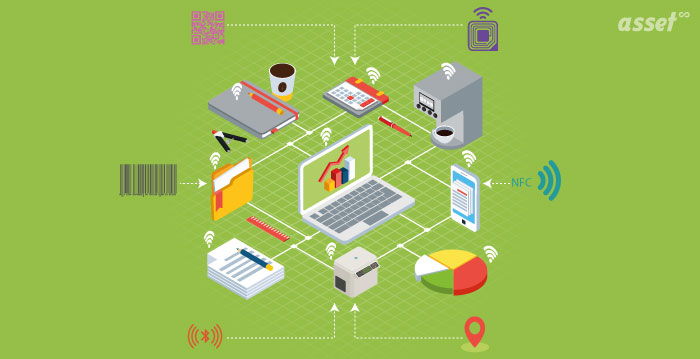
Old: To meet this need, processes were created to keep track of assets and inventory, but they were all done manually with pen, paper and spreadsheets.
New: As technology advanced, new methods came into practice and handled asset tracking well. They proved very helpful, capturing the data and information needed while saving time and money.
1. Barcode Asset Tracking
A barcode is a method of representing data in a visual format of machine-readable information about the item on which the tag is attached. A barcode represents data by varying in width and spacing of parallel lines.
2. QR Code Asset Tracking
QR code is the 2D variant of a barcode. 2D barcodes can be read using application software on mobile devices, such as smartphones with their in-built cameras.
QR code (Quick Response code) is the trademark for a type of matrix or 2D barcode.
3. RFID Asset Tracking
RFID is Radio Frequency Identification. It uses radiofrequency technology to send or receive the data. An RFID tag can hold more information about an item compared to a barcode.
There are three types of RFID: low frequency (30 to 300 kHz), high frequency (3 to 30 MHz) and ultra-high frequency (300 MHz to 3 GHz). Their read range grows from a few centimeters at low frequency to several meters at ultra-high frequency.
Latest trending technology in asset tracking
1. NFC Asset Tracking
NFC stands for Near-field Communication. It uses wireless data transmission to send and receive data from one device to another. Here, one device is used to transmit information and another to receive the signal. An active NFC smartphone can send and receive data and information via NFC.
2. GPS Asset Tracking
GPS is mostly used in vehicles, but organizations increasingly use it to keep track of other assets as well, because it shows their exact location.
3. BLE Asset Tracking
It stands for Bluetooth low energy (BLE). BLE exchanges small data at a regular interval of time. Through BLE, you can track & monitor assets outdoors as well as indoors. BLE preserves energy and it can run for a long time.
4. IoT Asset Tracking
IoT (Internet of Things) is a system of interrelated computing devices, mechanical and digital machines, objects, animals, or people that are provided with unique identifiers (UIDs) and the ability to transfer data over a network without requiring human-to-human or human-to-computer interaction.
Also Read: Why Asset Infinity for Fixed Asset Management Software?
Why is Asset Tracking Necessary?
- Responsibility of Assets
All assets of an organization are continuously tracked by the organization itself. However, it is a costly affair to track and assign ownership to every asset. Therefore, the organization keeps a special track over the most important and useful assets.
The importance of an asset can be listed on the basis of a number of factors like sensitivity, criticality, monetary value, or regulatory compliance.
- Fixed Asset Planning
Fixed asset planning is a complicated process that involves several related departments and information such as accounting, recording and tracking.
Fixed asset planning is important as it provides granular details of every department, working in coordination with reports.
- Tracking every Asset
Every asset in the organization should be tracked, but it is often not worth putting the same effort into all of them. Depending on the size of the organization and the number of assets, some assets need attention beyond regular tracking.
For example, for an owned building, its condition and depreciation need to be monitored. This is much more than just barcoding all the assets you own.
- Long-term Financial Planning
The long-term financial strategy provides a view of the gap that could arise between the organization’s revenue or funding and capital expenditures in the future years.
Asset management involves detailed asset inventories with their operational and maintenance tasks and long-term financial planning to ensure the creation of reserves for reinvestment.
- MRO approach
MRO (Maintenance, Repair, and Operations) refers to the supplies and goods used in production processes but are not part of final products.
Every organization aims to manage its facilities at the lowest cost in the shortest time. With MRO support, the store gets the right parts to the right places at the right time, which increases the organization’s operational efficiency.
Also Read: 5 Detailed Reports Expected from Asset Management Software
Why are Asset Tags Important?
Asset Tags are the labels identifying the equipment using a unique serial number or a code or a barcode.
The code on an asset tag holds details of the asset. The details can include the item’s manufacturing date, the company’s name from which item was purchased, cost price, shelf life, name of the person to whom it is assigned, and other relevant information pertaining to the item.
Asset tags or asset labels are commonly made of anodized aluminum or laminated polyester. The common designs of an asset tag include the company’s logo with a border for the pattern.
Asset tags are required to fulfill the need of keeping validated records. These asset labels help insurance providers and the police track assets in cases of damage or theft.
They are helpful in calculating the worth of equipment or assets at the business year-end reviews.
Asset tags have many practical uses:
- Retrieve stolen or lost equipment
- Keep proper asset records
- Keep a visual record for lease contracts and other arrangements
- Required by the insurance provider for recording and validation
- Required by police to track stolen or misplaced assets
Mobile Application for Asset Tracking: The New Trend
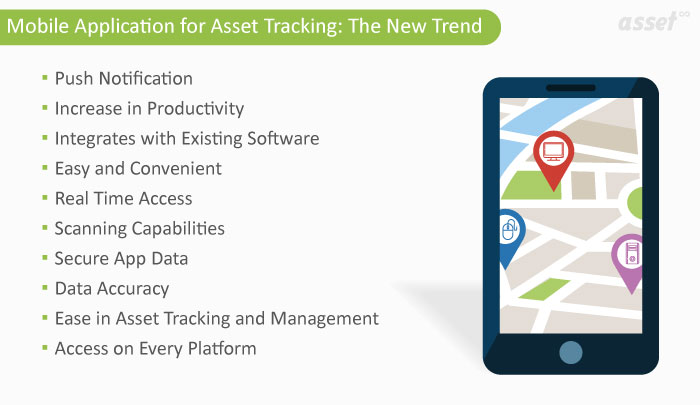
Mobile apps have become essential for business software. They give users access to many of the same features as the web application.
Smartphones are convenient to use, and so is its application, as the user carries the smartphone all the time and everywhere.
A mobile asset tracking system puts the service at your fingertips, with 24/7 access. If you want to know about the location of an asset, you need not rush to the desktop always. You can simply use your smartphone and access the application software.
Mobile asset tracking lets you look things up, resolve issues and act on time. You can check updates and information even when you are away from your workplace.
Mobile asset tracking software puts your asset management and tracking software in the palm of your hand, up to date and organized to suit your needs.
Also Read: How Can Asset Tracking Software Boost Your Business Efficiency?
Professional Tracking Starts with the Right Tools
A mobile asset tracking system offers large advantages to organizations of every size, and asset tracking works across all industries. Simply put, if you want to grow your business, you need asset tracking.
It can take a business to a new level of operational efficiency. If you need help setting up asset tracking software, the Asset Infinity team can support you.