






Barcodes and QR codes belong to the same family. A barcode is made of black and white stripes, and a QR code is made of squares. Both encode information that a scanner can read.
A barcode is a one-dimensional (1D) code that holds a single piece of information, while a QR code is a two-dimensional (2D) code that can store more information.
What is the Barcode and QR code in Asset Tracking?
A simple example explains the difference between a QR code and a barcode.
Suppose an asset is lost and someone finds it. The QR code can be designed so that:
- If a member of the public scans the QR code, they get information about your company and the address for returning the asset.
- If an employee scans the same QR code, they can perform work-related functions, such as checking the asset in or out and fetching its information, while a customer’s screen shows only the information meant for the customer.
This is how a single QR code can serve different information to different users.
What is RFID?
RFID stands for radio-frequency identification. An RFID tag is a small electronic device made up of a chip and an antenna. The chip usually carries a small amount of data.
RFID serves the same purpose as a barcode or the magnetic strip on the back of a credit card or ATM card: it provides a unique identifier for an object. Like a barcode or magnetic strip, an RFID tag has to be read to retrieve the identifying information.
RFID tags have excellent potential in warehousing and asset tracking because they can relay information over a longer distance. This makes it possible to know how much of something you have at any moment and reduces the risk of miscounted inventory, which is why an RFID asset tracking system suits many retailers and wholesalers.
The two technologies differ, and each has its own set of advantages and disadvantages. Each has its own use cases and is used successfully across industries.
QR Code vs Barcode vs RFID
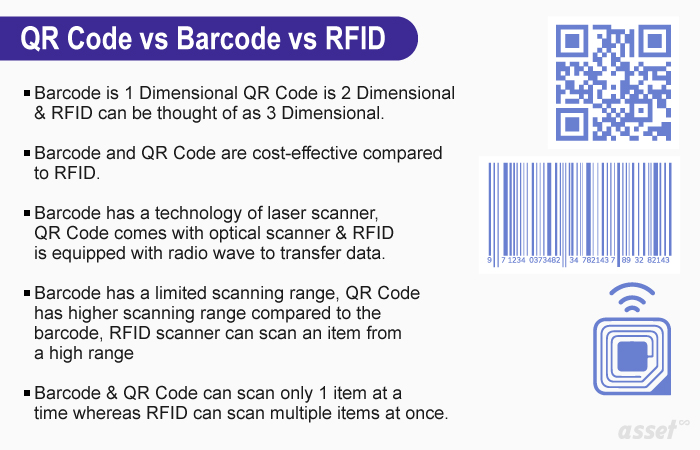
1. A barcode is one-dimensional and a QR code is two-dimensional. RFID is not a printed code at all; it stores its data on a chip.
2. Barcodes and QR codes cost less than RFID.
3. Barcodes are read by laser scanners, QR codes by optical scanners or cameras, and RFID uses radio waves to transfer data.
4. A barcode has a limited scanning range, a QR code can usually be read from a little farther away, and an RFID reader can read a tag from a much greater distance.
5. Barcodes and QR codes can be scanned only one item at a time, whereas RFID can read multiple items at once.
What Asset Infinity Offers?
Asset Infinity uses barcodes, QR codes and RFID tags for asset tagging. It also includes an inventory management module for all your inventory items, which can be anything from spare parts for assets to daily consumables. With Asset Infinity, you can track all these items without hassle.
Also Read: What Is the Importance of Unique Asset Code in Asset Tracking?
Following are some key features offered by Asset Infinity in Asset Tracking
- You can create and design multiple barcode and QR label templates to suit your needs.
- You can generate barcodes and QR codes for tagging your assets right from the application, for a single asset or many assets at a time.
- You can fetch asset details by scanning the barcode or QR code with the Asset Infinity mobile application.
- Scanning the barcode or QR code makes checking an asset in and out quick and simple.
- You can export movement history and summary reports on asset transactions to Excel.
Key features offered by Asset Infinity in the inventory module
- Parts can be linked to the assets they are used on.
- You can set reorder points and minimum stock levels for items in each store, and the storekeeper is alerted when an item falls below them.
- Stock is held in every store, down to the zone, rack, shelf and bin.
- Issues, returns and parts used are recorded against the job or asset.
- Parts a work order needs are reserved against it, so available stock is what is actually free.
- Each part lists its suppliers, with price and lead time.
- Every stock figure is the sum of movements you can open and review.
- Counts show the difference against the record before stock is adjusted.
- Stock available at every location can be viewed at any time.
- Reorder recommendations show the figures behind them.
Choosing Between Barcodes, QR Codes and RFID
Barcodes, QR codes and RFID each have their own advantages and disadvantages for asset tracking, from the asset labels themselves to how much information they store and how far away they can be read.
What matters is which one suits the way your organization works and the environment it works in.
Asset Infinity also provides asset audits and physical asset verification, maintenance management, utility monitoring and reports on your equipment, which you can use from anywhere at any time. Learn more about asset tags, or start a free 14-day trial.
Missed This One? Barcode vs QR Code vs RFID vs NFC vs BLE vs GPS: Which One Is Better?
Frequently Asked Questions (FAQs)
1. What Are the Advantages of Barcode?
Barcodes are the most cost-effective of the asset tracking technologies. They are accurate and one of the most widely used technologies, especially in inventory tracking, and they are well known in asset tracking.
2. What Are the Benefits & Drawbacks of the QR Code?
QR codes are popular and can be read with smartphones, so you can work from a phone and save the cost of buying a scanner. They scan quickly, they can still be read when partly damaged, and they can store information.
The disadvantages of QR codes are that they can be scanned only one at a time, which makes counting labor-intensive and slows work down. They also do not provide real-time location information.
3. What Are the Distinct Types of RFID Tags?
There are two types of RFID tags: active and passive. An active RFID tag uses a battery, whereas a passive tag has no internal power source. Passive RFID tags cost less than active tags but have a shorter range.