






Many organizations do not take asset depreciation tracking seriously, and as a result their bookkeeping is not accurate. It also affects tax reporting. Keeping a perfect depreciation record by hand is close to impossible, because an organization owns a lot of assets and equipment.
For depreciation tracking, an organization can use asset tracking software. The same software that tracks depreciation also helps you manage the assets themselves.
What Is Asset Tracking Software?
Asset tracking software provides a centralized platform through which crucial information of each asset is retrieved such as status, location, maintenance history, etc. It keeps track of assets as they move and is very helpful in depreciation tracking.
How is it done? With asset tags (barcode labels and radio-frequency identification tags). A tag carries a unique identification number, and once the tag is scanned by scanning devices, all the information about that asset is at hand.
Asset tracking improves asset utilization. It also makes assets more secure.
Asset tracking is helpful in physical verification of assets because it records where each asset is. The finance department can also confirm that the assets on the balance sheet exist. An organization that does not keep track of its assets loses money every year.
What Are the Benefits of Asset Tracking Software?
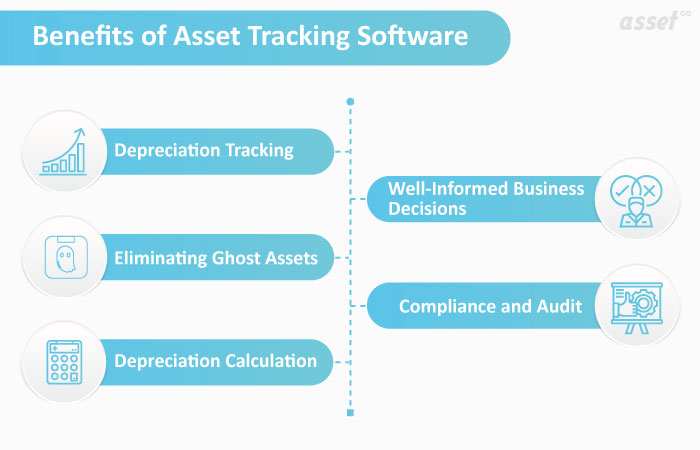
Depreciation Tracking
Depreciation tracking is the most overlooked benefit of asset tracking software. Fixed assets lose value as time passes, even as they keep generating revenue for an organization.
Without a proper asset tracking system, computing depreciation on your fixed assets may involve estimation and, as a result, errors, inaccuracy, and penalties. Tax laws change from time to time, which makes this work more complex.
While some organizations hand this work to an expert bookkeeper or accountant, others do not have the resources to outsource it, so they keep it in-house. In these situations, asset tracking software helps keep the calculation precise, consistent and in line with tax rules.
Eliminating Ghost Assets
Another benefit of asset tracking software is eliminating ghost assets from the company. They can cost an organization a lot of money if they are not dealt with.
Ghost assets are assets that appear in the account books and records but cannot be found physically. While they stay on the books, you keep paying expenses for assets that you are not using or that are not there. With asset tracking software, you can identify ghost assets and dispose of them properly.
With this software, you can report the exact net value of each asset. Many organizations only use the purchase value, but an asset’s value falls over time as it is used. Depreciation lets organizations recover the purchase cost over the asset’s life.
Depreciation Calculation
To calculate depreciation accurately and claim it, you need proof of each asset’s purchase. Paper gets lost, so keeping the purchase cost and dates on the asset record in your software means the figures are there when you need them.
Asset Infinity calculates asset depreciation with these methods:
- Straight-line method
- Declining balance (the written-down value method), including double-declining
- Rate tables, such as MACRS GDS and ADS
- Units of production, driven by meter readings
Well-informed Business Decisions
The most important benefit of tracking depreciation with this software is that it lets you make well-informed financial decisions based on reports and analytics.
Also Read: How Does Asset Management Software Help in Audits?
It also lets you see which assets need the most maintenance, when an asset’s productive life is over, and when it should be disposed of, so you can avoid the risk of asset failure.
Precise reports, warranty information, and other data let you make decisions on evidence instead of estimates and assumptions.
Compliance and Audit
Last but not least come compliance and audit. Every business owner knows how exhausting and time-consuming audits can be. During an audit, the software shows where each asset is recorded, which comes in handy.
This software also plays a crucial role in the physical verification of assets, because you can see a complete list of them. From the audit point of view, you can see the current condition of each asset and cross-check who holds it.
Regulators make sure that every organization follows its industry’s rules and standards, and an organization that does not can be penalized. IT asset management software helps you keep to those rules.
It also shows your software license position, so you can see where installations are not covered by a license before it turns into a compliance problem and a fine.
Also Read: Improving Warranty Tracking and Cost Savings
Depreciation Tracking Pays Off Beyond the Books
As we said above, depreciation tracking is often overlooked, and companies still make mistakes in their depreciation calculations.
Asset tracking software helps with depreciation management and also replaces spreadsheets that are only partially correct.
Asset tracking software can improve your business in many ways, from depreciation tracking to everyday asset management. It has something for everyone.
From asset maintenance to financial asset management, and from technicians to managers, anyone can use this software. With it, bottlenecks in the process can be found and productivity can rise for employees and the organization alike.
Frequently Asked Questions (FAQs)
1. What is the objective of depreciation recording?
The objective of depreciation recording is to spread the purchase cost of an asset over its useful life. It records how the asset’s value decreases over time, and that decrease can be deducted for tax purposes.
2. What are the advantages of asset tracking software for an organization?
The advantages of asset tracking software for an organization are as follows: 1. Reduced asset downtime 2. Increased asset performance 3. Increased asset life 4. Less asset theft 5. Inventory management 6. Purchase and requisition management 7. Eliminate human error 8. Asset security 9. Report and analytics 10. Audit & physical verification 11. Regulatory compliance 12. Cloud-based asset management 13. Ghost asset identification 14. Calibration management
3. What are the main features of Asset tracking software?
Main features of Asset tracking software: 1. Maintenance tracking 2. Work order status tracking 3. Alerts and notifications 4. Check-in & check-out 5. Real-time asset tracking 6. Utility monitoring 7. Barcoding/RFID tags 8. Service history tracking 9. Preventive maintenance 10. Maintenance scheduling