






Manually managing and tracking thousands of assets in a company is expensive, takes a lot of time and effort, and is still prone to error. Manual asset tracking methods become disorganized, especially when there are many assets.
We may know the advantages of asset management and how beneficial asset management can be. But what happens when an organization does not have asset management software?
First, it’s important to know what asset management is.
Asset management is a systematic process of developing, operating, maintaining, upgrading, and disposing of assets in the most cost-effective manner, taking account of all costs, risks and performance.
It is used in both business and public infrastructure to coordinate the balance of costs, risks, service performance and sustainability.
Also Read: What Is Asset Management and What Are Its Types and Benefits?
It covers the entire life cycle of physical and infrastructure assets: design, construction, commissioning, operation, maintenance, repair, modification, replacement, and decommissioning or disposal.
Overall asset management offers a systematic approach to monitor and track assets. Moreover, it includes activities such as servicing, assigning & discarding of assets.
The biggest advantage asset management provides is a better return on investment.
What Happens When an Organization Is Not Equipped with an Asset Management Software?
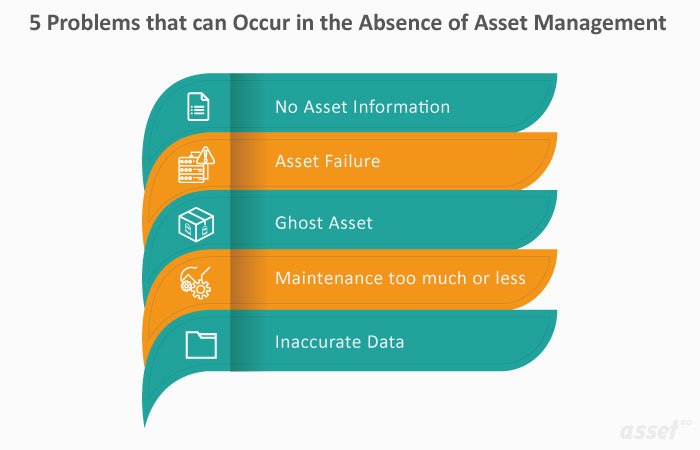
Several issues arise, as described below:
1. No Asset Information
You may not even know how many assets your organization has or what state they are in. Nobody notes what happens to the assets you own.
Your organization will also end up buying again, adding extra expense. Moreover, you will not know when maintenance is needed to one asset or, which asset is taking more maintenance & when it is procured, or even when it needs to be disposed etc.
| Other Asset Management Features We Provide To Our Clients | ||
|---|---|---|
| Asset Management Software | Asset Tracking Software | CMMS Software |
| Inventory Management Software | Preventive Maintenance Software | Utility Management Software |
| Purchase Requisition Software | Helpdesk Ticketing System | Purchase Order System |
Solution - The software allows you to keep a record of asset maintenance up to date. Moreover, it has all the information about the asset. It also reminds the responsible person when maintenance is due.
That means nobody has to keep maintenance dates in their head. The reminders are especially useful for organizations with many assets and much equipment.
2. Asset Failure
An unexpected breakdown costs money and lowers the organization’s productivity. The workers can be rendered idle because of the machine breakdown.
Assets which are not maintained regularly can cause unexpected breakdowns, expensive repairs, and replacement of machine parts.
Solution - Preventive maintenance feature of our software comes really handy! It minimizes the sudden asset breakdown & failure chances because when an organization follows this practice then assets are maintained regularly & sent for maintenance if any sort of issue is detected.
It puts proactive maintenance first.
Preventive (proactive) maintenance is much more economical than reactive maintenance. Reactive maintenance can make a huge dent in your pocket.
Also Read: 5 Risks of Not Using Asset Tracking Software in an Organization
3. Ghost Asset
Ghost assets can hurt your business badly because they directly affect the organization’s bottom line. Here is what ghost assets are.
They are assets listed in the books that are not physically available. Companies may be paying taxes on assets they are not even using.
Solution - To remove ghost assets completely from your organization you can use an asset tracking solution that records where every asset is and verifies it with regular counts. The software also has a check-in/check-out feature.
Through this process, you will always know where your assets are and what is the status of each particular asset and even who is using it, etc.
4. Maintenance Too Much or Too Often
Over an asset’s working life, maintaining it more than it needs, or more often than it needs, is also a problem.
Maintenance should be balanced and done when it is required. Excess maintenance is inefficient for the maintenance team and only produces big maintenance bills.
Solution - Maintenance shall be done on a regular basis or according to the asset requirement. In the process, asset priority is decided, along with the activities that need to be performed during maintenance.
An asset management and maintenance tool also provides the facility of monitoring maintenance activities. Regular maintenance results in full use of assets, higher productivity and a better asset lifecycle as well.
5. Inaccurate Data
Information & data are the most crucial aspects of strategic resource & how a company should operate. Several organizations still rely on traditional spreadsheet usage which is prone to error.
When wrong data is entered about asset then obviously decision based on this data will also be wrong. This type of mistake happens due to the absence of an automatic process. These errors can lead to asset loss, unmaintained asset and wrong decision making.
Solution - Asset management software is essential for keeping asset data accurate. It helps you avoid risks, gives you the vital information, and provides the data to plan well and set future goals for the organization.
Most importantly, it also helps you decide the areas where improvement can be done & how daily operations can be optimized. This software assists you in this process by providing all the reports as per your requirement.
Avoiding These Asset Management Issues
These are just a few of the possible outcomes when an organization is not equipped with asset management software.
Hence, asset management is very important for business. It provides assistance in many ways. Without it, the consequences include lower productivity and underused assets.
All of these problems & issues can be minimized with the help of an asset management solution. If you want complete control over your assets then asset management is a must.
Asset management can be very beneficial for all type of business. It can reduce asset breakdown, enhance productivity, minimize risk exposure etc.
If you need assistance in implementing it, you can contact us today, we will be happy to assist you.
Also Read: 5 Common Asset Tracking Issues That Need to Be Addressed
Frequently Asked Questions (FAQs)
1. Why is IT asset management important?
Asset management matters because it lets an organization manage and monitor its assets in an organized, systematic way. The advantages include profitability and effectiveness, which put a business in a better position to improve its return on investment.
2. Why are assets important for an organization?
Assets are important because they help in growing businesses. Assets add value to the organization and provide assistance in generating revenue. In short, they are very helpful in achieving future goals.
3. What are the advantages of asset management?
A few of the advantages of asset management are: Helpful in making business decisions, saving expenses, enhanced regulatory compliance, etc. Overall, it affects the bottom line in a positive way.