






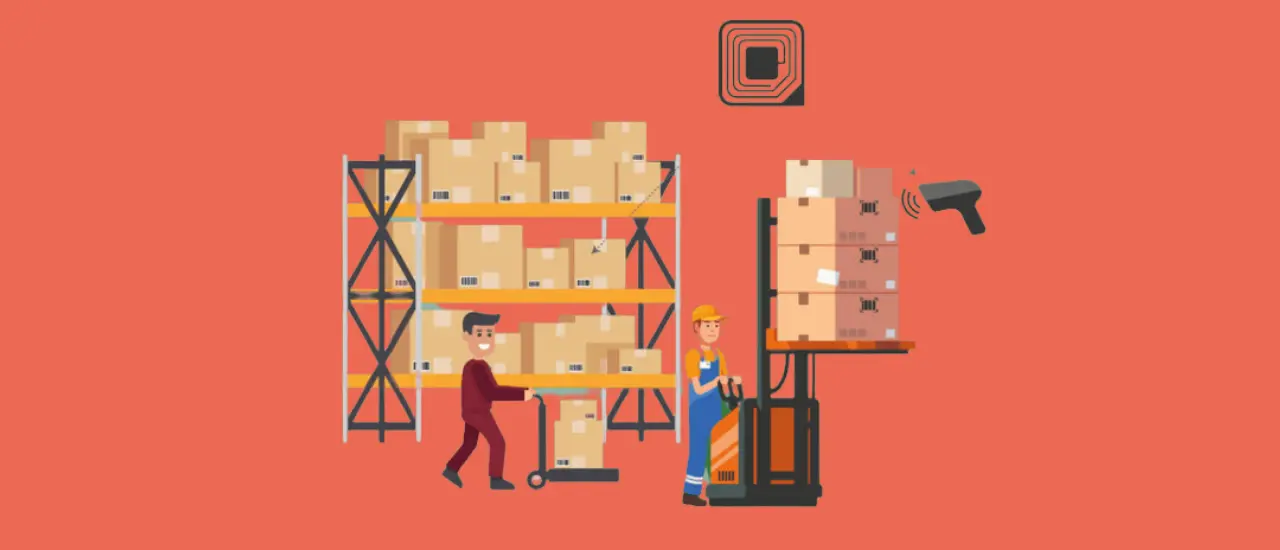
RFID asset tracking uses radio tags and readers to record where equipment is and when it moved, without anyone scanning a label by hand. A reader on a doorway notes every tagged asset that passes it, and a handheld reader can count a room full of laptops or a rack of tools without line of sight to each one.
This guide explains how an RFID asset tracking system works, which tags and frequencies suit which jobs, how RFID compares with barcodes, where it pays off by industry and for IT equipment, and how to roll it out without drowning in data.
What Is RFID Asset Tracking?
RFID asset tracking is the practice of attaching radio frequency identification tags to physical assets and using fixed or handheld readers to identify them automatically. Each read records which tag was seen, by which reader and when, so the asset register shows where an asset was last seen and when it entered or left a space.
RFID stands for radio frequency identification. A tag holds a small chip and an antenna. A reader sends out a radio signal, the tag answers with its number, and software matches that number to an asset record. Because the signal passes through cardboard, plastic and cloth, a reader does not need to see the tag, and it can read many tags in a second.
Teams buy it when the register says an asset is in one place and nobody can find it there. A barcode only updates when someone remembers to scan it. An RFID reader on a doorway updates every time the asset passes.
How an RFID Asset Tracking System Works
Every RFID asset tracking system has the same four parts:
| Part | What it does | Things to decide |
|---|---|---|
| Tags | Carry a unique number on the asset | Passive or active, label or hard tag, on-metal or standard |
| Readers | Send the signal and receive tag replies | Fixed at doorways or handheld for counts |
| Antennas | Shape where a fixed reader listens | One per doorway, dock door or gate |
| Software | Turns reads into locations and history | Matching tags to assets, filtering duplicate reads, alerts |
The flow is simple. A tag passes an antenna, the reader picks up its number many times a second, and the software turns that burst of reads into one event: “asset AST-0099 entered the tool crib at 9:14.” That last step matters most. A reader produces thousands of reads an hour, and without software that groups them into arrivals and departures, the data is noise.
Types of RFID Tags
Passive RFID Tags
Passive tags have no battery. They draw power from the reader’s signal, so they are cheap, thin and last for years. They suit most fixed assets, tools and IT equipment, and they are what you print onto labels. Read range depends on frequency, tag size and the reader.
Active RFID Tags
Active tags carry a battery and transmit on their own, so they can be read from much farther away, often up to around 100 meters. They cost more and their batteries need replacing. They suit vehicles, containers and large equipment in yards.
Semi-Passive Tags
Semi-passive, or battery-assisted, tags use a battery to run the chip or a sensor but still reply to a reader rather than transmitting on their own. They are used where a tag also needs to log temperature or another reading.
For a fuller comparison, see active vs passive RFID for location tracking.
RFID Frequencies and Read Ranges
RFID works in three main frequency bands. Ranges below are typical for passive tags and vary with tag size, reader power and what the tag is mounted on.
| Band | Frequency | Typical passive range | Common uses |
|---|---|---|---|
| Low frequency (LF) | 125 to 134 kHz | A few centimeters | Access cards, animal tags; works near metal and water |
| High frequency (HF) | 13.56 MHz | Up to about 1 meter | Library books, smart cards, NFC tags read by phones |
| Ultra-high frequency (UHF) | 860 to 960 MHz | Several meters | Asset tracking, warehouses, doorway readers |
Most asset tracking uses passive UHF, because it reads several meters away and many tags at once. NFC is a short-range form of HF that most smartphones can read, which suits tapping a tag on a single asset more than counting a room.
RFID vs Barcode for Asset Tracking
Barcodes and QR codes are cheaper and work with any phone camera. RFID costs more and needs readers, but reads without line of sight and in bulk.
| Barcode or QR code | RFID | |
|---|---|---|
| Line of sight | Needed; one label at a time | Not needed; many tags at once |
| Who reads it | Anyone with a phone or scanner | RFID readers only |
| Automatic movement records | No, someone has to scan | Yes, with fixed readers at doorways |
| Durability | Printed labels can scuff and fade | Hard tags survive heat, washing and impact |
| Tag cost | Lowest | Higher, more again for on-metal or active tags |
| Best for | Equipment people walk up to | Counting rooms, doorways, high-value mobile items |
Many sites use both: a QR code on the label for anyone with a phone, and an RFID chip in the same label for counts and doorways. More on this in RFID vs barcodes.
Benefits and Limits of RFID Asset Tracking
The benefits are mostly about removing the scan nobody remembers to do:
- Counts are faster. A handheld reader records every tag in range as you walk, so an annual count becomes a walk through each room.
- Movement is recorded automatically. Fixed readers at doorways, dock doors and gates note when an asset leaves.
- Fewer losses. An alert when a tagged asset leaves a building turns a missing item into a same-day question.
- Less handling. Assets do not need to be picked up or turned around to be identified, which also helps where contact should be kept to a minimum, such as isolation wards.
The limits are real and worth planning for:
- Metal and liquid. Metal reflects and liquids absorb UHF signals, so equipment with metal surfaces needs on-metal tags.
- Stray reads. A doorway reader can pick up tags in the next room unless its signal floor is tuned.
- Hardware cost. Readers, antennas and installation cost more than a box of labels. Start where the payoff is clearest.
- Tags you do not own. Day one usually brings thousands of reads from cartons and supplier tags that need filtering out.
RFID Asset Tracking by Industry
Hospitals
Infusion pumps, wheelchairs and monitors move between wards and hide in storerooms. RFID shows biomedical teams where a pump is and when it left for repair, and tracking beds, ventilators and devices that need cleaning between patients means nobody has to handle equipment just to identify it.
Manufacturing Plants
Readers on tool crib doorways and dock doors record gauges, torque wrenches and pallets of spares going in and out, so a missing tool is traced to the last doorway it passed.
Hotels and Hospitality
Linen, uniforms and high-value equipment move between rooms, laundries and stores. RFID makes stock counts of these items a walk-through and shows where losses happen.
Fleets and Yards
Vehicles and trailers carry tags read at gates, so a yard knows what is on site. Outdoors and on the road, GPS takes over; see GPS asset tracking.
Retail and Apparel
Retailers tag stock to count stores quickly and to know which size and color is on the shelf. Shared fixtures and equipment can be tagged the same way.
Schools and Campuses
Laptops, projectors and lab instruments are tagged at receiving, and handheld readers make the summer count much faster than reading barcodes one at a time.
RFID for IT Asset Tracking
IT equipment is small, valuable and portable, which makes it a good fit for RFID. A laptop cart, a server room or a storeroom of monitors can be counted with a handheld reader in minutes, and a reader at the IT store doorway records devices issued and returned. Tags are placed on the device body, and on-metal tags suit servers and network gear in racks.
RFID tells you a device is physically present. Discovery agents tell you what is installed on it and when it last connected. Used together, they find the two most common gaps: a device that reports in but is not in the building, and a device in the building that has not reported in for months. The IT asset management software page covers the discovery side.
How to Roll Out an RFID Asset Tracking System
- Pick the problem. Choose one place where assets go missing or counts take too long, such as a tool crib, an IT store or a dock door.
- Tag the assets that pass it. Use on-metal tags where needed and print labels that carry both a QR code and an RFID chip.
- Install and tune one reader. Point each antenna at a named place and set how strong a read must be, so the doorway does not hear the next room.
- Claim and filter tags. Attach every unknown tag to its asset or mark it as not yours.
- Add rules. Decide which doorways should move the asset’s recorded location or notify someone.
- Widen in stages. Add doorways and sites once the first one gives clean data.
How Asset Infinity Runs RFID Asset Tracking
In Asset Infinity, every read lands on the same asset record your maintenance and finance teams use. The RFID asset tracking page has the detail; the essentials:
- Readers and antennas. Fixed readers connect over MQTT or HTTPS, and each antenna is set to a site and location with a purpose of observe, entry, exit or checkpoint.
- Reads become visits. A tag read many times a second becomes one visit with an arrival and a departure, with thresholds so a forklift parked in a doorway does not arrive four times.
- Unrecognized tags. Unknown tags wait on their own list to be claimed for an asset or dismissed.
- Hardware health. A reader that stops reporting, or an antenna that goes quiet while its reader keeps reading, is reported to named people.
- Handheld readers. Zebra, TSL and Chainway handhelds work with the Android app to count, find a tag by beep, and write an asset’s number onto a blank tag.
- Labels. The label designer can write the RFID tag as the label prints, and a reprint writes the same number. See asset tags.
- Counts. A paired reader works in verification rounds in asset inventory software, recording each asset as verified, moved, not found or damaged.
BLE gateways place tagged assets on floor plans indoors, and GPS trackers cover vehicles outdoors, on the same record. Pricing for readers and the register is on the pricing page.
Frequently Asked Questions
What is the range of RFID asset tracking?
It depends on the tag and frequency. Passive UHF tags are typically read from several meters away, HF and NFC tags from a few centimeters to about a meter, and battery-powered active tags from much farther.
Can RFID track assets in real time?
RFID records an asset when it passes a reader or when someone scans the area with a handheld. For a continuous position indoors, BLE tags and gateways are used, and GPS outdoors.
Does RFID work on metal equipment?
Standard tags read poorly on metal, because metal reflects the signal. On-metal tags have a spacer or special antenna that makes them read reliably on machines, tools and servers.
Is RFID better than barcodes for asset tracking?
RFID is better for counting many assets quickly and for recording movement through doorways. Barcodes and QR codes are cheaper and readable by any phone, so many sites use both on one label.
How do I start with an RFID asset tracking system?
Start with one doorway or one count where assets go missing, tag the assets that pass it, and tune a single reader before adding more.