






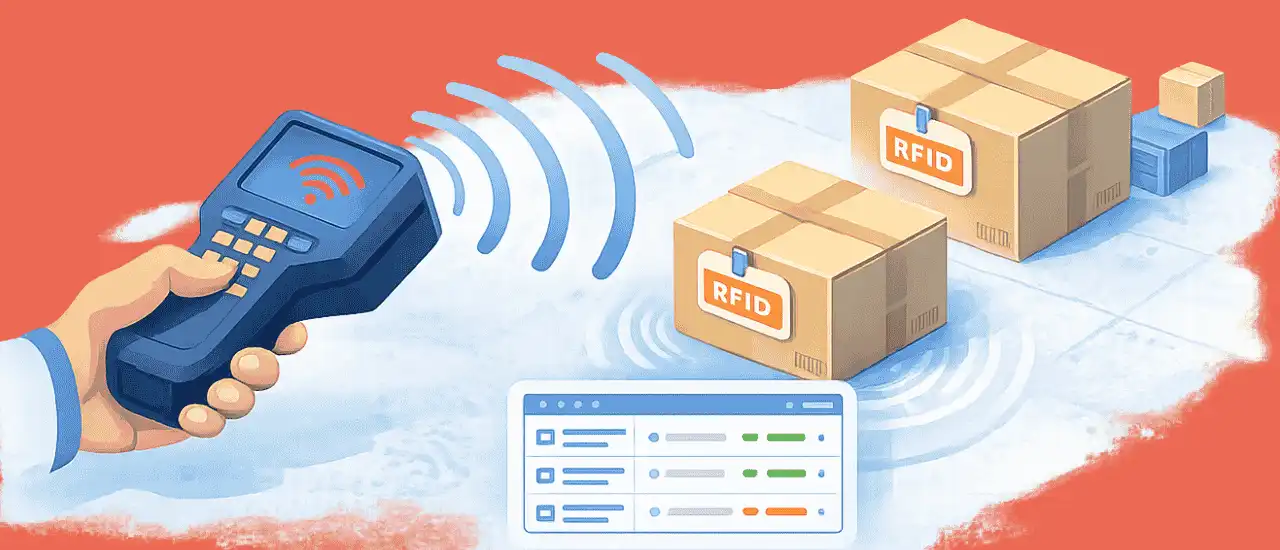
RFID asset tracking software records where your tagged equipment is by listening to radio tags instead of waiting for someone to scan a label. A reader at a doorway notices a tool cart leaving, a handheld reader counts a storeroom in minutes, and the software turns each read into an update on the asset’s record.
This guide explains how RFID tracking software works, the parts of an RFID asset management system, how it compares with barcodes, BLE and GPS, and the questions to ask before you buy. It finishes with how Asset Infinity handles RFID and a short set of answers to common questions.
What Is RFID Asset Tracking Software?
RFID asset tracking software connects radio frequency identification tags and readers to an asset register. Each tag carries a unique number linked to one asset. When a fixed or handheld reader detects the tag, the software records where and when it was seen, updates the asset’s location and flags anything that has moved without permission.
Teams buy it when the register says an asset is in one place and nobody can find it there. A barcode only updates when someone remembers to scan it. A reader on a doorway updates every time the asset passes.
How an RFID Asset Management System Works
An RFID asset management system has four parts. Each one can fail on its own, so it helps to know what each does.
| Part | What it does | What to get right |
|---|---|---|
| Tags | Carry a unique number on each asset | Pick on-metal tags for steel equipment and tags rated for heat, washdown or outdoor use where needed |
| Readers and antennas | Detect tags in range | Place fixed antennas at the doorways that matter; give counters a handheld |
| Middleware | Turns thousands of raw reads into events | Decide how many reads mean “arrived” and how long a gap means “left” |
| Software | Updates the asset record and raises alerts | The reads must land on the same record your maintenance and finance teams use |
The process, from first tag to daily use, follows the same steps in most organizations:
- Choose what to tag. Start with assets that move and matter: tools, IT equipment, medical devices, returnable containers.
- Encode and attach tags. Each tag gets the asset’s number written to it, then goes on a spot the reader can see.
- Install readers. Fixed readers go at dock doors, tool cribs and yard gates. Handhelds go to whoever runs counts.
- Map each antenna to a place. A read on antenna 1 then means “dock door 1, inbound”, not just “reader 4”.
- Turn reads into visits. A tag read many times a second becomes one arrival and one departure.
- Act on events. Move the asset’s recorded location, or notify a supervisor when something leaves the site.
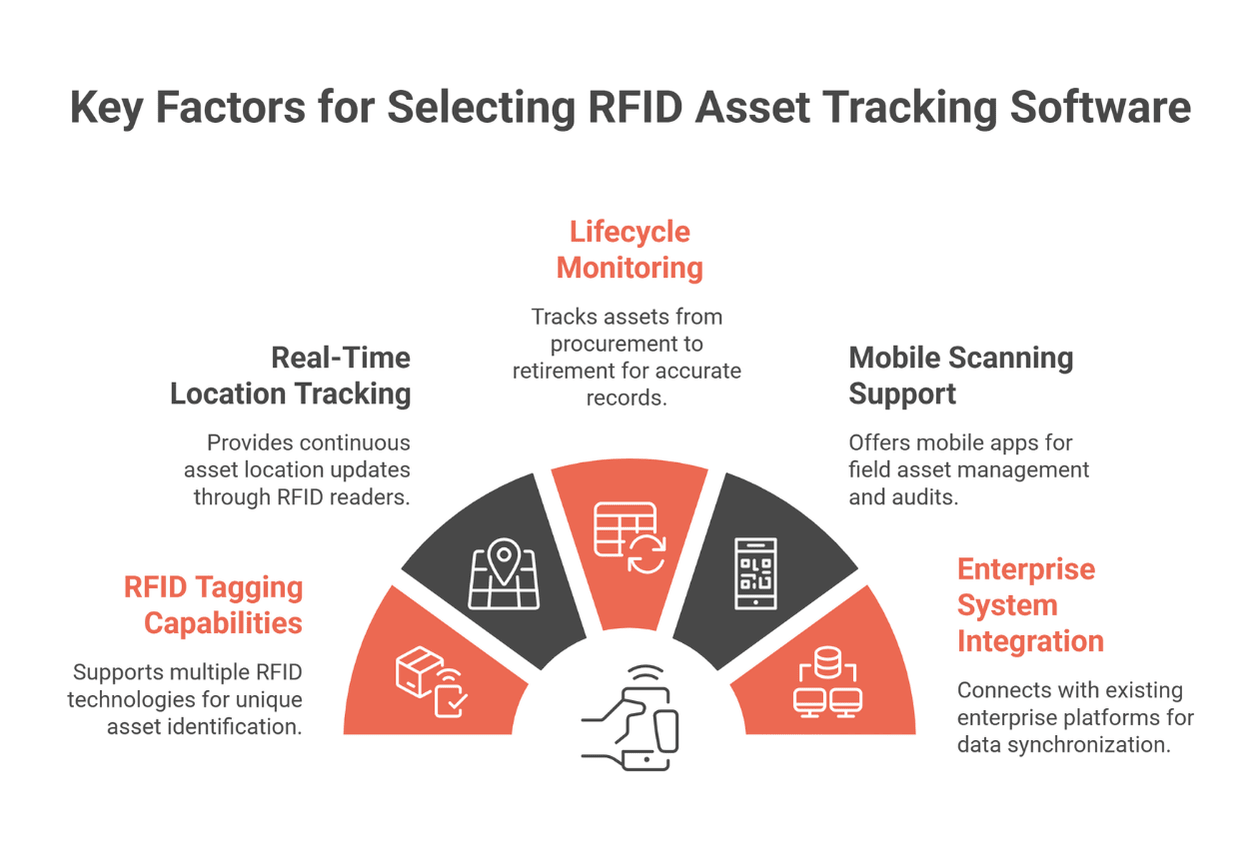
Passive, Active and Handheld RFID
Not every RFID setup works the same way. The type of tag and reader decides what questions the system can answer.
- Passive UHF tags have no battery. They are cheap, last for years and can be read from several yards away by a fixed or handheld reader. Most asset tracking uses them.
- Active RFID tags have a battery and broadcast their own signal, so they reach farther but cost more and need battery changes.
- HF and NFC tags are read from a few inches away. They suit proof-of-presence checks, such as a technician tapping a phone at a machine.
Our comparison of active vs passive RFID for location tracking goes deeper into the tradeoffs.
RFID vs Barcode, BLE and GPS Tracking
RFID is one of several ways to keep an asset register current. Most sites end up using more than one.
| Technology | What it tells you | Needs line of sight? | Best for |
|---|---|---|---|
| Barcode or QR label | The asset was scanned by a person | Yes | Low-cost tagging, counts with a phone camera |
| Passive RFID, fixed readers | A tag passed a particular antenna, and when | No | Dock doors, tool cribs, yard gates, ward entrances |
| Passive RFID, handheld | Which tags are near you now | No | Fast counts and finding one item on a shelf |
| BLE tags and gateways | Which room a tag is in, continuously | No | Mobile equipment inside a building |
| GPS trackers | Where a vehicle or machine is outdoors | No | Fleets and plant that moves between sites |
Barcodes cost almost nothing and remain the right choice for many assets. RFID earns its cost where assets move often, sit in bulk, or must be counted without handling each one. Outdoors, GPS asset tracking covers what readers cannot reach.
What to Look for in RFID Asset Management Software
Many products can read a tag. The differences show up on the first day, when thousands of unknown tags arrive, and on the day an antenna cable is cut and the doorway goes quiet. Ask every vendor these questions.
| Capability | Why it matters | Question to ask |
|---|---|---|
| Reads turned into visits | Thousands of reads an hour are noise until they become arrivals and departures | How do you decide an asset arrived or left? |
| Per-antenna settings | A yard gate and a tool crib need different thresholds | Can I tune each antenna separately? |
| Reader choice | You should not be tied to one hardware brand | How do I add a reader from another maker? |
| Unknown tag handling | Day one brings tags you do not own | What happens to a tag the system does not recognize? |
| Hardware health | A dead antenna looks like a quiet doorway | Who is told when a reader or antenna stops reading? |
| Tag encoding and printing | Replacement labels must read as the same asset | Can I write the asset number to a tag as the label prints? |
| One register | Tracking data is wasted if it lives apart from maintenance | Do reads update the same asset record as work orders and costs? |
| Mobile counts | Audits happen on the floor | Does the phone app pair with handheld readers, and which ones? |
Questions about scale
Ask how the system behaves with your largest site, not your smallest. Ask whether readers at several sites report into one register, and whether counts can run site by site. If you plan to add BLE or GPS later, check that they write to the same asset record rather than a separate map.
RFID Asset Tracking Examples by Industry
Hospitals
Infusion pumps, wheelchairs and monitors move between wards. A reader at the loading dock records equipment leaving for repair, and handheld counts find devices due for safety checks. Indoor BLE tags can add which room each one is in. See how this works in healthcare.
Manufacturing plants
A reader on the tool crib doorway records gauges and torque wrenches going out and coming back. A reader on each dock door records pallets of spares arriving. Tool tracking software handles the check-out side, so each tool has a named holder.
Warehouses and distribution centers
Readers on dock doors and yard gates record reusable containers, equipment and forklifts passing through. A rule on the exit antennas tells the yard supervisor when a tagged asset leaves.
Campuses and offices
Laptops, projectors and lab instruments are tagged at receiving. Handheld readers make the annual count a walk through each room instead of a hunt for barcodes.
How Asset Infinity Does RFID Asset Tracking
Asset Infinity’s RFID asset tracking feeds the same asset register your maintenance, IT and finance teams already use. Each read updates a record that also carries work orders, meters, contracts and costs.
- Readers screen. Add a fixed reader, choose its site and how it reports (MQTT or HTTPS), and map its message format in settings. A new reader brand is a settings change, not a project.
- Antennas mean places. Each antenna has a site, a location and a purpose of observe, entry, exit or checkpoint.
- Visits, not reads. Minimum reads to open a visit, an absence timeout and a reopen grace period stop a forklift parked in a doorway from arriving four times.
- Unrecognized tags. Unknown tags wait on their own list to be claimed for an asset or dismissed as not ours.
- Hardware alerts. A reader that misses its heartbeats is reported down, and an antenna that goes quiet while the rest of its reader keeps reading is flagged.
- Rules on arrival. Switch on events for the doorways that matter, then let a rule move the asset or notify someone.
- Handhelds and labels. Zebra, TSL and Chainway handhelds pair with the Android app to scan, encode and locate tags. Label designs can write the asset’s number to the tag as it prints; see asset tags.
Handheld readers also work in verification rounds, so a full count in asset inventory software becomes a walk through each room. For a customer view, read why businesses trust Asset Infinity for RFID asset tracking.
Getting Started With RFID Tracking Software
Start with one doorway and widen once the visits look right:
- Pick one place. Choose a doorway where losses or disputes already happen, such as the tool crib.
- Tag what passes it. Print RFID labels for those assets and attach them.
- Install and map the reader. Add the reader and its antennas, and check the message map against a real read.
- Clean up unknown tags. Spend a day claiming tags that are yours and dismissing the rest.
- Add one rule. For example, “tell the supervisor when a tagged asset leaves the yard”.
Frequently Asked Questions
What is RFID asset tracking software?
It is software that links RFID tags on assets to readers and an asset register, so the system records where and when each asset was seen without anyone scanning it by hand.
Is RFID better than barcodes for asset tracking?
RFID reads tags without line of sight and in bulk, so it suits assets that move often or need fast counts. Barcodes cost less and work well for assets that are counted once or twice a year.
Can RFID track assets in real time?
Fixed readers update an asset’s record each time it passes an antenna. Between readers, the system knows the last place it was seen. For continuous room-level location, BLE tags fill the gap.
Does RFID work on metal equipment?
Yes, with on-metal tags designed to read when mounted on steel. Standard tags placed directly on metal often read poorly.
Do I need to tag every asset at once?
No. Most teams start with one high-value group of assets and one doorway, then add sites once the reads are clean.