






A bank is where we deposit our money and the institution that lends to us. Banks are financial institutions that accept deposits from the public and create credit.
A bank lends either directly or indirectly through capital markets. Banks are regulated in most countries because of their importance to a country’s financial stability.
Banks hold a great many assets of their own, spread across head offices, branches and ATM sites, and keeping track of them is a serious job. A single branch may hold furniture, computers, cash handling machines, security systems and an ATM, and a bank with hundreds of branches multiplies that list many times over. Assets move between branches as staff change, machines are replaced and new branches open. Without a central record, nobody can say with confidence what the bank owns, where it is or what it is worth, and that gap shows up at audit time, in insurance claims and on the balance sheet.
What Are the Fixed Assets of a Bank?
Fixed assets are tangible assets, or property, plant and equipment, that are purchased for long-term use and are not easily converted into cash.
Like any other business, a bank has different types of assets, including physical or fixed assets such as equipment and land. Banks need to maintain a complete register of all these assets to ensure effective management, accurate tracking and compliance.
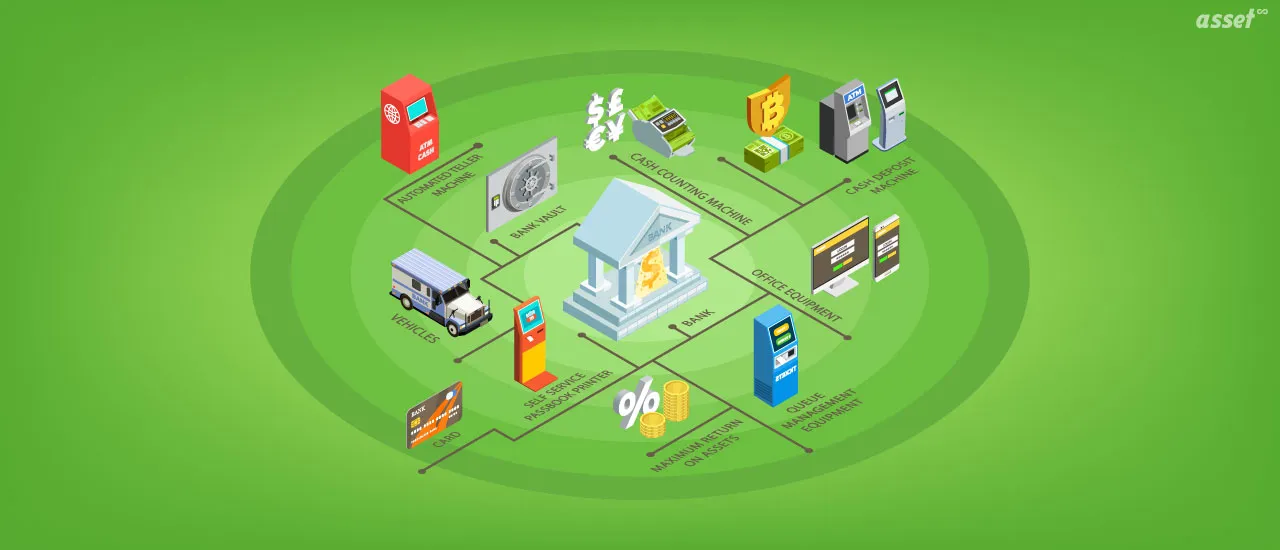
The physical assets or fixed assets of a bank include:
- Building
- Land
- Vehicles
- Furniture
- Office Equipment
- Computers
- Fixtures and Fittings
- Plant and Machinery
- Audio/Video Security
- Automated Teller Machine (ATM)
- Cash Deposit Machine (CDM)
- Self Service Passbook Printer (SSPBP)
- Queue Management Equipment
- Cash Counting Machine/Money Counter
Also Read: Bank Asset Management Across India
What Is Fixed Asset Management?
Fixed asset management is an accounting process that involves tracking fixed assets for financial accounting, preventive maintenance, theft deterrence and more.
It is a systematic way to acquire, maintain, upgrade and dispose of assets in the most cost-effective manner, taking account of all costs, risks and performance. The process begins with the acquisition of an asset and continues through its entire lifecycle.
It helps extend an asset’s life at every stage. It also improves the condition of assets and the way the bank manages its fixed assets.
The fixed asset management process keeps each asset’s value, location and other relevant details on record. Capturing details such as the asset’s original cost and location is essential for compliance and effective decision-making, and it gives the bank more control over its fixed assets. Accurate records let asset managers make informed decisions about maintenance, replacement and disposal.
How an Asset Management System Makes It Easier for a Bank to Manage Its Fixed Assets
Fixed asset tracking lets a bank follow the movement of its IT devices, equipment and machines wherever they are located. Fixed asset software and accounting software together provide a complete way to manage and track assets accurately and efficiently.
Fixed asset tracking is an important part of fixed asset management.
With tracking software, the bank can count its fixed assets across every branch and keep the records in one database. Fixed asset data is essential for accurate reporting and forecasting. Some of the tasks fixed asset tracking software performs:
- Inventory Management
- Tracking of Assets
- Maintenance Management
- Simplifying the daily operations of an organization
- Tagging assets with barcodes or RFID
- Tracking assets by location
- Monitoring asset performance
- RFID Asset Tracking
Depreciation software helps banks calculate accurate depreciation for their books, including tax books. These systems help reduce costs by simplifying asset management and maintenance. Accurate asset records support tax returns, insurance and balance sheet reporting, and exporting depreciation journals to the general ledger avoids entering the same figures twice.
Also Read: Effective ways to control movement of assets in and out of facilities
Importance of Fixed Asset Management System for a Bank
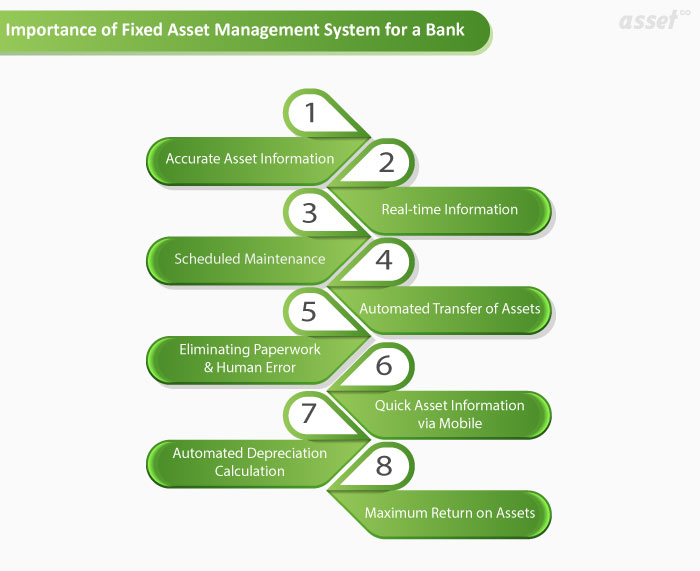
1. Accurate Asset Information
The asset manager can access information on every fixed asset in the institution. Assets can be tagged with RFID tags, BLE tags or beacons and more, and tracked to wherever they are located and whichever branch they are assigned to.
2. Current Information
Information about the bank’s assets is kept current: where each asset is and whom it is assigned to. Asset managers can make better decisions and inform employees accordingly. This way you know the recorded location of each asset and can reduce asset loss or theft.
3. Scheduled Maintenance
Scheduled maintenance is one of the most important benefits, because it helps you head off unexpected breakdowns. Breakdowns can be very disruptive for the bank and for the public it serves. An asset management system helps you avoid them.
4. Recorded Transfers of Assets
With the software, every transfer is recorded, so asset managers have up-to-date information during the transfer process. A transfer can be from one branch to another or between departments within the same branch.
5. Eliminating Paperwork & Human Error
When everything is managed in software, there is less paperwork and fewer human mistakes. Digital records are easy to search and store. They are faster to find, and when every document is online it cannot be misplaced. Approvals and handovers that once needed a signed form can be recorded in the system, with the date and the person responsible.
6. Quick Asset Information via Mobile
Asset managers can see the data on their computers or their mobile devices, which makes it efficient and easy to manage all the assets. The mobile app extends the bank’s reach to assets in every branch.
7. Automated Depreciation Calculation
Asset management software helps asset managers produce accounting reports for compliance. It also calculates depreciation over each asset’s useful life.
8. Maximum Return on Assets
An asset management system monitors each asset to extend its life, and an asset that works properly gives a better return on investment. The software helps the bank keep track of its fixed assets and also supports profitability.
How self-audits can ease asset physical verification
Accounting and Asset Management
Integrated asset management plays an important role in helping banks simplify their accounting, manage asset depreciation and comply with regulatory standards. With fixed asset management software, banks can oversee all their fixed assets, from buildings to office equipment. The software tracks assets precisely, keeping asset records accurate and up to date.
With automated depreciation calculations, banks can manage the useful life of each asset and produce the reports needed for compliance and financial audits. Asset management software also gives current insight into asset status and performance, helping decision-makers make informed choices about purchases, maintenance scheduling and disposal. By reducing human error and automating routine tasks, integrated asset management systems help banks make better use of assets, minimize costs and keep asset data accessible for accounting and compliance. Finance and operations then work from the same records instead of reconciling separate lists at the end of each year.
Cloud-Based Asset Management
Cloud-based asset management solutions offer banks real advantages in scalability, accessibility and security. With cloud-based asset management software, banks can scale to more assets as business needs change without the burden of extra infrastructure. Asset data can be reached from any location with an internet connection, so information is at hand whether staff are in the office or working remotely.
Security is a top priority for banks, and cloud-based asset management software should provide strong protection against data loss and unauthorized access. Regular updates keep the system current and reduce the risk of downtime. With cloud-based solutions, banks get continuous access to the latest features and security improvements, so they can manage their fixed assets efficiently and securely.
Implementation and Best Practices
Implementing an asset management system in a bank involves a series of strategic steps and proven best practices. The process begins with a thorough assessment of the bank’s business needs and asset management requirements. Many banks start with one region or a handful of branches, check that the data and processes work, and then roll out to the rest of the network. Selecting the right asset management software is crucial, ideally a solution that works with existing ERP systems and other software.
Once the software is chosen, configuring reports and establishing dependable asset tracking processes, such as barcode scanning and asset tagging, are essential for accurate asset records. Training ensures everyone understands how to use the system, while regular maintenance and data updates keep the asset register current and reliable.
Best practices such as scheduling regular maintenance and automating depreciation calculations add further value. By following these steps, banks can simplify accounting, depreciation and compliance, improving their asset management and supporting long-term business success.
Keeping a Bank’s Fixed Assets Under Control
Banks and financial institutions hold many fixed assets, whether purchased or procured. These assets can be monitored and tracked through their movements, their maintenance and their audits.
Asset management software brings all these together, gathering the details and data of all the fixed assets on one platform.