






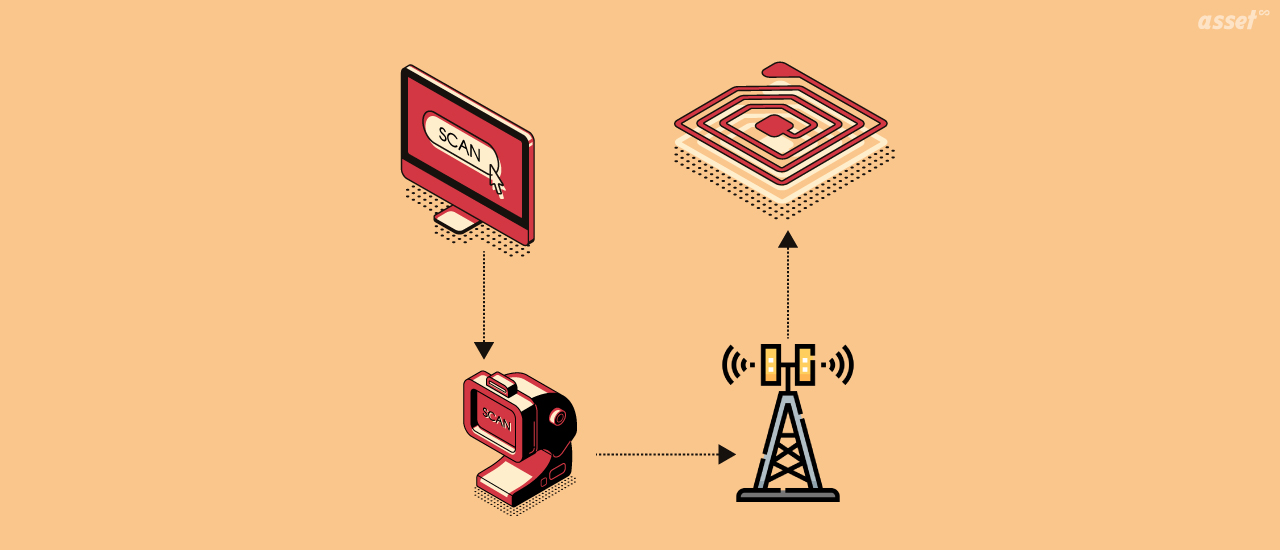
The components of an RFID system are the tag on the item, the reader that talks to it, the antenna that carries the radio signal between them, and the software that turns each read into something useful, such as “this pump left through dock door 2 at 3:14 pm”. Take away any one of them and the system tells you nothing.
Most RFID projects that disappoint do so because one component was chosen without the others in mind: a tag that cannot be read on metal, an antenna pointing the wrong way, or software that records thousands of raw reads but never says where an asset is. This guide explains each component, how they work together, the frequencies and tag types to choose from, and how to put together RFID solutions for asset tracking.
What Is an RFID System?
An RFID (radio frequency identification) system identifies and tracks items using radio waves. A reader sends a signal through an antenna, a tag on the item answers with its identifier, and software records which tag was seen, where and when. Unlike a barcode, a tag can be read without line of sight, and many tags can be read at once.
RFID is used for asset tracking, inventory, access control, toll collection, library books, retail stock and patient wristbands. The components are the same in every case; what changes is the frequency, the type of tag and what the software does with the reads.
The Main Components of an RFID System
| Component | What it does | Choices to make |
|---|---|---|
| Tag | Carries an identifier, and sometimes user data, on a chip with its own antenna | Passive or active, frequency, form factor, on-metal or standard |
| Reader | Powers and talks to tags, and passes reads to software | Fixed or handheld, number of antenna ports, how it connects |
| Antenna | Sends and receives the radio signal | Linear or circular polarization, gain, mounting |
| Middleware | Filters and organizes raw reads | Built into the reader, separate, or in the software |
| Software | Links each tag to an asset and acts on reads | Asset register, rules, reports, mobile app |
| Printer-encoder | Prints labels and writes data to tags | Thermal printer with RFID encoder |
| Network | Carries reads from readers to software | Wired Ethernet, Wi-Fi or cellular |
1. RFID Tags
A tag is a small chip attached to an antenna, packaged as a label, a hard case, a wristband, a key fob or a card. The chip stores at least a unique identifier. In UHF tags this is held in the EPC memory bank, with separate banks for the chip’s own ID (TID) and optional user data.
Tags come in three power types:
- Passive tags have no battery. They draw power from the reader’s signal, cost the least and last for years, but have the shortest range.
- Active tags have a battery and transmit on their own, giving much longer range at a higher cost per tag and a battery to replace.
- Battery-assisted passive (semi-passive) tags use a battery to power the chip but still answer the reader’s signal, which improves read reliability and range.
Tags for metal surfaces include a spacer or special antenna design, because metal reflects the signal and stops standard tags from working. Our guide to types of RFID tags compares form factors in more detail, and active vs passive RFID explains the trade-off for location tracking.
2. RFID Readers
A reader produces the radio field that powers passive tags, decodes their replies and sends the results to software.
- Fixed readers are mounted at doorways, dock doors, gates or conveyor lines, with several antennas connected. They record items passing a point without anyone doing anything.
- Handheld readers are carried by a person, often paired with a phone or built around one, to count a room, audit a shelf or find a single item.
- Desktop readers and printer-encoders read or write tags at a counter, for issuing badges or tagging new assets at receiving.
A toll booth reading a windshield tag is a fixed reader; a technician counting tools with a gun-shaped device is using a handheld.
3. RFID Antennas
The antenna shapes where the reader’s signal goes, and so decides the read zone. Fixed readers usually have several antenna ports, so one reader can cover both sides of a doorway or several dock doors.
Antennas differ in polarization:
- Linear polarization sends the signal in one plane. It gives longer range when tags always face the same way, such as tags on items on a conveyor.
- Circular polarization rotates the signal, so tags are read in any orientation, at a somewhat shorter range. It suits doorways where items pass at random angles.
Antenna placement matters as much as the hardware. An antenna that reaches into the next doorway reports items that never passed through yours.
4. Middleware
A reader can see the same tag dozens of times a second. Middleware filters those raw reads: it removes duplicates, ignores weak reads from far away, and turns a burst of reads into one event, such as “arrived at dock door 1”. It may run on the reader, on a separate server or inside the asset software.
5. RFID Software
Software is where reads become information. It links each tag to an asset record, records where and when the asset was seen, raises alerts or updates locations, and reports on what is missing. Without it, an RFID system produces data nobody can act on. RFID asset tracking software is the layer most buyers spend the most time choosing.
RFID Frequencies and Read Ranges
The frequency decides read range, data speed and how well tags cope with metal and liquids.
| Band | Frequency | Typical passive read range | Common uses |
|---|---|---|---|
| Low frequency (LF) | 125 to 134 kHz | Up to about 10 cm | Animal ID, older access badges, car immobilizers |
| High frequency (HF), including NFC | 13.56 MHz | A few centimeters up to about 1 m | Payment cards, passports, library books, NFC tags |
| Ultra-high frequency (UHF) | 860 to 960 MHz | Several meters, up to about 10 m or more | Asset tracking, inventory, retail, supply chain |
| Active RFID | Often 433 MHz or 2.45 GHz | Tens of meters or more | Large yards, high-value items, real-time location |
For asset tracking, passive UHF is the most common choice, because it reads many tags at once from several meters away at a low cost per tag.
How an RFID System Works, Step by Step
- Tag the asset. A label is printed and its chip encoded with the asset’s number, then fixed to the asset.
- The reader sends a signal. Through its antennas, the reader produces a radio field across its read zone.
- The tag answers. A passive tag in the field powers up and replies with its identifier; an active tag transmits on its own.
- The reader collects reads. It decodes each reply, notes which antenna heard it and how strong the signal was.
- Middleware filters. Duplicate and weak reads are removed and bursts become single events.
- Software acts. The read is matched to an asset, its location is updated, and any rule, such as “tell the supervisor when this leaves the yard”, runs.
How to Plan RFID Solutions for Asset Tracking
Choosing RFID solutions is mostly about matching components to the question you need answered.
| Question | Components you need |
|---|---|
| How many of our assets are in this room? | Passive UHF labels and a handheld reader |
| When did this asset leave the building? | Passive UHF labels, fixed readers and antennas at the exits |
| Which room is this asset in right now? | BLE tags and gateways, or active RFID |
| Where is this vehicle on the road? | A GPS tracker, not RFID |
Before buying hardware, check the environment. Metal shelving, liquids and tightly packed items all reduce read rates. Test the tags you plan to use on the real assets, at the real doorway, before ordering thousands. Our guide to what an RFID system costs covers the budget side.
RFID Solutions by Industry
Manufacturing
A fixed reader on the tool crib doorway records gauges and torque wrenches going out and coming back, and readers on dock doors record pallets of spares arriving.
Hospitals
Handheld readers count equipment on a ward in minutes, and a reader at the loading dock records equipment leaving for repair.
Warehouses and Distribution
Readers on dock doors and yard gates record reusable containers, pallets of equipment and forklifts passing through.
Offices and Campuses
Laptops, projectors and lab instruments are tagged at receiving, and the annual count becomes a walk through each room with a handheld.
How Asset Infinity Puts the Components Together
Asset Infinity provides the software layer, and works with the tags, readers and antennas you choose:
- Tags written as they print. The label designer can write the asset’s number to the EPC, User or TID memory bank on a printer with an RFID encoder. See asset tags.
- Fixed readers from any brand. Readers connect over MQTT or HTTPS, and a payload map in settings says which fields hold the tag, the antenna and the signal.
- Antennas as places. Each antenna is set to a site and location and marked as entry, exit, checkpoint or observe.
- Reads turned into visits. Minimum reads, an absence timeout and a grace window turn a stream of reads into one visit with an arrival and a departure.
- Handhelds in the app. Zebra, TSL and Chainway readers pair with the Android app for counts, tag encoding and finding a single tag.
- Hardware watched. A reader that misses its heartbeats, or an antenna that goes quiet, is reported to a named person.
For the wider picture of tracking methods, see asset tracking software and our RFID asset tracking guide.
Frequently Asked Questions
What are the main components of an RFID system?
The tag, the reader, the antenna and the software. Most systems also include middleware to filter reads and a printer-encoder to create labels.
What are the types of RFID tags?
Passive tags have no battery and are powered by the reader. Active tags have a battery and transmit on their own. Battery-assisted passive tags use a battery to power the chip but still answer the reader.
What are the types of RFID systems by frequency?
Low frequency (125 to 134 kHz) reads at a few centimeters, high frequency (13.56 MHz) up to about a meter, and ultra-high frequency (860 to 960 MHz) at several meters. Active systems reach further.
Can RFID read through metal?
No. Metal reflects radio signals, so tags behind or inside metal often cannot be read. Tags designed for metal surfaces work when mounted on metal, not inside it.
What is the difference between an RFID reader and an antenna?
The reader produces the signal and decodes the replies; the antenna sends that signal into a space and picks up the replies. A fixed reader usually drives several antennas.