







There was a time when barcodes were the only option for asset tracking, but technology has moved on and there are now several asset tracking technologies available. Clients want the best, and this is where RFID comes into play. RFID is widely used across many business verticals, and many more organizations are thinking of adopting it. Before they do, several questions come to mind: How much will an RFID system cost us? What does an RFID tag cost? Will it meet all my requirements? Is it expensive? This article answers those questions.
What is RFID used for?
RFID is a versatile technology used in many industries, such as pharmaceuticals, hospitals and hospitality. Each uses it in different ways.
Hospitals use RFID wristbands to identify patients and link them to information about their care. They combine patient ID with tracking technology, which helps hospital staff tailor care to each patient. Staff can also use them for billing.
The pharmaceutical industry has many costly assets and a lot of inventory, such as medicines. Some medicines are so sensitive that they lose effectiveness if they are not kept within a specific temperature range. RFID with temperature sensing helps you monitor storage conditions and protect stock from theft. With so many medicines, keeping count can be difficult, and RFID can scan all these items within minutes. The system can also alert staff when stock is low so they can restock.
Hotels and restaurants have many valuable items that are hard to count. For example, a hotel with 50 rooms has many assets in each room, and counting them by hand is hectic and time-consuming. Keeping track of them matters, and RFID gives an accurate count quickly: a staff member walks into each room, and all the assets in it are counted within a minute. That saves time and labor.
The two main ways RFID is used
RFID scanner
An RFID scanner reads the tags nearby and retrieves information about the items each RFID tag is attached to. For example, if a room is full of assets, you just turn on the scanner and it gives you the number and details of all the assets in the room. In a warehouse, you simply walk the aisles with a scanner, and it counts items and fetches their information.
RFID gateway
A good example of an RFID gateway is India’s FASTag toll collection. An RFID sticker is fixed to the vehicle and linked to a bank account, so travelers drive through the toll plaza without stopping. It saves a lot of time, because drivers do not have to pay cash or wait in a queue. This electronic toll collection (ETC) system uses RFID to take toll payments directly from the linked prepaid or bank account.
How does RFID work?
RFID works by attaching a tag to an item and using radio waves to read the tag. An RFID system has three main components: a reader, an antenna and a transponder (tag).
Reader
Readers fall into two categories:
Mobile RFID
A mobile RFID reader is a handheld device that reads RFID tags as you walk. Many handheld readers pair with a smartphone or tablet so the readings go straight into an app.
Fixed RFID
As the name suggests, a fixed RFID reader is installed at a stationary point, such as a tollbooth or the entry and exit points of a mall.
Antenna
The antenna sends out a radio-frequency signal that lets the reader communicate with the RFID tag. When the tag passes through the antenna’s field, it picks up the activation signal and sends back its data for the antenna to receive.
Transponders
Transponders are also known as tags. They are what make RFID easy to use and accurate. Tags are affordable to produce and can be made small enough to fit on almost any item.
What are the advantages of using RFID?
Here are the advantages of using RFID:
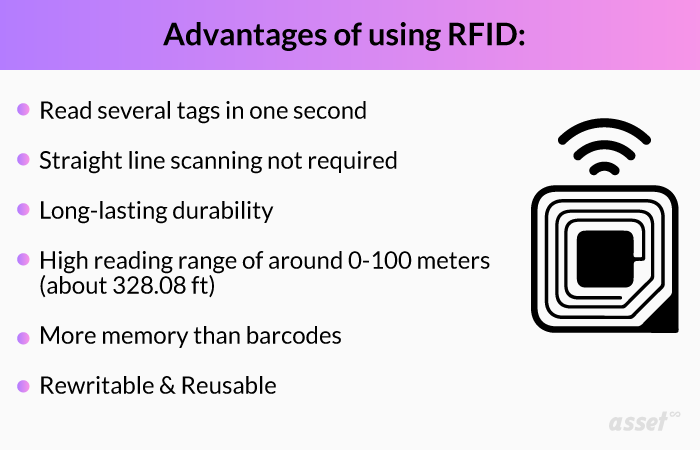
- RFID can read many tags in one second
- Tags do not need to be in a direct line of sight to be read
- Tags are durable and long-lasting
- Read ranges are long, up to around 100 meters (about 328 ft) for active tags
- Tags hold more data than barcodes
- Many tags can be reused and rewritten
Overall, RFID can save a lot of time, increase your productivity and reduce the labor needed, because staff no longer scan one item at a time.
RFID System Cost
There is no single answer to what an RFID system costs, because the cost of RFID is made up of several parts: tags, scanners and software.
Tag cost
There are many types of RFID tags, such as passive UHF and passive high-frequency tags, so the first step is to work out which type you need. Simple passive labels for non-metal items are the cheapest. Tags designed to be mounted on metal cost more each, and active RFID tags, which carry their own battery, are the most expensive.
Scanner cost
Readers are usually the largest hardware cost. Handheld readers and fixed readers each come at a range of prices depending on read range, ruggedness and how many antennas they support, so ask suppliers to quote for the number of doorways and teams you need to cover.
Software cost
Without an asset management system, RFID tags would be of little use. RFID asset tracking software turns each tag read into an update on the asset’s record, which is what makes the system valuable to your organization.
Cloud-based asset management software such as Asset Infinity keeps this cost predictable. In Asset Infinity, the asset register starts at $130 a month for up to 500 assets with unlimited users, and fixed RFID readers are $670 per reader per year with the reader included. See pricing for the full list, and our team can help you plan and implement the complete system.
Also read: RFID Technology Benefits & Drawbacks: Active, Semi-Passive & Passive
Planning Your RFID Budget
Asset management software is essential for an effective RFID asset management system. An RFID system can make your business more efficient and protect assets from theft and misplacement. It gives you accurate, up-to-date information and valuable data on assets that helps you make crucial business decisions.
Overall, RFID system costs vary with your requirements, so it is important to know exactly what you need and what problem the system will solve. An RFID software system can improve the results and raise your business productivity. Investing in RFID asset management software can be a turning point for your organization.