







Patient safety is always a major concern in healthcare. Using today’s technology, the industry relies on the patient ID wristband: a band that links to every relevant detail about the patient.
The healthcare sector’s aim here is clear: provide the safest, highest-quality care to patients with the least chance of error. Patient ID wristbands have proved very successful at this.
The patient ID wristband as an identification method has been shown to improve safety processes for over a decade now.
Patient identification involves cross-checking the data on the patient’s ID wristband against the records and against the information the patient provides. This step is important because it is where the patient interacts with the medical team. Staff typically confirm at least two identifiers, such as the patient’s name and date of birth, before giving medication, taking a sample or starting a procedure, and the wristband makes that check quick and consistent every time.
A barcode wristband makes it easy to keep an error-free record. Before barcode bands, this was a laborious and often inaccurate process. Careless data entry can cause harm if a patient is not given a barcode wristband, or if the wristband does not carry accurate identifying information.
The healthcare industry has worked hard to adopt technology, from the latest equipment and machines to security systems, including protection for patient data. Medical facilities and patient security systems have improved enormously over the past decade, even though human error still poses a continuing risk.
What Are Patient ID Wristbands?
Patient ID wristbands carry a barcode that serves as the patient’s identification code. Staff scan the barcode to read the information it links to.
Patient ID wristbands suit every part of the healthcare industry, including hospitals, clinics, senior care homes, rehabilitation centers and dispensaries.
Identifying patients correctly is essential for accurate tracking and correct medical treatment.
A patient ID wristband can hold, or link to, the following information:
- Patient name
- An assigned medical record number (ID number)
- Patient’s date of birth
- Contact details
- Photograph
- Medical history
- Details of all known allergies
- Administered medication
- Medication dosage
- Assigned lead physician and team
- Details of surgeries, etc.
How Efficient Are Patient ID Wristbands?
Patient ID wristbands have reduced the errors that can compromise patient safety. They greatly lower the chance of medical errors and help doctors and nurses keep accurate track of each patient’s treatment and health measurements.
Modern barcode bands are a marked improvement over the old low-quality or handwritten wristbands. Some of their advantages are listed below:
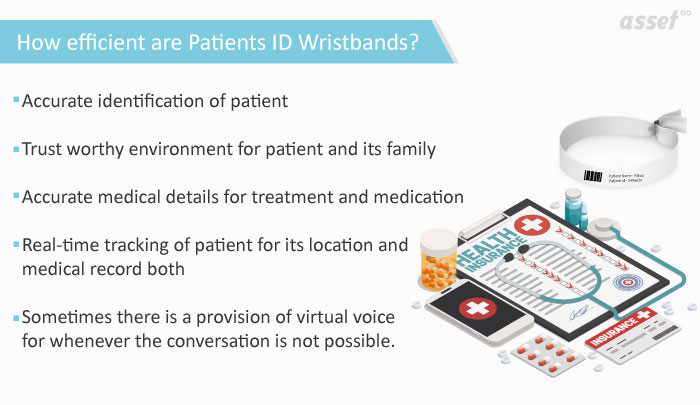
- Accurate identification of patients
- A trustworthy environment for the patient and their family
- Accurate medical details for treatment and medication
- Tracking of patients’ location and medical records within the facility
- A way to “speak” for the patient when direct conversation is not possible
- Before modern patient ID wristbands were introduced, the sector struggled with many safety failures, such as:
- Failure to correctly identify the patient
- Medication errors
- Transfusion errors
- Testing errors
- Procedures performed on the wrong person
- Even infants discharged to the wrong families
Benefits of Patient ID Wristbands
Patient records and the security measures around them are highly confidential, so any solution must meet high security standards and must not be breached.
The solution should give access only to the staff who need it, and it must be accurate and reliable. Barcode wristbands remain one of the most effective ways to protect patient safety across medical records, medication and tracking within the healthcare premises.
Barcode patient ID wristbands bring many benefits, such as:
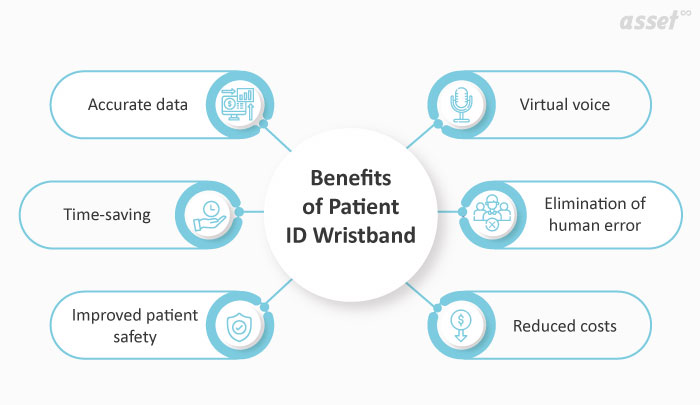
Accurate Data
Scanning the barcode on a wristband gives accurate patient data, making it reliable to identify patients and their treatment. It is a much more efficient method of tracking than recording data by hand.
Time Saving
A barcode scan saves much of the time once spent on administrative tasks and finding history records. With one scan, all the patient’s essential details appear on the computer system or a handheld device.
The same scan can be repeated at every step of a patient’s stay: on admission, when medication is given at the bedside, when a blood sample is labeled and when the patient moves between wards. Because each step uses the same code, nurses spend less time writing and checking details by hand and more time caring for patients.
Improved Patient Safety
Barcode wristbands give instant access to patients’ records, so staff can make decisions on the spot.
For example, if a patient leaves their room and falls or faints somewhere in the hospital, the barcode on their wristband tells the medical staff about that patient: their medical condition, the medication they were on, the dosage, and their assigned doctor and team. This helps staff take the right precautions for the patient’s welfare.
Virtual Voice
The wristband can “speak” for the patient whenever conversation is not possible.
Elimination of Human Error
Barcode patient ID wristbands make record-keeping easy without the risk of manual data entry errors. They address the classic problems of missing data and misread dosages that used to put patients’ lives at risk.
Reduced Costs
Tracking and managing patient data digitally has cut costs considerably.
How Wristbands Changed Patient Identification
Barcode wristbands have greatly improved documentation and identification in healthcare facilities. The goal of going digital is the best possible safety, quality patient care and error-free medical records.
Barcode wristbands have overcome the practical hurdles and met the important objectives: patient safety, fewer human errors, smoother surgeries and correct medicine dosages.
The patient ID wristband is one of the best tools for keeping patients safe and secure, and the same scanning discipline supports hospital asset management.
Barcodes provide accurate data for assets and inventory too. Hospitals also use healthcare asset management software to maintain and track their machines and equipment.