






Theft and misplacement happen every day. Businesses depend on their assets to run efficiently, and those assets need maintenance. When an asset does not work properly, manufacturing and production work stops. Work orders are not completed on time and productivity suffers. That is why asset management software is essential for a business.
Asset management takes care of several areas where organizations run into trouble. Fixed asset management software is used to organize maintenance, extend the life of assets and improve productivity, and more businesses adopt it every year.
Below are five problems that show up again and again in business statistics, and how asset management software helps with each one.
Problem 1: Asset Theft
Asset theft has been a problem for a long time. Heavy plant, equipment and vehicles are stolen from businesses every year, and portable plant such as compressors and generators is especially easy to take from construction sites. Every theft means a replacement cost, a delayed job and often a higher insurance premium.
Also Read: Ultimate Guide About Enterprise Asset Performance Management
Solution - Asset management software helps prevent theft with asset tags and labels. Each tag ties an asset to its record, so you always know where it was last seen and who has it. That keeps every asset accounted for and makes theft harder to hide.
Problem 2: Manual Process
Employees lose a large share of their working day simply looking for information.
This is common when work runs on manual, paper-based procedures. The more paper you have, the longer every search takes, and some searches take far longer than they should.
Solution - Asset management software replaces the manual process with an automated one. It makes the process more efficient and saves time. With this software in place, you do not have to waste time looking for papers, because the software finds the document within seconds.
Problem 3: Inventory Management
Overstocks and out-of-stocks cost retailers a great deal of lost revenue. Too much stock ties up cash and space, and too little stock means lost sales and idle work.
These problems show that many organizations cannot work out how much inventory they should hold to avoid both overstocking and running out.
Solution - Asset management software lets you set a reorder level and alerts you when inventory falls below it, so you can prevent these problems easily. The software keeps track of your inventory.
Problem 4: Asset Maintenance
Many businesses spend most of their maintenance time reacting to problems instead of preventing them. Reactive maintenance is more expensive than proactive maintenance, because assets and equipment are run until they fail.
Also Read: Why Managing a Fixed Asset Register Is Vital & What Are Its Benefits?
Solution - Asset management software puts the emphasis on proactive maintenance, specifically preventive maintenance, and schedules maintenance according to how each asset is used. Preventive maintenance reduces the chance of asset failure. It extends asset life, improves performance and makes the asset more reliable.
Problem 5: Data Security
Data theft is one of the most sensitive topics in business. A large share of the data that businesses hold needs protection, and much of it is still not protected.
Solution - Today, data is one of the biggest assets any organization has, and it must be protected from theft. With cloud-based asset management, a specialist provider takes on much of the work of protecting the infrastructure, which makes data theft much harder.
These providers hold a lot of data, and securing it is their core responsibility. They secure the network and the systems your data lives on.
What Asset Management Software Fixes Across the Business
Asset management helps an organization in many ways. It helps overcome problems that industries have struggled with for a long time, which is why asset management software has a bright future.
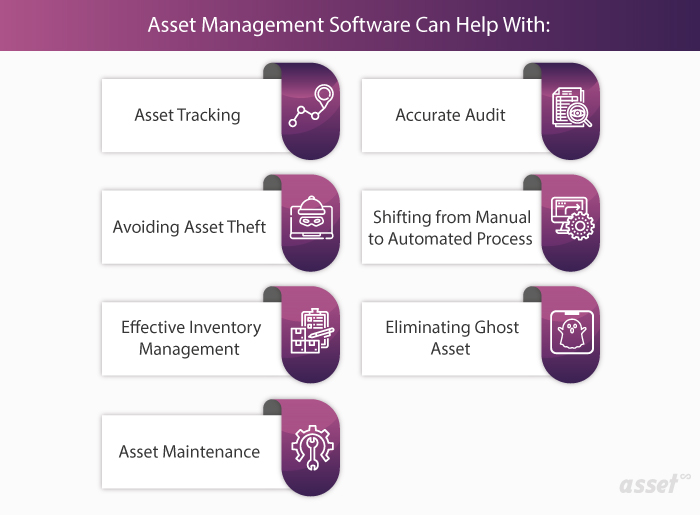
Asset management software can help with:
- Asset tracking
- Preventing asset theft
- Effective inventory management
- Asset maintenance
- Accurate audits
- Moving from manual to automated processes
- Removing ghost assets
- Reports and analytics
Asset management removes manual processes and keeps track of assets with barcodes, QR codes, RFID and similar tags. It improves efficiency across daily operations, maintenance and inventory management, and it helps with the auditing process.
It helps with the physical verification process, which is an essential part of an audit. It also saves the organization a lot of time and protects it from ghost assets.
Asset management cuts business costs and avoids unnecessary spending. It supports business growth and expansion.
Frequently Asked Questions (FAQs)
1. What is a ghost asset?
A ghost asset is an asset that is listed in the accounting books but is not physically available. It means you are paying taxes and insurance on an asset you are not using.
2. What is an asset audit?
An asset audit is the process of verifying assets physically. Each asset’s documents are checked and verified, and its condition is cross-checked. During the audit, ghost assets are identified and written off correctly. The audit also helps you understand the financial statements.
3. In which industries is asset management used most?
Finance, risk management, accounting, real estate, business intelligence, banking, automotive and manufacturing are a few of the industries that use asset management most.