






Asset management does not only mean repairing assets when they break. It also means having assets ready to use when they are needed. Organizations run into several asset management challenges along the way while using their assets. This post covers what those challenges are and how to deal with them. First, let us look at what asset management software is.
What Is Asset Management Software?
Asset management software gives you an automated way to track and manage assets. All asset information is stored in one place and used to extend asset life, so you get more return on what you spent.
It helps organizations manage assets at every stage, including procurement, maintenance, use and disposal. It also sends alerts and notifications to the people who need them.
Manual processes are error-prone, which is why it is better to use asset management software. Automation helps with scheduling maintenance and monitoring asset condition.
Its features make day-to-day asset management much simpler.
Recommended Reading: 5 Problems Occur Due to the Absence of Asset Management
4 Asset Management Challenges Faced by Small Organizations
Below we discuss the main asset management challenges:
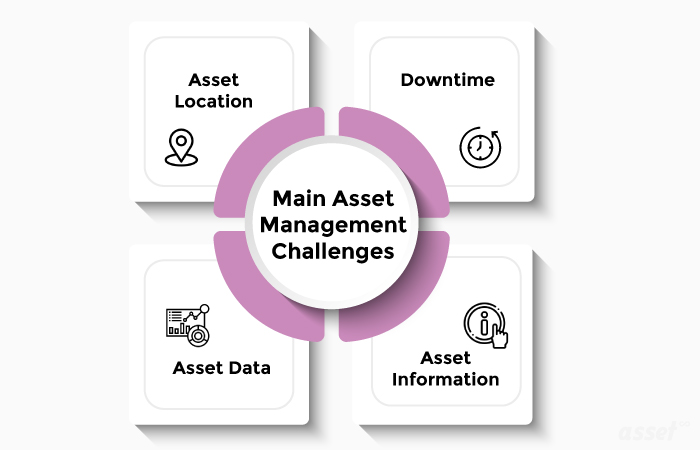
1. Asset Location
You should always know where each asset currently is. Most importantly, assets must be found quickly, because employees’ time is wasted searching for them. When an asset is needed, you can then take it to the right place without delaying the work.
This is not a simple job, because there are many assets and pieces of equipment, and nobody can keep track of every asset by memory.
Solution
With asset management software, you can keep track of assets as they move. This is especially helpful in construction, where the work location keeps changing. With this software, you can plan asset use more efficiently.
You also always know where an asset was last recorded. That means you can find assets when you need them, and it helps when assets are stolen or misplaced.
2. Downtime
Downtime has always been a big challenge for asset management, because it hurts productivity and slows operations, which delays production.
When an asset is not working, it adds no value to the organization. On top of that, the organization spends money on maintenance while no revenue comes in. That is why reducing downtime is essential for every organization.
Solution
To meet this challenge, downtime must be planned for each asset. To do that, organizations should invest in automated asset management software that helps schedule maintenance for each asset. Over time, you should see average downtime fall.
3. Asset Data
Collecting all asset information can be hectic. It is one of the major asset management challenges, because most of the work is done by hand. Keeping everything organized, putting all the information in one place and finding accurate information when you need it can be difficult.
Solution
With asset management software, you can keep all documents in one place and find any of them within seconds. You can also make sure the data is accurate.
Accurate information gives you insight that helps you save money and extend asset life. Asset information also helps with decision-making and setting future goals.
Missed It? What Do We Need to Know About the Asset Reservation System?
4. Asset Information
Managers often do not know where assets are, who is using them and whether they are used often.
These challenges are common when you work manually. They are a real problem, because employees sometimes use assets for personal work.
Sometimes assets are not used at all. Sometimes they are unavailable because someone else is using them. Problems like these are common.
Solution
Asset management software solves this with check-in and check-out. Through this feature, managers know who is using an asset, when it will be returned and how often it is used.
Assets can also be reserved for upcoming work, so jobs can be planned in advance around the availability of assets.
Why Growing Businesses Should Move Off Manual Tracking
Small organizations often manage their assets by hand because their budgets are tight. As the organization grows, these become the most common asset management challenges.
You can avoid these issues with asset management software, which brings several benefits to the organization.
Investing in this software can give your business an edge and help increase your return on investment (ROI).
Also Read: Benefits of Asset Management Planning and How to Implement It.
Frequently Asked Questions (FAQs)
Q.1 - What Is Asset Management?
Asset management is a structured approach to tracking, monitoring and maintaining assets so that they are used well and downtime is reduced. The purpose of asset management is to improve productivity and make equipment more efficient.
Q.2 - What Are the Benefits of Asset Management?
The benefits of asset management are given below:
1. Avoiding sudden asset breakdowns.
2. Improving asset performance.
3. Protecting assets from theft and misplacement.
4. Extending asset life.
5. Lowering maintenance expenses.
Q.3 - How Does Asset Management Software Help Prevent Asset Theft and Misplacement?
Asset management software uses asset tracking technologies such as barcodes, QR (Quick Response) codes, RFID (Radio Frequency Identification), BLE (Bluetooth Low Energy), GPS (Global Positioning System), NFC (Near Field Communication) and IoT (Internet of Things). These technologies record where each asset is, which helps prevent theft and misplacement.