







Many organizations do not get the results they expect from their asset management system, and they start to think the software is not right for them. Often the real reason is that they did not research or plan. It is crucial to understand exactly what your organization needs and what problem you want to solve with the software. After that, you should do asset management planning before purchasing asset management software. This article explains why asset management planning is crucial for an organization and how to implement it.
What Is the Importance of Asset Management Planning?
Asset management planning is the backbone of an effective asset management system. It provides a roadmap for that system.
It helps you get the most value from physical assets with the least maintenance expense. With proper asset management planning, you can work out which features the software must have to achieve the productivity you want.
Asset management planning can help extend asset life so that output improves. Accurate planning and a strategic approach are essential to reach this goal.
Asset management planning defines which activities must be avoided and how essential activities are carried out. It also defines relationships and dependencies, so that work is not held up and confusion does not arise.
In simple words, asset management planning is the blueprint of an asset management system. It helps organizations change, invest in and update their asset management systems.
What Are the Benefits of Asset Management Planning?
Asset management planning is a continuous process that increases asset reliability. That makes reliable assets one of its major benefits.
It also improves operational safety, creating a safe environment for employees and for assets. Many incidents around the world have been caused by sudden equipment failure.
When an asset is maintained on time, it performs better and its asset lifecycle is extended. This is how asset management planning leads to a better return on investment (ROI). It is a major benefit of proper planning, though it takes effort to achieve.
Asset management planning is a long-term approach to managing assets that helps organizations reduce downtime, get more from each asset, and lower work costs.
These are the major benefits of asset management planning.
How to Implement an Asset Management Strategy?
Here is how to implement an asset management strategy:
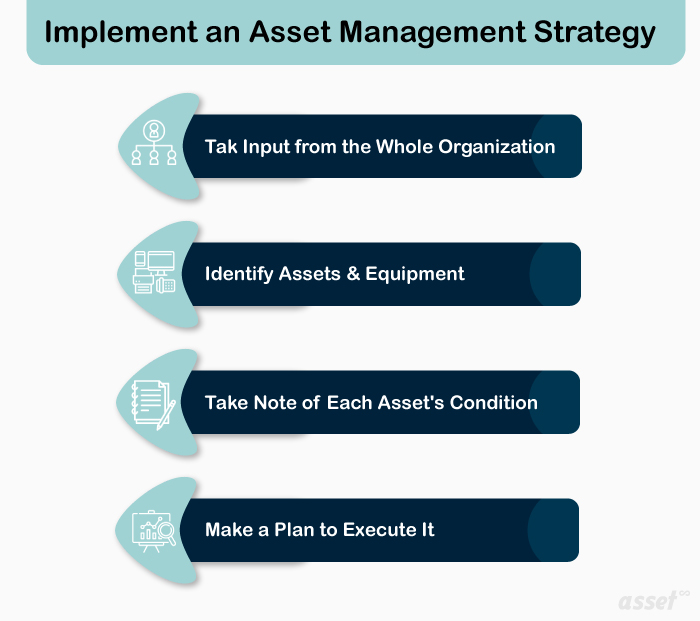
1. Take Input from the Whole Organization
When making plans, take input from everyone. However knowledgeable you are, every employee who runs operations day to day has insights that can help.
Requirements built this way produce a system that fits your business needs better than one chosen without them.
2. Identify Assets & Equipment
When creating an asset management strategy, identify all your assets and pieces of equipment along with their priority.
Some assets matter more than others, so it is important to prioritize and categorize every asset. The maintenance team can then plan its work accordingly and deliver productive work.
Once you have a list of all your assets, you can make sure every asset is maintained on time.
3. Take Note of Each Asset’s Condition
Keep track of every asset and its condition. To do so, record data for each asset, such as when it was purchased and how often it is used.
4. Make a Plan to Execute It
An enterprise needs to stay organized, and that is why a plan is required. Deciding is one thing, though, and executing the plan is another.
Execution can be hard and will raise issues, but in the long run it supports your business growth.
Suggested Read: How Important is ITAM Strategy for IT Systems and Assets?
What Good Planning Makes Possible
Asset management software helps you manage, track and monitor all your assets. It can help you save on maintenance, and employees will know exactly where inventory and assets are kept, which saves their time. It also lowers the chance of asset theft.
Frequently Asked Questions (FAQs)
What Are the Best Practices of Asset Management?
Best practices of asset management are:
1. Tag assets with asset tracking technology.
2. Monitor assets regularly.
3. Track each asset’s complete life.
4. Make sure assets get proactive maintenance.
5. Create a checklist for maintenance.
6. Conduct asset audits on a regular basis.
Why Is Asset Management Widely Used in the Manufacturing and the Oil & Gas Industry?
Asset management software is widely used in the oil & gas industry and manufacturing industry. These industries are asset-intensive, with large, complex machines, so keeping track of every aspect of those machines is crucial for day-to-day operations. If these assets do not work properly, work is delayed, which is why asset management is widely used in these industries.
What Are the Features of Asset Management Software?
Common features of asset management software include:
1. Asset maintenance schedules.
2. Alerts when performance is poor.
3. Notifications to the maintenance team for upcoming maintenance.
4. Reorder levels for inventory.
5. Inventory and asset tracking.
6. Real-time information with cloud technology.
7. Mobile access to use the app on the go.