






School asset management software that gets every room ready for the first bell
Our school asset management software sends a teacher's report of a broken projector to facilities with the room filled in. Furniture, student devices, labs and buses are counted, maintained and booked from one register.
- Uniform Guidance 2 CFR 200.313 (federally funded equipment inventory)
- NFPA 101 (Life Safety Code)
- OSHA 29 CFR 1910 (general industry)
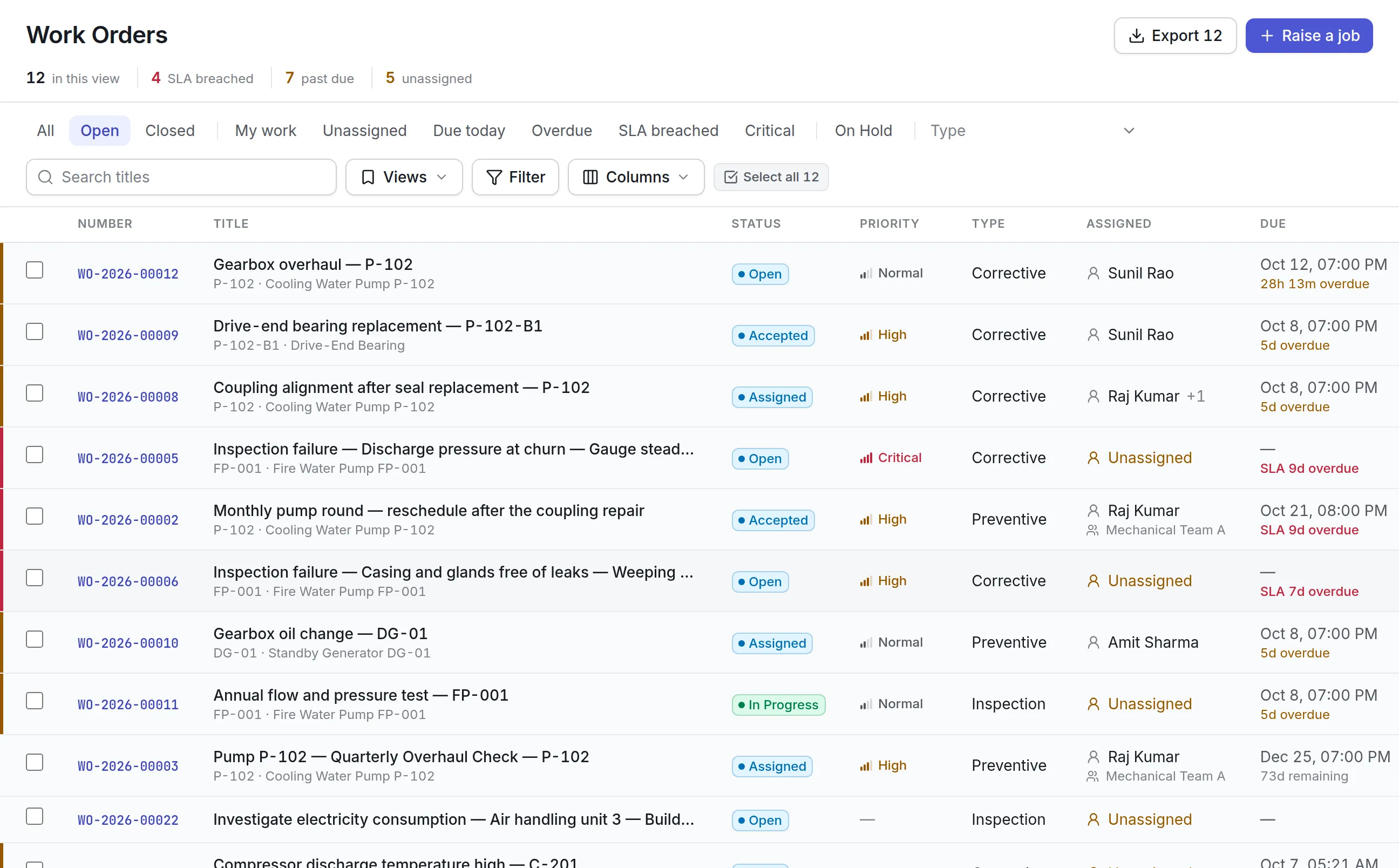
What our school asset management software does for districts and campuses
Requests from teachers
Staff report faults from the web or by email, and every request reaches facilities in one queue. Technicians scan the label in a classroom to raise a job on the right asset.
Rooms ready for term
Start-of-term checklists cover projectors, lighting, desks and the evacuation route. A failed safety item raises a job on that room.
Equipment counted
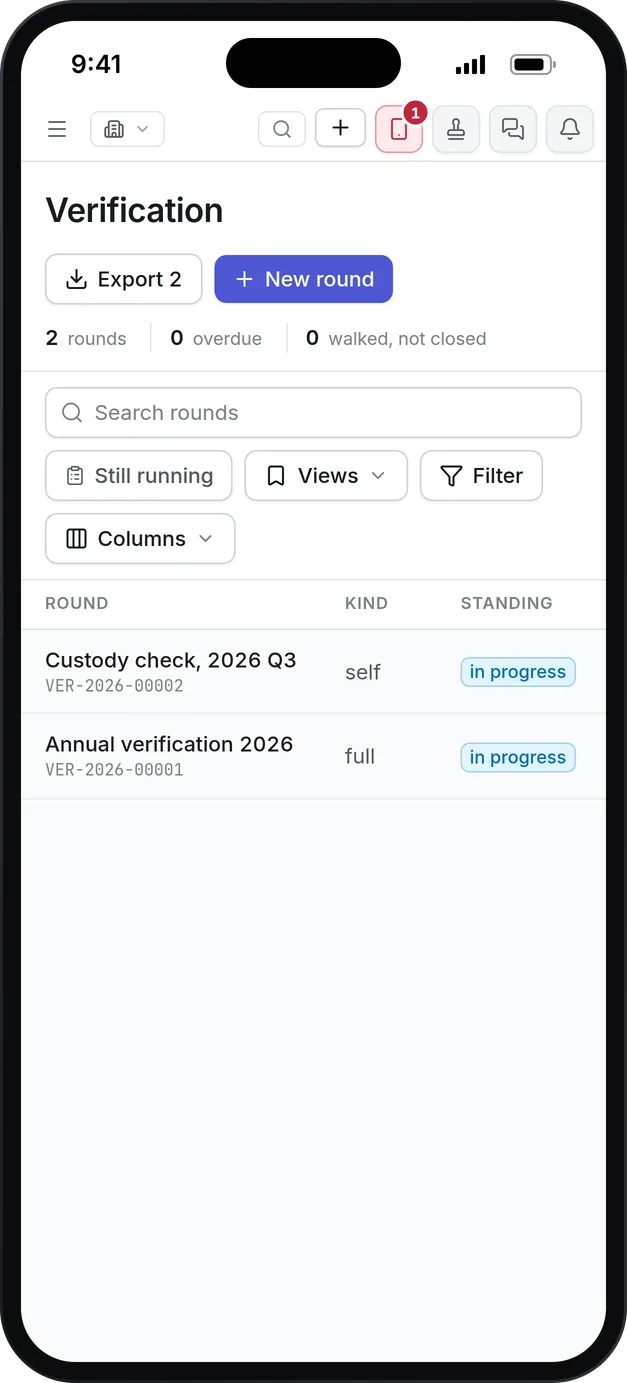
Verification rounds count furniture, lab equipment and devices room by room, listing what is missing, damaged or somewhere else.
Devices and loans
Laptops and tablets are tracked by serial and holder, lent and returned with their condition, and discovered on the network with their installed software.
Labs, halls and courts booked
Auditoriums, labs and gyms are bookable by the hour, with outside groups charged and refused requests counted.
Buses and plant on schedule
Pre-trip checks, bus service by mileage, boilers and fume hood tests fall due on their own and raise work orders.
What is school asset management software?
School asset management software is a system that keeps a register of everything a school, district or university owns, from buildings, boilers and buses to furniture, lab equipment, projectors and student laptops. It records where each item is, who holds it, what it cost and the maintenance done on it, and runs the repairs that keep classrooms usable.
Districts buy it because equipment bought with grant money has to be counted, devices walk out of classrooms, and the facilities team hears about a broken projector from five different people in five different ways.
How school asset management software works in Asset Infinity
Each campus is a site with buildings, floors and rooms beneath it: classrooms, laboratories, the library, dorms and sports facilities. Projectors and laptops are recorded against the rooms they belong to. A typical repair runs like this:
- A teacher reports the problem.From the web portal or by email, with the room and a photo. Staff with a requester sign-in can follow their own requests without seeing the whole work order list.
- Facilities triages it.The request lands in one inbox, sorted worst first. A planner classifies it, converts it to a work order, or rejects it with a reason the teacher will read.
- A technician takes the job.The job appears in the mobile app. At the room, the technician scans the projector’s label to open its record and history.
- The fix is recorded.Parts, time and the cause go on the job, so a projector that fails every term shows up in its history.
- Planned work keeps it from happening again.Projector lamp and filter services, fume hood tests, generator runs and bus services fall due by calendar or odometer and raise their own work orders.
Maintenance request software covers request intake, and work order software covers what happens on the job.
Equipment counts for grants and audits
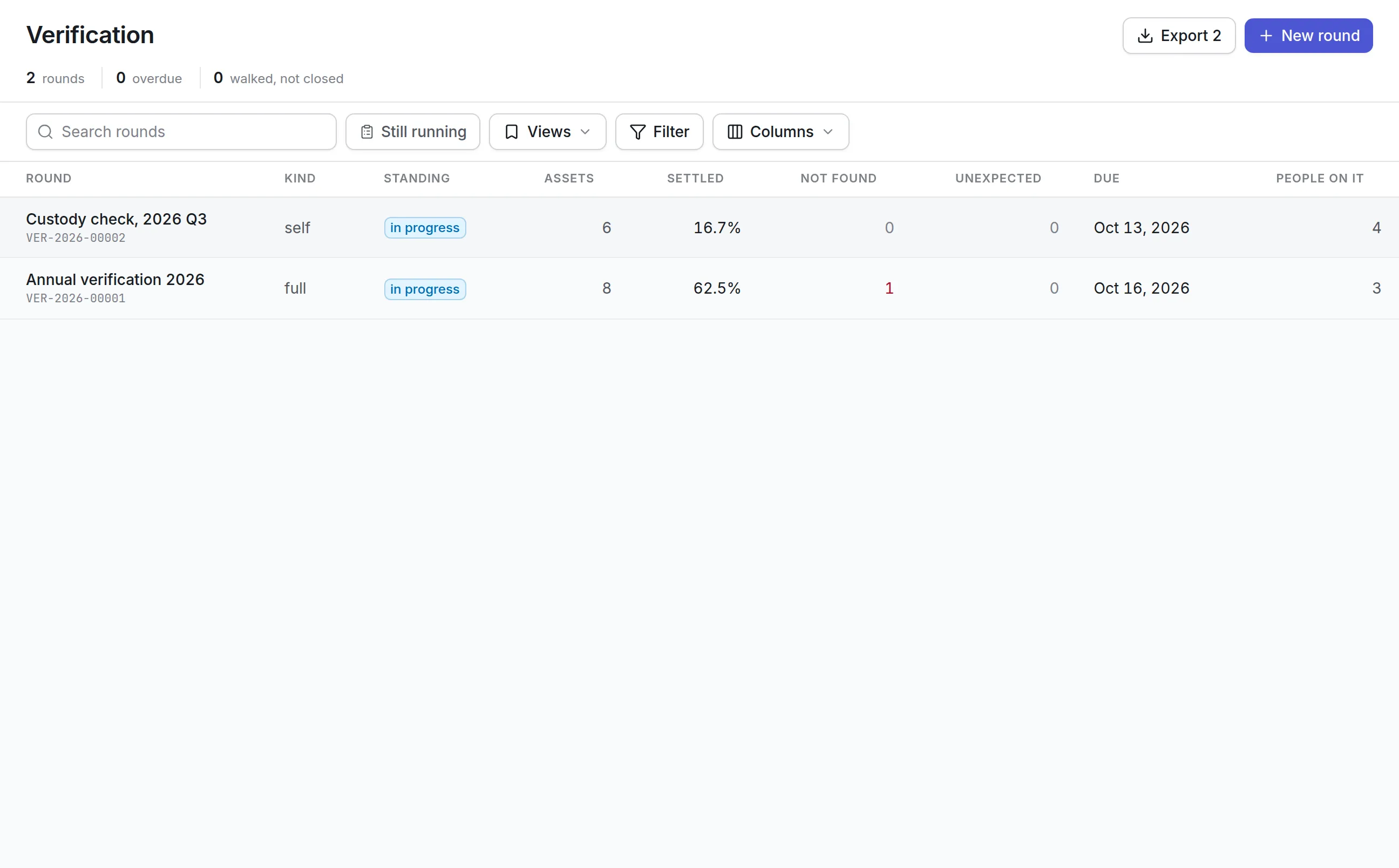
Equipment bought with federal funds has to be inventoried. Uniform Guidance asks for a physical inventory at least once every two years, and many districts count every year. Verification rounds do that room by room.
- Scope the round by campus, building, room or category, or supply a list to recount
- Send auditors with the mobile app to scan what they find, room by room
- Or ask custodians by email to confirm the items recorded against them, without an account
- Require a photo for anything recorded as here, moved or damaged
- Close the round with a report of what is verified, missing, damaged or in the wrong place
More detail
How a count works:
More detail
Asset Infinity keeps the inventory records; your business office decides what they mean for a grant. Asset inventory software covers verification in depth.
Labs, halls and courts booked by the hour
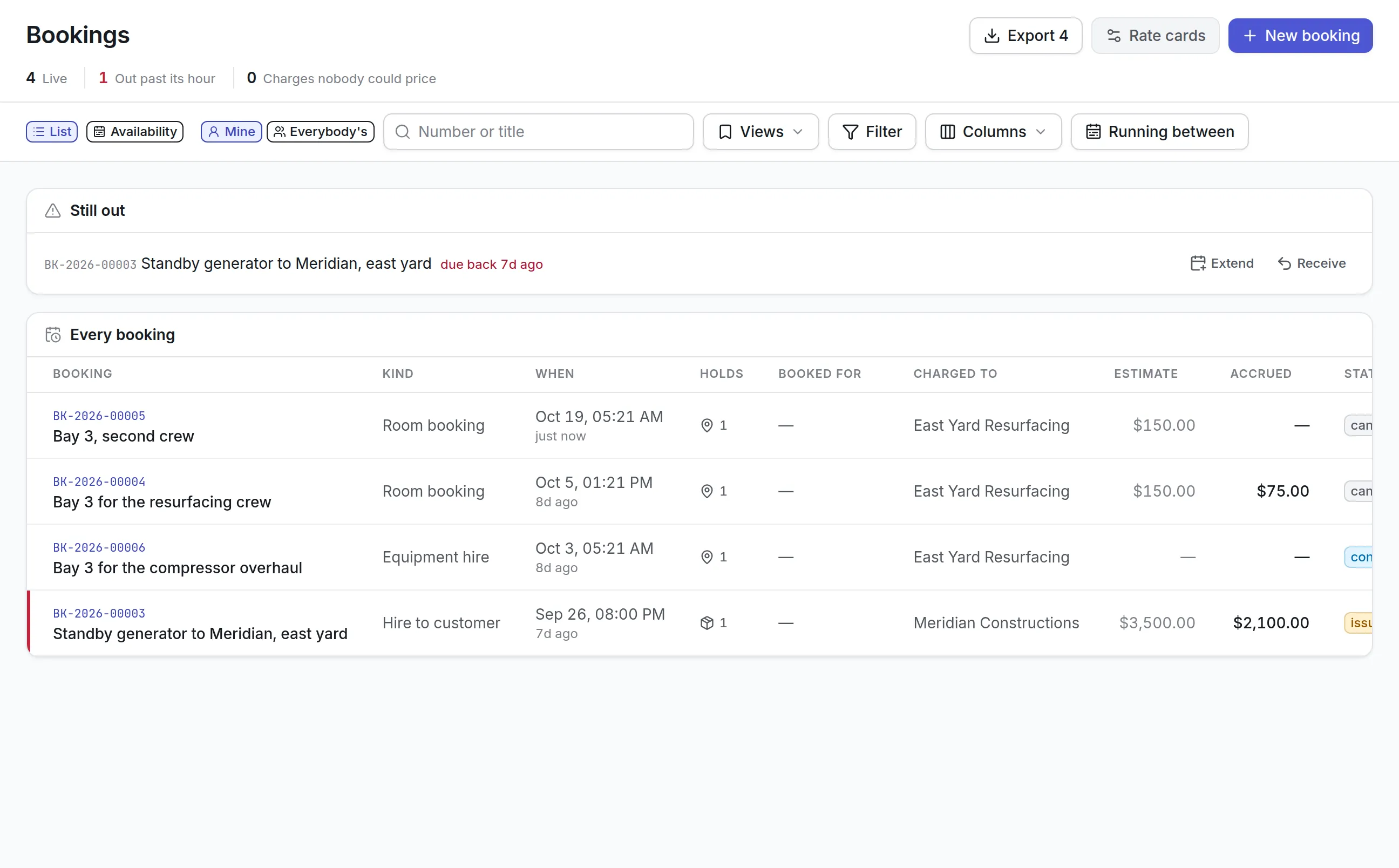
Auditoriums, labs and gyms are places people book. The bookings module reserves a place, an asset or a piece of equipment for a window, hands it over and takes it back, and says who pays.
- Rooms, labs and the auditorium bookable by the hour
- Rate cards for outside groups, with charges worked out on the booking
- Bookings still out past their hour flagged at the top
- Cameras, calculators and laptops lent through equipment checkout, with their condition on the way out and on return
Student and staff devices on the same register
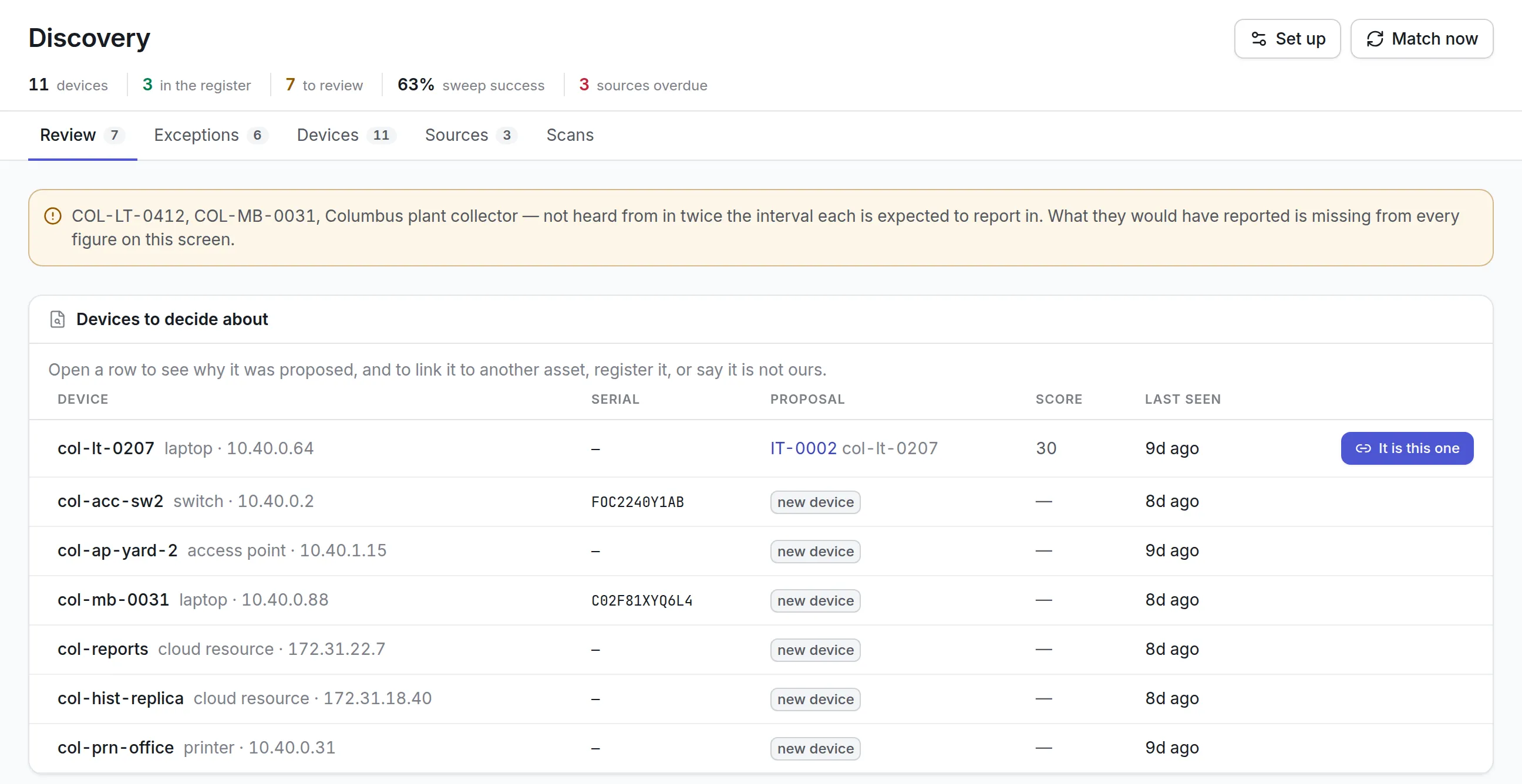
Laptops, tablets and interactive panels are assets like any other, recorded by serial number, room and holder. IT discovery adds what is on the network.
- Devices found by endpoint agents and network collectors, matched to the register by serial
- New devices nobody registered, waiting for someone to link, register or dismiss them
- Installed software listed per device, compared with licenses bought
- RFID readers at a loading door can record when a laptop cart leaves a building, as described on RFID asset tracking
More detail
IT asset discovery explains agents, collectors and matching.
Safety checks for labs, buses and buildings
Schools run more recurring safety checks than most organizations, and each one is a record someone may ask for after an incident. In Asset Infinity they run as graded inspection rounds on the phone:
More detail
Each check is graded against its expected answer or range. A failed critical check raises a corrective work order on that room, lab or bus by itself, and the round keeps the checklist version it was asked, the photos and notes, and who carried it out. Asset Infinity keeps those records; it does not certify that a school complies with any code. The visitor register, an optional module, records who is expected on a campus and who is still there.
What to look for when choosing school asset management software
| Capability | Why it matters | In Asset Infinity |
|---|---|---|
| Campus, building and room hierarchy | Every request and count happens in a room | Campuses with buildings, floors and rooms |
| Requests from teachers | Teachers will not learn a maintenance system | Web portal and email, with requester sign-ins |
| Unlimited users | Every staff member may need to report something | The asset register price includes unlimited users |
| Physical inventory | Grant-funded equipment must be counted | Verification rounds by room, with auditor or custodian counts |
| Device tracking | Laptops move between students and rooms | Serial, holder, loans with condition, and network discovery |
| Room and equipment bookings | Labs and halls are shared | Hourly bookings with rate cards for outside groups |
| Preventive maintenance | Boilers, fume hoods and buses cannot wait for a fault | Calendar and meter triggers raising work orders |
| Safety checks | Labs and buses are inspected | Graded rounds that raise a job when a critical check fails |
| Access by campus | Each school runs its own buildings | Site access per user, with a district-wide view for leaders |
| Offline mobile app | Basements and portables have weak signal | iOS and Android app that syncs when back in range |
See it on your own assets, or price it in two minutes.
School asset management software by team and campus type
K-12 district facilities
The facilities team runs teacher requests, the start-of-term classroom readiness check and monthly lab safety checks across every school. Boilers, HVAC and generators run on planned maintenance, and each school’s custodial lead sees only their own buildings while the district sees all of them. Response targets follow what is waiting: in the trial, a fault stopping a lesson promises a one-hour response and a laboratory safety fault thirty minutes.
District technology department
IT keeps student and staff devices on the same register as the furniture, with network discovery listing what is connected and what software is installed. Loans of laptops and tablets carry their condition out and back, so a returned device with a cracked screen is recorded at the desk. Licenses bought are compared with installed software.
Transportation
Buses are assets with odometers. The pre-trip check runs on the driver’s phone, a failed brake or light item raises a work order on that bus, and services fall due by distance driven. A school bus servicing agreement sits on the contract register. Spare buses, tires and filters are tracked too, so the transportation office sees which buses are off the road and why.
College or university campus
A university runs several campuses with dorms, labs and sports facilities. Lab equipment and fume hoods have their own plans, auditoriums and labs are booked by departments and outside groups, and the business office counts grant-funded equipment each year. Departments can each be given access to their own buildings, while the facilities office keeps one view of open work, overdue plans and spend across the whole university.
What school asset management software costs with Asset Infinity
The asset register starts at $130 a month for up to 500 assets, with unlimited users, so every teacher can report a problem without a per-seat charge. Maintenance is $25 per user per month for the people who work the jobs. Add-ons are flat per organization:
- Maintenance requests, $75 a month
- Bookings and reservations, $150 a month
- RFID fixed readers, $670 per reader a year with the hardware included
Build a quote for your district. The education trial opens with a campus of classrooms, labs, a library and sports facilities, projectors and laptops tagged to rooms, buses with pre-trip checks, a bookable auditorium and two labs, and an annual stock-take of one building half done.
Getting started
To see it with your own campus, book a demo.
What teams in this industry use most
Common questions
What is school asset management software?
School asset management software keeps a register of what a school or district owns, from buildings and buses to furniture, lab equipment and student devices. It records where each item is, who holds it and the maintenance done on it.
Can it run school maintenance as well?
Yes. Teachers and staff report problems, facilities turn them into work orders, and boilers, HVAC, fume hoods and buses run on preventive maintenance schedules.
Does it help with physical inventories of equipment?
Yes. A verification round lists what should be in each room, staff scan what they find, and the report shows what is verified, missing, damaged or in the wrong place.
Can it track student laptops and tablets?
Yes. Each device is recorded by serial and holder, loans and returns keep their condition, and network discovery lists devices and their installed software.
Does it work for a university as well as a K-12 district?
Yes. A campus, its buildings, floors and rooms are set up the same way whether it is an elementary school or a university, and access can be limited so each campus team sees its own buildings.
How much does school asset management software cost?
Asset Infinity's asset register starts at $130 a month for up to 500 assets with unlimited users, so every teacher can report problems without a per-seat charge. Maintenance and other modules are priced separately.
See it with your own assets
A demo run on an example from your industry. Or start the trial and look around on your own.