





What is the best EAM software in 2026?
The best EAM software for your organization depends on scale and on the ERP you already run. IBM Maximo, SAP, IFS and Oracle suit large asset-intensive enterprises; Octave Attune EAM suits linear infrastructure; eMaint suits reliability teams; Asset Infinity suits mid-sized organizations that want maintenance, assets and finance in one product without an ERP project.
We make Asset Infinity, so we are not neutral. Every claim about another product comes from that product’s own website as of October 2026, and where we could not confirm a feature we say so. This page compares features only; enterprise software is quoted on your own scope.
EAM software defined, and why organizations move to it
Enterprise asset management (EAM) software manages physical assets across their whole life: planning and buying them, maintaining them, measuring how reliable they are, accounting for their cost and value, and deciding when to repair, replace or dispose of them. It covers what a CMMS does and adds the financial and lifecycle side, usually across many sites.
More detail
Organizations move to an EAM when these questions have no single answer:
Because an EAM touches so many departments, it usually stays in place for a decade, so the choice deserves more care than a CMMS.
How to choose the best EAM software
- Asset register depth and structure.It should hold your companies, sites, plants and the asset hierarchy down to components, and keep each site’s people to their own records. If you run pipelines, roads or rail, ask about linear assets.
- Work orders and maintenance strategy.Calendar, meter and condition-based maintenance are the base. Plants also need shutdown planning, permits to work and a check that parts, tools and skills are ready before a job is released.
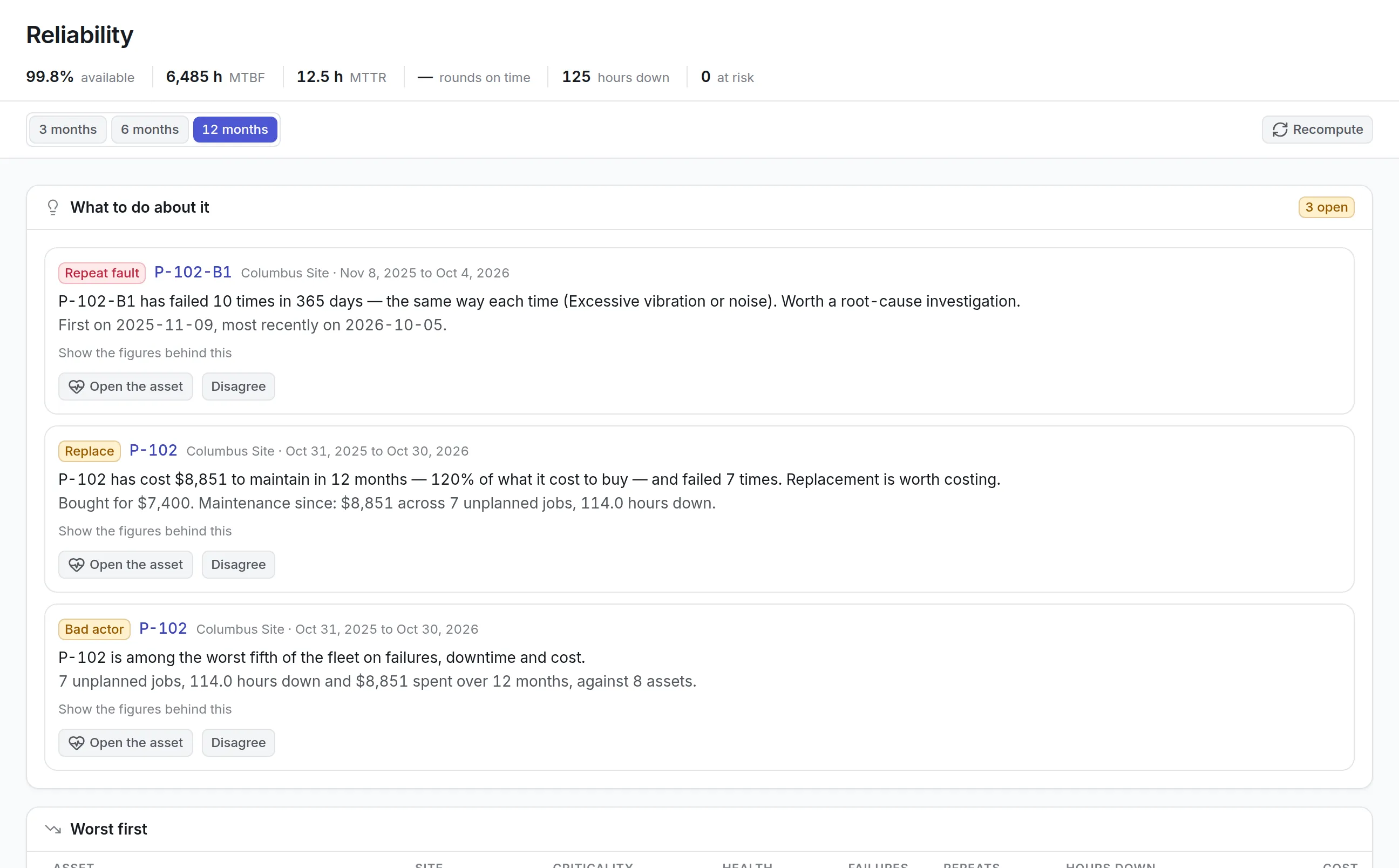
- Reliability.Failure codes, root cause analysis, reliability-centered maintenance and a view of which assets fail most turn records into decisions.
- Mobile and offline.Plants, substations and pipelines are rarely well connected. The field app should work offline and say plainly what has reached the server.
- Inventory and purchasing.Stock across storerooms, reorder planning, requests, quotations, purchase orders and receiving, or a clean link to the ERP that holds them.
- IT assets.Few EAM suites cover IT. If operational technology and IT sit with one team, ask about network discovery.
- Depreciation and money.Budgets, capital plans, contracts and depreciation live either in the EAM or in the ERP. Know which you want before the demos.
- Integrations and API.Ask for a documented API, webhooks, file exchange for older systems, and single sign-on with your own identity provider.
- Deployment options and setup effort.Cloud, on premises or both. Ask how long a rollout like yours took; an eighteen-month rollout costs more than its license.
EAM software features compared
Yes means the vendor’s own website lists the capability. Partial means it lists a narrower version or lists it on some plans only (see the notes). Not listed means we did not find it on the vendor’s site; large suites in particular do far more than one page shows, so ask. For our own product, No means it does not do it.
| Capability | IBM Maximo | SAP | IFS Cloud | Oracle | Octave Attune | eMaint | Asset Infinity |
|---|---|---|---|---|---|---|---|
| Condition-based maintenance | Yes | Yes | Yes | Yes | Not listed | Yes | Yes |
| Reliability analysis (failure modes, RCM, root cause) | Yes | Yes | Not listed | Not listed | Yes | Not listed | Yes |
| Planning and scheduling | Yes | Not listed | Yes | Not listed | Yes | Not listed | Yes |
| Mobile app that works offline | Partial | Yes | Not listed | Partial | Partial | Yes | Yes |
| Inventory and procurement | Partial | Partial | Yes | Yes | Yes | Partial | Yes |
| Finance on the same platform or record | Partial | Yes | Yes | Yes | Not listed | Partial | Yes |
| Linear assets and geospatial | Not listed | Not listed | Not listed | Not listed | Yes | Not listed | No |
| IT asset discovery | Not listed | Not listed | Not listed | Not listed | Not listed | Not listed | Yes |
| Runs on your own servers | Yes | Not listed | Not listed | Not listed | Not listed | Not listed | Yes |
Notes on Partial: Maximo and Oracle list a mobile app for technicians, and Octave lists mobile inspections and work requests, without saying they work offline. Maximo lists AI-assisted inventory optimization and capital planning; SAP lists closed-loop asset management that keeps supply chain and finance in step; Oracle lists work order cost accounting. eMaint lists inventory with reorders and cycle counts, and ERP connectors on its Enterprise plan. Asset Infinity tracks GPS-fitted assets on a map but does not offer linear asset management.
See it on your own assets, or price it in two minutes.
Three EAM suites built on an ERP
SAP Enterprise Asset Management
SAP’s asset management, built on SAP S/4HANA, aims at asset-intensive industries. Its site lists reliability strategies based on FMEA and RCM, AI-based predictive maintenance that estimates remaining useful life, a mobile app that works online, offline or occasionally connected, and closed-loop asset management that keeps finance, supply chain and execution in step.
Suits best: organizations that already run SAP for finance and supply chain and want maintenance inside it.
IFS Cloud EAM
IFS says IFS Cloud EAM manages assets from design through decommissioning. Its site lists AI-driven dynamic scheduling, predictive maintenance from condition data, interactive 3D models that work can be raised from, repair-or-replace decision support and lifecycle cost forecasts, with finance and procurement on the same platform.
Suits best: asset-intensive organizations that want EAM and ERP from one vendor, with planning, maintenance and finance in one platform.
Oracle Fusion Cloud Maintenance
Oracle describes its maintenance product as part of Oracle Fusion Cloud SCM. Its site lists integration with Oracle’s supply chain, customer and financials applications, work order cost accounting, condition-based maintenance from connected equipment, warranty tracking and claims, spare parts planning and a mobile-enabled experience for technicians.
Suits best: organizations already on Oracle Fusion Cloud that want maintenance costs to land in the same ledgers.
Three EAM products for reliability and infrastructure
IBM Maximo Application Suite
IBM describes Maximo as a unified asset and facilities management solution covering maintenance, inspections and reliability. Its site lists condition-based maintenance from sensor and meter data, predictive asset performance management, failure mode analysis, AI visual inspection, AI-assisted inventory optimization, capital planning and a mobile app for field teams. It can run as SaaS or client-managed software.
Suits best: large organizations in energy and utilities, manufacturing, oil and gas, transportation and government.
For a side-by-side look at the two products, see our IBM Maximo alternative comparison.
Octave Attune EAM
Octave Attune EAM is the rebranded HxGN EAM, which its site describes as a cloud-based solution for fleets, facilities, equipment and infrastructure. It lists linear asset management with geospatial tracking, reliability-centered maintenance, smart scheduling, an embedded AI assistant, mobile inspections and work requests, digital twins, and inventory and procurement.
Suits best: organizations with infrastructure that runs in lines, such as roads, rail and pipelines.
eMaint
eMaint, part of Fluke Reliability, describes itself as enterprise-grade CMMS and EAM software. Its site lists preventive and condition-based maintenance with Fluke sensors, a mobile app with an offline work mode, inventory with reorders and cycle counts, calibration, and on its Enterprise plan multi-site operations, single sign-on, APIs and ERP connectors.
Suits best: maintenance and reliability teams that want a lighter rollout than an ERP-based EAM.
How Asset Infinity handles reliability and maintenance as an EAM
Asset Infinity is an EAM for mid-sized organizations that want the asset’s whole life in one product without an ERP project behind it.
More detail
Suits best: mid-sized organizations across many sites. A national utility with linear networks, or a company standardized on SAP or Oracle, will usually be better served by those suites.
Finance, integrations and deployment in Asset Infinity
The money side sits on the same asset record as the maintenance history, so a repair-or-replace decision can see both.

EAM software by industry
Utilities and water
Linear and buried assets, regulatory inspections and long replacement horizons shape the choice. Capital planning and condition data matter most, and so does a register that can show which assets are near the end of their life. If your network is mostly pipe and cable, weigh linear asset support heavily; if it is mostly plants and pump stations, a site and asset hierarchy may be enough. See water utility asset management.
Oil and gas
Permits to work, isolations, shutdowns and turnarounds dominate, and remote sites often have no signal at all. Look for a field app that queues work offline, a shutdown plan with a critical path, and a check that every job in the work package is ready before the plant stops. Sensor readings that cross a limit should raise an alert and, where needed, a work order. See oil and gas asset management.
Manufacturing
Production uptime, spare parts and failure analysis by machine come first. Look for meter-based plans tied to run hours, a reliability view that ranks machines by failures, downtime and cost, and stores that reserve parts for planned jobs. Shifts and a skills matrix matter when one crew covers several lines and only some technicians are certified for certain equipment. See manufacturing maintenance software.
A shortlist in three steps
- Name three decisions. For example “repair or replace”, “which shutdown jobs are ready” and “what does this site’s equipment cost to keep”.
- See them on your data. Ask each vendor to show those three on your own records, not a demo tenant.
- Ask about the rollout. How long one like yours took, and whether you can start with one site.
Asset Infinity’s asset register starts at $130 a month for up to 500 assets with unlimited users, with maintenance, purchasing and finance added as bundles; build a quote for your scope. Read more about our EAM software, capital planning software, root cause analysis software and on-premise deployment, or book a demo.