







Is keeping track of assets becoming an exhausting and laborious job? Then it is time to use telecom asset management software to help your business.
The telecommunications industry is developing quickly and faces difficulties that other sectors don’t. It stands apart because it needs huge capital investment spread over a wide geographic area.
This industry needs to pay closer attention to every detail than most, because its customers depend on its technology directly.
The telecommunications business is generally capital-intensive, and operators carry many types of heavy assets on their books, such as exchanges, ducts, cell towers, copper and fiber networks, and data centers.
What Is the Telecommunication Sector?
The telecommunication sector is made up of organizations that make communication possible on a global level. Communication can take place by various methods, such as telephone and internet, and it can be a video or an audio call.
In the telecommunication sector, the big organizations include telephone operators and satellite companies. Telecommunication companies need a lot of cash to purchase instruments and equipment and to build a network. Overall, this industry is huge, and expensive as well.
Also Read: Elevating Telecom Network Management with Asset Infinity
How Can Asset Management Software Benefit the Telecom Industry?
Asset management software can benefit the telecom industry in various ways:
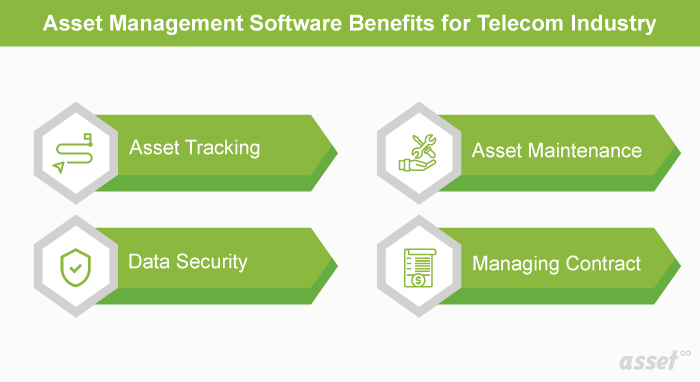
1. Asset Tracking
Asset tracking is the process of monitoring assets so you know where each one is physically located. It also tells you the status of each asset. Asset tracking helps assets be used to their full potential, and it keeps them secure. Asset tracking is very important for telecom asset management.
Many options are available for asset tracking, such as barcodes, QR (Quick Response) codes, GPS (Global Positioning System), BLE (Bluetooth Low Energy), RFID (Radio Frequency Identification), and IoT (Internet of Things).
These asset tracking technologies can be used for indoor or outdoor tracking. Every organization has its own reasons for tracking assets, and each of these technologies has its pros and cons.
Asset tracking also provides crucial information, for example when an asset was purchased, when it needs maintenance, and when it should be decommissioned. Overall, you can see the complete lifecycle of each asset.
2. Data Security
The data center is one of the most important assets of the telecommunication sector, and cyberattacks and data breaches keep happening.
Data breaches expose large numbers of sensitive records every year.
Telecom asset management software helps here too. Knowing exactly which servers, network devices, and storage you have, where they are, and who is responsible for them is the starting point for protecting them. A good cloud service provider adds multiple levels of security of its own to protect the data you keep in the software.
3. Asset Maintenance
Huge and expensive assets carry a huge responsibility. These assets and equipment need maintenance, or they can stop working at any time.
Maintenance does not always mean repairing the asset. During maintenance, assets are inspected closely, and any issue is found before it causes a failure.
This maintenance is done proactively and reduces the chance of sudden asset failure. Maintenance also includes replacing old parts with new ones so the asset keeps performing well, and checking that instruments still read correctly, which is known as calibration. Proactive maintenance reduces downtime and pays off in the long run.
4. Managing Contracts
Overseeing contracts in a telecom organization is a demanding job, with a wide range of contract papers to deal with. It is increasingly important for telecommunication groups to manage contract agreements in detail, with automation and AI capabilities.
Using AI well in contract management can increase efficiency without compromising accuracy.
In the telecommunication industry, operators need simple yet effective asset management software that presents complex data and figures in a simple form, so management can make decisions based on data.
Telecom Asset Management Software Brings Everything Together
Telecom asset management software has a lot to offer the telecom sector, and businesses of every other kind too. The software centralizes data, so no information is left behind, including how many assets there are in total.
It provides a complete view of the asset list, everything related to each asset, and its history. The software also supports network operations and helps maintain regulatory compliance.
With this software, you can conduct an audit easily and save a lot of time. Even assets that frequently move from one place to another are not a problem during an audit.
Frequently Asked Questions (FAQs)
1. What is inventory management in the telecom sector?
It means managing inventory and spare parts the right way: using stock before it expires and keeping a balance so you have neither too much nor too little. The same principles apply in the telecom sector as anywhere else.
2. Why is it important to have assets?
Assets are crucial for an organization because they are its source of income. They help generate revenue, and they can be converted into cash.
3. What are the other benefits of telecom asset management?
Telecom asset management provides several other benefits. It supports compliance, helps with asset audits, and makes physical verification of assets straightforward. It also helps make sure ghost assets don’t build up, and that assets are used well.