







An incident is anything that disrupts business continuity. In IT services, an IT incident is any disruption that affects anyone from a single user to the entire business.
An incident occurs when something goes wrong: a fault, an error, a problem or something that didn’t work. Its impact on the customer is immediate.
IT incident management is the process of managing IT service disruptions and restoring services. Incident management restores the service as quickly as possible after an incident occurs, and minimizes the impact of issues on the business.
Incident management can also be defined as a process for logging, recording and resolving incidents. Its main aim is to restore service to customers as soon as possible, with a temporary fix if needed, until a permanent solution is in place.
The aim of incident management is to restore normal service as soon as possible and minimize the harm to business operations, protecting the quality and availability of the service.
Objectives of Incident Management
- Use standard methods for efficient response, analysis, documentation, ongoing management and reporting of incidents.
- Give IT support staff clear visibility of issues and keep communication flowing.
- Keep users satisfied with quality service.
Cases of Incidents
- Service unavailable - You cannot use the application because the service, or one of its features, is unavailable for some reason.
- Error messages in the application - Unwanted or unexpected error messages pop up.
- Application issue preventing a user from working - You have a problem with the use or functionality of the application.
- Disk space full - Your system runs out of space and you cannot work properly.
- Technical incident - A technical issue disrupts your work, such as the failure of a configuration item.
- System down - Your system goes down for some reason and your work is interrupted.
- New hardware issues - New hardware does not perform as it should, or you cannot operate it correctly.
Submit and Manage Incidents
Creating an incident report takes only a few seconds. It records which service is affected, who it is assigned to, what needs to be done and when it should be resolved by.
When adding information, you can include context and custom fields so you know everything you need. All the listed incidents are visible in one place, so you can work through them in order of priority.
Easy Ticketing
People can raise an issue in a few taps through Asset Infinity’s maintenance request software, from a browser or the mobile app. They choose a category from a predefined list, which sets the default priority.
Requesters can follow the tickets they reported until the issue is resolved, without seeing the rest of the system.
Stages involved in Incident Management
There are four stages in handling a major incident:
- Initial Response - Incident details are logged at the service desk, and configuration details are taken from the configuration management database.
- Consolidation Phase - The incident is detected, recorded, investigated and diagnosed, after which the service is resolved and recovered.
- Recovery Phase - After resolution, the incident is closed. Work on the incident’s ownership, monitoring and communication is completed.
- Restoration of Normality - Once the user has been told about the workaround and any change request, the incident record is updated.
Benefits of Incident Management
Incident management brings many benefits, including:
- Better quality of service for customers.
- Detailed information on how reliable each service is.
- Reported issues can be tracked by status from start to finish.
- Workflows and SLAs make sure each incident is addressed and not forgotten.
- Each request shows its age, and jobs past their SLA stand out, so you can keep an eye on the time taken to resolve an issue until the ticket is closed.
- Asset Infinity keeps an audit trail of every change made to a record.
- Less impact from incidents.
- Incidents are resolved quickly, before the underlying problem is fixed.
- Better monitoring and clearer reports.
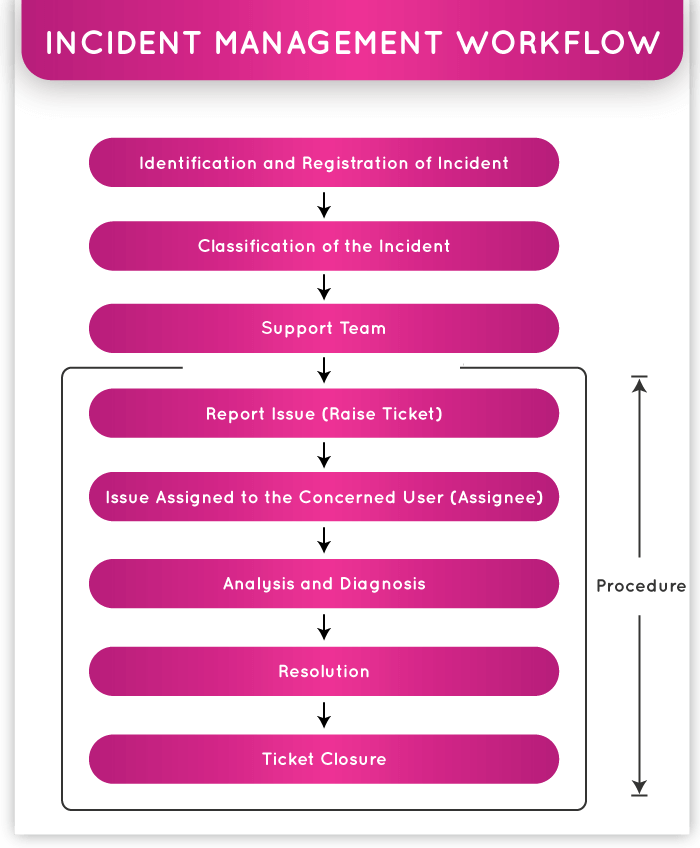
A Clear Process Gets Every Incident Closed
This is how an incident management process works. It makes it easy to manage and coordinate your organization’s response to the issues that stop people working. A clear process cycle, from ticket to fix, makes incident management easy for everyone to follow.