







Governments have taken several steps to control the sale and purchase of counterfeit medicines in pharmacies and hospitals. In India, for example, the Union Health Ministry (UHM) has made barcodes on medicines one of those steps.
Medicinal barcodes are meant to confirm that branded and other medicines are genuine. The UHM directed manufacturers to put barcodes on their medicines from the earliest stage.
Counterfeit and substandard drugs have been a serious problem for the domestic pharmaceutical industry, and fakes have turned up under the names of popular medicines.
To counter this, the UHM planned to require barcodes on all Active Pharmaceutical Ingredient (API) packages for raw materials. This step makes it easier to track imported and domestically manufactured materials.
What Is Barcode Medication Administration?
Barcode medication administration (BCMA) is a system used in hospitals to prevent errors when medication is given to patients.
The system is fairly easy to implement. It needs medicine barcodes, barcode scanners, printers, software, a computer server and staff training.
Mobile computers are recommended as scanners because they work like smartphones. BCMA is used mostly for bedside care and is growing in popularity in hospital pharmacies.
Medication barcodes help avoid human error and make sure a patient gets the right medication at the right time. Every drug in the hospital and pharmacy is labeled with a unique barcode generated by the BCMA system.
Here is an example of how medication barcodes work in hospitals:
When a patient is admitted to the hospital, they receive a unique patient ID wristband, a barcode wristband carrying the patient’s details. When a medication is prescribed, the wristband is scanned and the prescription in the patient’s medical record is sent electronically to the hospital pharmacy.
The pharmacy scans the barcode to get the prescription from the patient’s medical record, with the strength, dosage and type of drug, before sending the medicine to the patient’s ward.
Medicinal barcodes are a great tool for verifying drug information before a drug is given to a patient and for avoiding mistakes in dosage. They make it possible to check every patient’s medicine and dose thoroughly.
The pharmacy barcode system also alerts pharmacy and nursing staff to any dispensing error so it can be monitored and controlled. Action is taken before the medicine reaches the patient and before any adverse effect can occur.
There are some points to consider when barcoding medication:
- Allow only limited overrides of barcode checks.
- Dispense all medication in ready-to-use single doses with a unique barcode attached.
- Keep a record of all alerts generated by barcode scanning so any issues can be addressed.
- Use the data and records to identify training needs and support performance reviews.
Where Medication Errors Happen
Preventable adverse drug events (ADEs) caused by medication errors can occur at several stages:
Also Read: Efficient Asset Management Software For Veterinary Clinics
- Prescribing
- Transcription
- Dispensing
- Administration
Errors made early in the process, such as at the ordering stage, are more likely to be caught before they reach the patient. Errors made at administration, the last step, are the hardest to catch, which is why scanning at the bedside matters.
Benefits of Medication Barcode
- Medication barcodes deliver their benefits at the point of dispensing, and barcode medication administration provides a large safety benefit.
- Records of barcodes and the scanning technology used in hospitals help managers make informed decisions and support the growth of the organization.
- Scanning the barcodes on medicines is also known as automatic identification and data capture. It improves accuracy and identifies the product.
- The process reduces errors by limiting how much data staff enter by hand, and it gives staff the most current data on patients and their medication.
- Electronic barcode medication administration simplifies processes and removes manual work, saving a lot of time and money on paperwork.
- Staff members can scan the barcode on their ID badge to create an automatic audit trail, which increases accountability.
How Medication Barcode Work and Assist in Medication Dispensing?
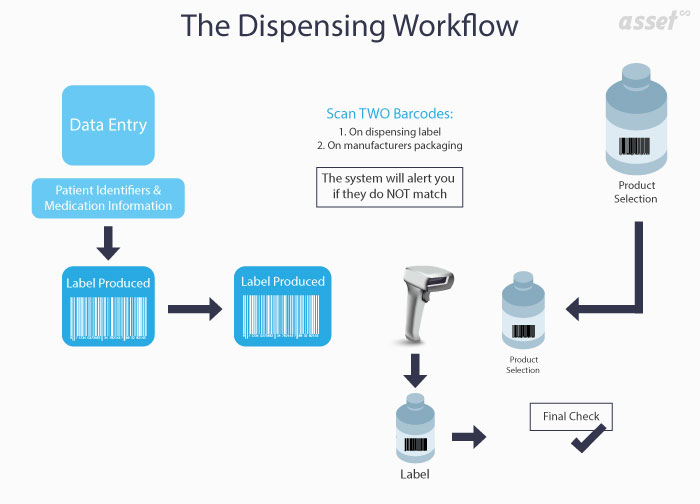
Choosing the right medicine is essential when it is dispensed to a patient. If anything goes wrong, it can cause serious harm. The patient could receive the wrong medication, the wrong strength or the wrong formulation of the prescribed medicine.
Scanning medicinal barcodes identifies these potential errors and prevents them before the medicine reaches the patient, avoiding harmful results.
The pharmacy barcoding system captures data by scanning the barcode on the patient’s ID or prescription and generates a number that identifies the medication to be dispensed. This number can be a barcode used by the pharmacy.
When both barcodes are scanned (the new barcode assigned from the prescription and the manufacturer’s barcode), the software checks the record against the product taken from the shelf to confirm the two medicines match.
The barcode is scanned at the final stage of the process, dispensing, before the label is attached, to confirm it matches the commercial pack.
Barcodes Protect Patients at Every Step
Asset management software is widely used for inventory tracking and management in every field. Medication barcodes work just as well as barcodes on medical devices and other assets.
Medicinal barcodes are critical because they remove chances for error in situations where a patient’s harm or recovery, and even life or death, is at stake.
Frequently Asked Questions
1. How does barcode medication administration work?
Barcode medication administration (BCMA) is the control system hospitals use to prevent errors in giving out medication. It relies on electronic scanning to detect medication errors and to monitor and manage dispensing. It needs barcode scanner software, printers, a computer server and trained staff.
2. What is barcode medicine identification?
Barcode medicine identification is the process of checking prescribed medication at every stage of its journey. From prescribing and transcription to dispensing and administration, the medication is checked against the patient’s barcoded ID and the manufacturer’s barcode.
3. What does patient ID wristband do?
The barcode wristband holds the necessary information about the patient and the reason they were admitted to the hospital. Scanning it alongside the barcode on the medication confirms the two match.