






Hardware asset management (HAM) is just as important as software asset management, because it can save a significant amount of money. That makes HAM crucial for asset management.
It also matters at every stage of an asset’s life. HAM and software asset management (SAM) are connected, and neither is much use without the other.
If you think only SAM can help you grow your business, think again, because HAM can help your organization in many ways too.
What Is Hardware Asset Management (HAM)? What Is the Aim of HAM?
HAM aims to manage hardware assets efficiently. Managing assets and equipment means answering several questions, such as:
- What is the asset?
- How much is it costing the company?
- How safe and secure is it?
- What will the organization do when the equipment reaches the end of its life or is no longer needed?
Also Read: What is IT Asset Management and why is it important?
Hardware asset management is the process of maintaining hardware assets such as computers, laptops and servers. It manages assets efficiently from procurement to disposal. Overall, it lets you manage the whole life of each asset.
What Are the Benefits of Hardware Asset Management (HAM)?
The benefits of hardware asset management are discussed below:
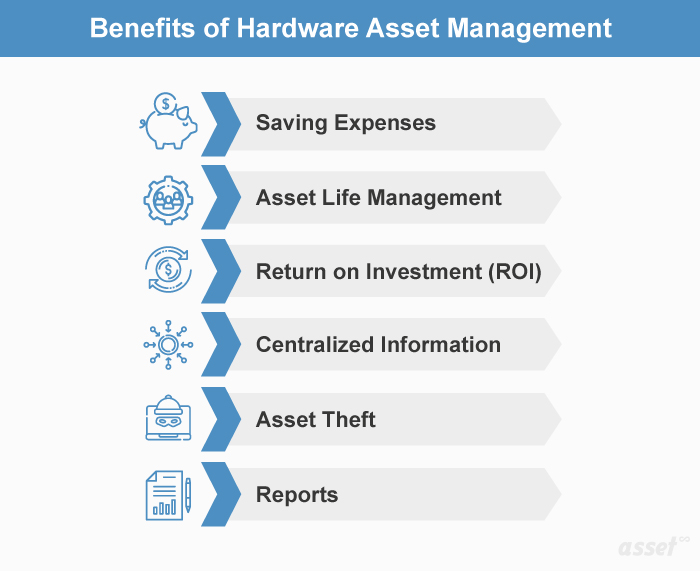
1. Saving Expenses
With HAM, asset maintenance stops being a worry. HAM saves money in several ways. It cuts unnecessary maintenance costs and reduces the chance of unexpected asset failure.
It keeps you informed about asset life. Organizations need to dispose of assets when their life is over, but companies often keep these assets, and they end up paying a lot to keep them running.
An asset should be disposed of when its life is over, which saves a great deal in maintenance. Assets that are serviced and kept in good order break down less often.
2. Asset Life Management
When every crucial hardware asset is maintained on a regular schedule, you get the most out of it. Most importantly, maintenance extends asset life.
With software, you can track all the crucial information about each asset, such as purchase date, warranty expiry, last maintenance, next scheduled maintenance and asset disposal date.
These details help you decide what to do as an asset ages, such as whether it needs an upgrade or a replacement. That improves business efficiency and helps you avoid risks.
3. Return on Investment (ROI)
Hardware asset management is like software asset management in one respect: the impact is not visible at the start. Over the long run, though, the investment pays off for your business.
With the right processes, tools and information in place, the long-term return on HAM is a steady fall in money spent on hardware and a smaller IT budget for equipment.
Also Read: The major difference between ITAM and SAM (Software Asset Management)
That money can then be spent elsewhere in IT, or in another department entirely, to support the success of the organization as a whole.
4. Centralized Information
Many organizations are surprised by asset invoices. The reason is that information is not centralized, so departments do not know about a cost until the invoice arrives.
That is why information needs to be centralized. For example, if an employee is working on a work order that needs specific equipment to complete it, they can note that in the software as a comment.
Everyone can then see the requirement.
5. Asset Theft
Asset theft hits a business hard. It leads to other problems, such as time wasted looking for assets (lower productivity), new assets bought to replace them (unnecessary expense) and more ghost assets.
With asset tracking, you can track information related to hardware and its purchase. You can also see where an asset is and who is using it, as it changes.
It shows the team whether hardware is used regularly or is sitting underused. These hardware assets are costly and prone to theft.
The software keeps track of assets and reduces the chances of loss and theft. It keeps assets safe and secure, and your team does not waste time looking for lost assets.
6. Reports
With reports and statistics, management can find maintenance issues, such as which asset needs more maintenance than expected.
Asset management reports give you deep insight into your assets, which helps you make crucial business decisions and plan strategies.
Reports are especially effective at finding issues and solving them, and they help businesses in the long run.
Why Hardware Asset Management Pays Off
Hardware maintenance directly affects an organization’s bottom line. Asset maintenance is important and should always be done, or the organization may lose money.
With asset management software, you do not have to worry about maintenance, because it notifies you in advance.
It also gives you up-to-date information, extends asset life, helps you use assets fully, avoids non-compliance and supports purchase order management, vendor management and calibration management.
Overall, you can make better use of your assets and improve the productivity of your employees and the organization.
Also Read: How Important is ITAM Strategy for IT Systems and Assets?
Frequently Asked Questions (FAQs)
1. Are HAM (hardware asset management) and SAM (software asset management) similar?
They are quite similar. Both have the same objective, which is asset management. The only difference is that HAM manages hardware and SAM manages software.
2. How does real-time asset tracking work?
Tags and labels are used for real-time asset tracking. Tags such as barcodes, QR codes, RFID, BLE and GPS carry a unique identifier that makes tracking possible.
3. What is the aim of hardware asset management?
Managing asset life efficiently and increasing the accountability and transparency of hardware assets are a few of the objectives of hardware asset management.