






Asset movement tracking is the record of every time an asset changes place or hands: from one site to another, one room to the next, or one person to a colleague. It is how an organization knows where its assets are today and how they got there, which is the first question in managing assets at all.
Most asset registers are accurate on the day they are built and drift from then on, because each move depends on someone remembering to update a spreadsheet. This guide covers why asset movement tracking matters, the methods available, how to control moves between locations step by step, examples by industry and what to look for in software.
What Is Asset Movement Tracking?
Asset movement tracking is the practice of recording each transfer of an asset between locations, sites, departments or custodians, with when it happened, who moved it, why and its condition on arrival. The result is a movement history for every asset and a register whose locations can be trusted.
An asset movement can be permanent (a transfer of a machine to another plant), temporary (a laptop lent for a project, a generator sent to a job site) or routine (a pump carried between wards). Each kind needs its own kind of record: a transfer changes the asset’s home, while a loan has a due-back date.
Why Asset Movement Tracking Matters
When moves go unrecorded, the same problems show up in every organization:
- Lost and stolen assets. An asset whose last known location is wrong cannot be found, and a theft is noticed months later or never.
- Duplicate purchases. A site buys equipment that another site has standing idle.
- Wasted time searching. Staff walk buildings and phone colleagues to find a single item.
- Slow audits. Counts turn up assets “somewhere else” by the hundred, and each one needs investigating.
- Wrong accounting. Transfers between legal entities, cost centers or departments change who carries the cost and depreciation.
- Missed maintenance. A technician cannot service a machine that is not where the schedule says it is.
- Data exposure. IT equipment that leaves a building with company data on it is a security event as well as a lost asset.
Construction, field service and events companies feel this most, because their equipment moves between sites every week.
Methods for Tracking the Movement of Assets
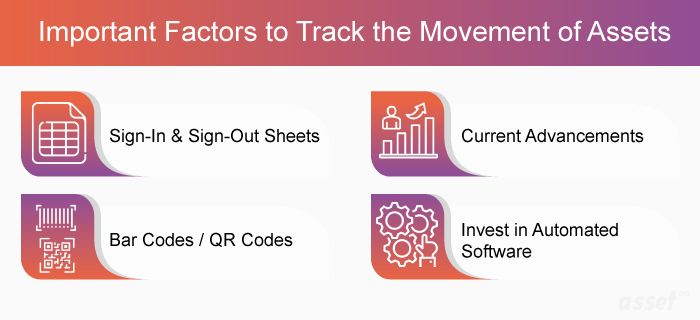
| Method | How a move is recorded | Best for | Limits |
|---|---|---|---|
| Sign-out sheets | A person writes the move on paper or a form | Very small inventories | Depends on everyone remembering; no live view |
| Barcode or QR labels | Scan the asset when it is moved or handed over | Almost every asset | Moves without a scan go unrecorded |
| Check-out and check-in | The asset is issued to a person with a due-back date | Tools, laptops, shared equipment | Covers loans more than permanent transfers |
| Fixed RFID readers | A reader at a doorway records the tag passing | Dock doors, tool cribs, gates | Needs readers at the right chokepoints |
| BLE tags and gateways | Gateways report which room a tag is in | Mobile equipment inside large buildings | Battery tags and ceiling hardware |
| GPS trackers | The tracker reports its position | Vehicles, trailers, generators, plant | Needs power; outdoors |
Most organizations combine them. A QR label goes on everything, check-out covers shared equipment, and readers or trackers go on the few assets whose movement is most costly to lose. Our guide to asset tracking methods compares the technologies in more depth.
How to Control the Movement of Assets Step by Step
- Give every asset a home and a custodian. Record the site, location and the person or department responsible. A move is only meaningful against a known starting point.
- Label everything. A barcode or QR label means anyone can identify an asset with a phone and record its move on the spot. See asset tags for label types.
- Decide which moves need approval. Transfers between sites, legal entities or cost centers usually need sign-off. Moves within a building usually do not.
- Record each move as a transfer. A transfer keeps the from and to locations, the date, the reason and who did it. Overwriting the location field erases the history.
- Issue paperwork for assets leaving a site. A handover note or gate pass lets security check that equipment leaving the premises is authorized.
- Use check-out for temporary moves. Loans to a person or job get a due-back date, so overdue items are chased.
- Automate where the stakes are high. Readers at exits and GPS on vehicles record movement without anyone scanning, and can alert when an asset leaves an area.
- Verify on a schedule. A periodic count catches the moves nobody recorded and shows where your process leaks.
Fixed Asset Movement Tracking Across Locations
Fixed assets moving between locations need more than a new address on the record. Finance cares about three things:
- Entity and cost center. If the asset moves to another company in the group or another department, the cost and future depreciation move with it.
- Audit evidence. Auditors ask when an asset left, where it went and on whose authority. A transfer record with an approver answers all three.
- The asset movement history report. A list of every transfer in a period lets finance post the accounting entries and reconcile the register with the ledger.
When a count finds an asset “somewhere else”, treat it as an unrecorded transfer: record the move, find out why it was missed, and fix that step. Our fixed asset reconciliation guide covers matching the register to the ledger after transfers.
Asset Movement Tracking by Industry
Construction
Equipment and tools move between project sites constantly. GPS on heavy plant and vehicles shows where they are, check-out against a project records who took smaller equipment, and a transfer record moves the cost to the right job.
Hospitals
Pumps, monitors and wheelchairs follow patients between wards. Readers at ward entrances and Bluetooth tags record where they went, so staff find equipment and clinical engineering finds devices due for service.
Offices and IT
Laptops and monitors move with people. Assignment to a custodian, a gate pass for equipment leaving the building and a recovery list when someone leaves keep devices and their data accounted for.
Media and Events
Cameras, lighting and AV kits go out to shoots and venues. Check-out with due-back dates and scanning on return show what is out, with whom and what came back damaged.
What to Look for in Asset Movement Tracking Software
| Capability | Why it matters |
|---|---|
| Moves recorded as transfers with history | Auditors and managers can see every move, not just the latest location |
| Bulk transfers | Moving a whole office or project site should not take hundreds of edits |
| Custodian with due-back dates | Loans to people are chased when overdue |
| Handover notes and gate passes | Equipment leaving a site is authorized and documented |
| Approvals on transfers | Moves between sites or entities get sign-off |
| Mobile scanning | Moves are recorded where they happen |
| Readers and GPS | High-value moves are recorded without a scan |
| Movement history report | Finance can post and reconcile transfers |
How Asset Infinity Tracks Asset Movement
In the Asset Infinity asset register, an asset is never moved by editing its site. A move records where the asset went, who took it on, why and the status it arrived in, and it can print a handover note or a gate pass. Moves and bulk transfers go onto the asset’s history, and the asset movement history report lists every move for finance and auditors. Each asset has a custodian (a user, or a named person without an account) with custody and due-back dates.
For shared equipment, equipment checkout issues items to a person with a due-back date and records the condition they came back in. Fixed RFID readers can move an asset to the location an antenna points at, or notify someone when it leaves, and GPS trackers alert when a vehicle or machine leaves its area; see asset tracking software for both. Verification rounds catch the moves nobody recorded: an asset found somewhere else stays a finding until someone presses Move it, which records the move in the register.
Frequently Asked Questions
Why is it important to track asset movement?
It keeps the register accurate, so assets can be found, maintained, counted and accounted for. It also deters theft and stops duplicate purchases.
What is the difference between an asset transfer and a check-out?
A transfer changes an asset’s home location or owner permanently. A check-out lends it to a person or job temporarily, with a due-back date.
How do I manage assets in an organization with several locations?
Keep one register for all sites, give every asset a location and custodian, label everything, record moves as transfers with approvals between sites, and verify each site on a schedule.
Can asset movement be tracked automatically?
Yes, for assets fitted with RFID tags, Bluetooth tags or GPS trackers, readers and trackers record movement without a scan. Other assets are tracked by scanning their labels when they move.