







Healthcare asset management is how hospitals, clinics, pharmaceutical manufacturers and medical supply businesses keep track of the equipment and supplies that patient care depends on: where each device is, whether it is safe to use, when it is due for service, and what stock is on hand. When a nurse needs an infusion pump or a surgeon needs a complete instrument set, the answer has to be immediate and correct.
The stakes are different from most industries. A missing pump delays treatment, an overdue safety check is an accreditation finding, and an expired supply can harm a patient. This guide covers what healthcare asset management includes, the assets and supplies it tracks, how it works for hospitals, pharmaceutical plants and medical supply businesses, and what to look for in software.
What is healthcare asset management?
Healthcare asset management is the practice of recording, tracking, maintaining and auditing the medical equipment, facility assets and supplies a healthcare organization owns, through their whole life. It covers each item’s location, custodian, condition, maintenance and calibration history, warranty and service contracts, cost, and disposal, so equipment is available, safe and accounted for.
Hospitals buy it to stop losing time searching for mobile equipment and to prove maintenance to inspectors. Pharmaceutical companies buy it because good manufacturing practice demands documented, controlled equipment. Medical supply businesses buy it to keep critical stock available and avoid waste from expiry.
What healthcare organizations need to track
| Category | Examples | Why it matters |
|---|---|---|
| Mobile medical equipment | Infusion pumps, patient monitors, wheelchairs, beds, portable ultrasound | Moves between wards and is often hard to find |
| Fixed medical equipment | Imaging systems, sterilizers, anesthesia machines | High value, service contracts and planned maintenance |
| Instruments and kits | Surgical instrument sets, emergency carts, field medical kits | Must be complete, clean and ready before use |
| Laboratory and production equipment | Analyzers, balances, mixers, filling lines, cold rooms | Calibration and documented maintenance |
| Facility assets | HVAC, generators, medical gas systems, elevators | Hospital operations stop if these fail |
| IT equipment | Workstations on wheels, tablets, servers | Hold patient data and must be accounted for |
| Supplies and spares | Consumables, spare parts, items with an expiry date | Stock-outs delay care; expired stock is waste |
Why healthcare asset management matters
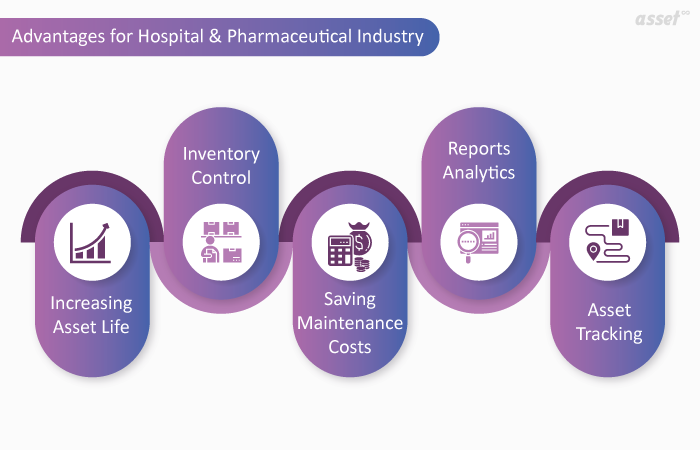
- Equipment is available when needed. Staff find a device in minutes instead of searching wards, and fewer spares are bought to cover for equipment nobody can locate.
- Maintenance is documented. Accreditation bodies such as The Joint Commission expect hospitals to keep an inventory of medical equipment and to inspect and maintain it on a defined schedule. The work order history is the evidence.
- Assets last longer. Planned maintenance catches wear before failure and keeps expensive equipment in service for its full life.
- Costs are visible. Repair costs, contract cover and age on each record show which devices to replace and which to keep.
- Supplies are controlled. Reorder points prevent stock-outs, and expiry dates are tracked so stock is used before it goes out of date.
- Audits are faster. A physical count against the register finds missing equipment and proves what exists.
Hospital asset management
In a hospital, the hardest problem is mobile equipment. Pumps, monitors and wheelchairs move with patients, end up in the wrong ward and get hidden by staff who want to be sure of having one. The result is time lost searching and equipment bought to make up for what cannot be found.
- Build one register. Record every medical device with its asset number, category, manufacturer, model, serial number, department, location, criticality, purchase date and warranty.
- Tag every device. A QR code or barcode label on each device lets staff and biomedical engineers scan it to see its record and report a fault. Use labels made to survive cleaning.
- Add location tracking for mobile equipment. Bluetooth Low Energy (BLE) tags heard by ceiling gateways show which room a pump is in. RFID readers at doorways record equipment leaving a ward or the building.
- Plan maintenance by device type. Set preventive maintenance and safety checks from the manufacturer’s recommendations, with checklists that record measured values.
- Record service contracts. Warranty, service contract and OEM support details on each device tell biomedical engineering who to call and what is covered.
- Count regularly. Verification rounds by department confirm what is where and flag anything missing.
For more on the hospital side, see tracking hospital equipment and how a hospital improved medical equipment availability with real-time asset tracking.
Pharmaceutical asset management
Pharmaceutical manufacturers work under the FDA’s current good manufacturing practice (cGMP) rules, which require equipment to be cleaned, maintained and calibrated under written procedures, with records of the work. Asset management in a pharma plant is as much about the record as the equipment.
- Controlled records. Every change to an asset, maintenance plan or work order should be recorded with who made it, when, and the values before and after, in a trail nobody can edit.
- Calibration. Balances, gauges and test instruments carry a calibration due date, and an instrument past its date should be blocked from use until it is recalibrated.
- Preventive maintenance with evidence. Checklists that require readings within an acceptable range, photos or signatures produce the documentation inspectors ask for.
- Spare parts and materials. Critical spares are reserved for planned jobs, and items with a shelf life are tracked by expiry.
- Validated releases. Some sites want their maintenance system under their own IT controls, with upgrades applied only after validation.
Our article on asset management software in the pharma industry goes into the requirements in more detail.
Medical supplies and equipment businesses
Distributors and suppliers of medical equipment and consumables face a different version of the problem. Their assets include stock that must not run out and equipment that is lent or rented to customers.
- Reorder before stock runs out. Reorder points per item and per store, with recommendations that turn into purchase requests.
- Track expiry. Items with a shelf life are recorded with their expiry so the oldest stock is used first.
- Track equipment placed with customers. Devices on loan or hire carry a custodian and a due-back date, and come back with their condition recorded.
- Plan for surges. Knowing exactly what is in stock and where makes it possible to redeploy equipment quickly when demand spikes.
Examples by team
- Biomedical engineering owns the medical equipment register, preventive maintenance and safety checks, and works from a mobile app on the wards.
- Facilities maintains generators, HVAC, medical gas and elevators, with planned maintenance and inspections on the same system.
- Supply chain controls consumables and spare parts, with stores, reorder points and counts.
- Finance uses the same register for depreciation and to prove that recorded assets still exist.
What to look for in healthcare asset management software
| Capability | Why it matters in healthcare |
|---|---|
| One register for medical, facility and IT assets | Biomedical, facilities and IT stop keeping separate lists |
| Labels that survive cleaning, and a mobile app | Staff scan devices on the ward, even with poor signal |
| Indoor location for mobile equipment | Pumps and monitors are found in the room they are in |
| Preventive maintenance with checklists and readings | Safety checks are done on time and documented |
| Calibration tracking | Out-of-date instruments are kept out of use |
| Service contract and warranty records | Repairs go to the right provider at the right cost |
| An audit trail that cannot be edited | Inspectors and auditors can trust the history |
| Parts and supplies with expiry and reorder points | Stock is available and expired items are caught |
| Access by site and department | Each hospital or ward sees its own equipment |
| On-premise option | Sites that keep data in-house can still use the system |
Healthcare asset management in Asset Infinity
Asset Infinity puts medical equipment, facility assets, tools and spares on one system that biomedical, facilities and supply teams share.
- The register. Each asset carries its number, category, site, location, department, criticality, manufacturer, model, serial number, warranty expiry, purchase cost and custodian, and contracts such as warranty, AMC, service contract and OEM support.
- Tags and tracking. QR labels print at high error correction, so a scuffed label still reads. BLE tags place mobile equipment on each floor plan with a trail you can replay, and silent tags are listed first so a flat battery is replaced before a pump goes missing. See RFID asset tracking.
- Maintenance. Preventive plans fall due by date, meter or condition, with checklist steps that demand a reading within range, a photo or a signature. Tools and instruments past their calibration date are flagged before they are issued.
- Parts and supplies. Stores include quarantine areas, parts can carry a shelf life, and reorder recommendations turn into purchase requests. See parts inventory management.
- Audits and audit trail. Verification rounds record each asset as verified, moved, not found or damaged, and every change is recorded with values before and after.
- On-premise. Sites that keep their maintenance records under their own IT controls can run the same release on their own servers.
See the healthcare page for how hospitals set it up.
Frequently Asked Questions
What is the difference between healthcare asset management and inventory management?
Asset management tracks individual items that are kept and used, such as pumps and monitors, each with its own record and history. Inventory management tracks quantities of consumables and spare parts that are used up and reordered.
How do hospitals track mobile medical equipment?
Most hospitals label every device with a QR code or barcode and add BLE or RFID tags to mobile equipment. BLE gateways show which room a device is in, and RFID readers at doorways record it leaving an area.
Why is asset management important in the pharmaceutical industry?
Good manufacturing practice requires equipment to be cleaned, maintained and calibrated under written procedures with records. Asset management software keeps those records, schedules the work and flags out-of-calibration instruments.
How often should medical equipment be maintained?
It depends on the device, the manufacturer’s recommendations and your hospital’s equipment management policy. Critical life-support equipment is usually checked more often than low-risk devices.