







Year after year, the pharma industry goes through rapid change, with considerable challenges and opportunities.
The role of asset management software within the pharma industry has changed significantly over these years.
The pharma industry is under constant pressure to manage costs and maximize labor productivity. Managing inventory costs and working capital, saving time, and improving purchase accuracy have always been important too.
In the pharma industry, an asset management system adds discipline and strength to manufacturing, packaging, transportation and all their related processes.
How Does the Pharma Industry Work?
As part of the healthcare sector, the pharma industry deals in medicines, including their development, production and marketing.
Its aim is well known: it provides drugs to prevent infections, maintain health and cure diseases.
The pharma industry monitors several regulatory objectives, such as:
- Safety Check
- Quality Check
- Quantity Check
- Market Flow
- Research and Development, etc.
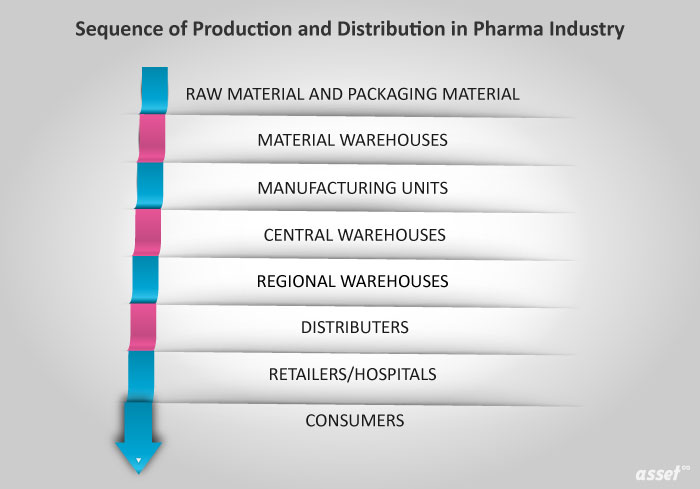
Like any other industry, its chain includes raw material suppliers, manufacturers, finished goods manufacturers, R&D companies, marketing companies and consumers.
That makes it all the more important to keep these processes in sync, and asset management software helps achieve this.
Problems and Solutions in the Pharma Industry
The pharma industry has many problems and challenges to deal with. These challenges have not stopped the industry’s growth overall, but they have always been a hurdle.
A few of the major challenges are discussed below, along with how asset management software helps solve them.
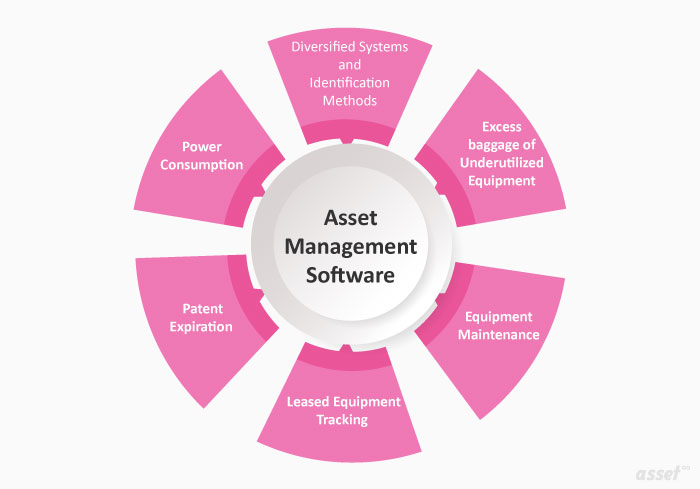
Problem 1: Diversified Systems and Identification Methods
Many departments in a pharma company are responsible for tracking and managing assets and equipment, and they use a variety of systems and identification methods.
Each department uses its own software to manage its work. For example, the finance department uses software for accounting and depreciation, the maintenance department uses software for scheduling preventive maintenance, and the department that handles inventory uses software to keep records of stock and items.
Solution:
Asset management software can keep the records of every department in one place. Bringing every department onto one system means finance, maintenance and stores all see the same asset record. With asset tracking management software you can cover the following areas:
- Asset tracking
- Purchase order (PO) and Requisition
- Ticket handling
- Equipment maintenance
- Asset management
- Inventory management
- Check-in/check-out
- Leased equipment tracking
- Device management
- Plant maintenance
Also Read: Key Features to look while choosing Asset Management Software
Problem 2: Excess Baggage of Underused Equipment
Excess baggage occurs when equipment is not in use but occupies valuable space on the manufacturing floor, in a warehouse or in another expensive on-site storage area.
The space taken by underused equipment has a measurable cost, along with a large opportunity cost. Unproductive equipment is often not stored in good condition, which leads to unnecessary damage. Rented storage space also carries an annual cost that may be an unnecessary expense.
This underused equipment may have full capacity, yet irregular maintenance keeps it from working properly.
Solution:
Asset management software holds data and records for all the assets and equipment your company owns or rents. This keeps you informed about both well-used and idle equipment.
You can then identify underused assets and schedule maintenance so equipment lasts longer. With maintenance management software, a pharma company can record asset information such as names, purchase dates, use, annual depreciation and the location where assets are kept.
Problem 3: Equipment Maintenance
Maintenance and service are a major expense in the pharma industry. Unexpected equipment breakdowns are common, causing both lost production and lost money. Despite being such a serious issue, maintenance often does not get the attention it needs because of a lack of strategic planning.
Solution:
Planned equipment maintenance includes replacing or overhauling equipment at regular intervals, regardless of its working and physical condition at that time.
Asset management software provides all the information about a piece of equipment. It keeps records for each one, for instance when it was last maintained and when the next maintenance is due. You can schedule maintenance without interrupting daily operations.
A few advantages of equipment maintenance:
- Equipment runs efficiently
- Potential problems are identified early
- Lifespan and resale value increase
Problem 4: Patent Expiration
Patent expiry is a big deal for the pharma industry, because its manufacturing deals with drugs and medicines. If a patent’s expiry goes unnoticed, the consequences can be severe.
An unnoticed patent expiry causes losses in production and packaging as well as in finances and capital.
Solution:
Keeping important expiry dates in one system, with reminders well ahead of each date, gives the team time to act before anything lapses. The same approach works for licenses, certifications and calibration due dates.
Also Read: Why Use Mobile Application for Cloud-Based Asset Management Software?
Problem 5: Power Consumption
Every facility consumes power, and a bill arrives each month for utilities such as electricity, gas and water. Small amounts of waste become expensive when nobody notices them.
Suppose a water tap is left running for several hours on a day off. It adds expense, and it costs extra time for cleaning if the water floods the floor.
Solution:
The best answer to this problem is utility tracking. With energy management in Asset Infinity, you can:
- Record electricity, gas, water and fuel readings.
- Set up supply points for a whole site or building, or for a single asset.
- Read meters on rounds with the mobile app.
- Handle meters that roll over or are exchanged, so consumption stays correct.
- See the cost of what each supply point uses.
- Get findings when a supply point uses more than its own past or comparable supply points.
Also read: Smart Grid Management with Asset Infinity
Problem 6: Leased Equipment Tracking
Leased equipment is taken on lease from another organization. Rather than buying equipment, companies rent it, for reasons such as budget limits.
Or a project may require specific equipment for a short time, which is returned when the project is complete.
If equipment stays in the unit for several years and its rental agreement expires unnoticed, the mistake may be unintentional, but the consequences are real.
Management then has a costly problem to solve. You will have to pay rent for the extra period, often with a penalty, and your reputation can suffer too.
Solution:
Tracking leased assets and equipment becomes necessary once a company hires equipment on lease. Asset tracking software helps you keep track of this equipment.
Recording each lease against the assets it covers, with its end date and a renewal notice, keeps the records that support easy decision making.
Why Pharma Companies Need Asset Management Software
Asset management software is needed in pharma and in many other offices and industries. It helps save money, and it also plays an important part in saving utilities such as electricity and water.
Investing in efficient asset management software is also a good way to meet environmental and social responsibilities. An external audit can identify excessive waste and inefficiencies.