






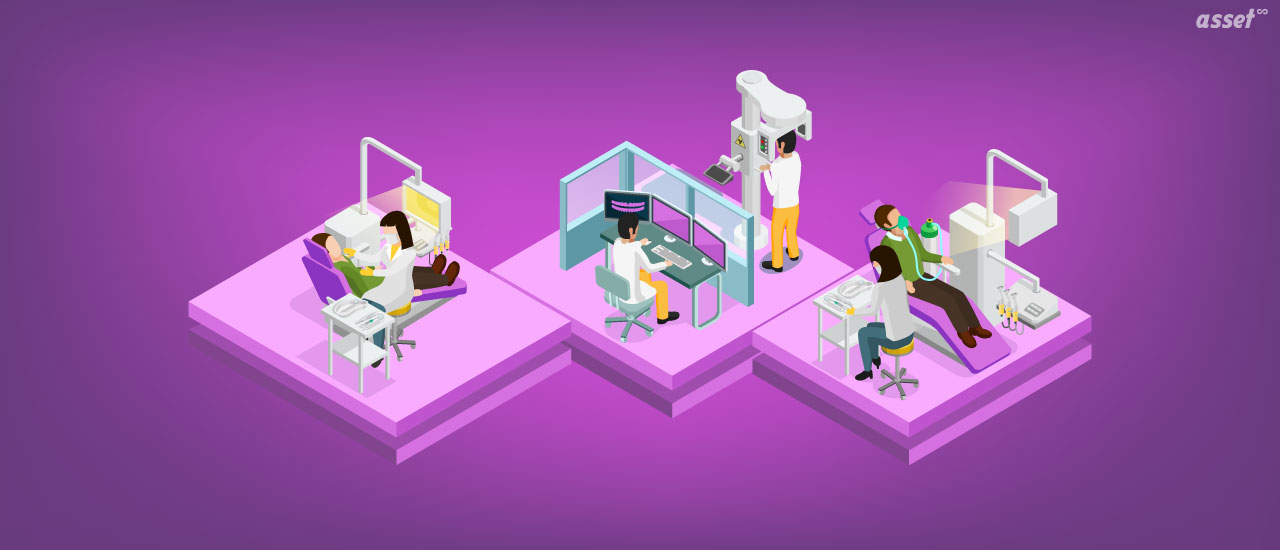
The dental industry is a distinguished part of the healthcare sector and offers well-paid careers to the people who work in it.
The dental industry mainly covers the health and care of teeth, gums and related parts of the mouth. The industry revolves around dental devices and instruments and the use of dental consumables to maintain healthy teeth.
These dental consumables are used on patients to treat dental problems, restore teeth and so on. Besides consumables, dental practices use instruments to provide treatment, such as explorers, probes, dressing pliers and cone socket mirrors.
New dental equipment is expensive, and upgrading a practice with new technology can help dentists save money in the long run and treat more patients in less time.
Also Read: Healthcare Asset Management for Hospitals and Pharma
Assets and Equipment Used in the Dental Industry
Whatever the type of practice, the following machines and equipment are required in the dental industry:
- Dental patient chair
- Operatory cabinetry
- Delivery systems
- Dental operatory lights
- X-ray imaging equipment
- Handpieces
- Utility equipment
- Intraoral cameras
- Chairside CAD/CAM systems
- 3D imaging systems
- Surgical microscopes
- Dental lasers
- Endodontic equipment
- Dental sleep medicine equipment
- Portable dental equipment
Besides this equipment, dental consumables include dental composites, latex gloves, bib napkins, dental burs, endodontic instruments, orthodontic supplies and dental sutures.
Challenges of the Dental Industry for Asset Management
The dental industry holds a prominent position in the healthcare sector and continues to grow. Private and public dental centers alike are improving by adopting new and innovative ways of working.
Buying new machines and equipment takes investment and careful planning.
Beyond equipment and consumables, the dental industry also depends on utilities that provide power, disinfectants for infection control protocols, and portable tools.
Keeping track of all this equipment can be as painful as treatment without anesthesia. The dental industry has to deal with many challenges, such as:
Lost Inventory
Losing any piece of equipment can bring treatment to a halt, and the risk of fraud can cause serious problems. Monitoring inventory is therefore necessary to control how assets are used.
Contamination
Unsterilized equipment is a threat to patients as well as dental staff, and contamination can sometimes be fatal. This is why every health and quality standard requires equipment to be sterilized.
Shortages of Pharmaceuticals
An unexpected shortage of pharmaceuticals can hold up treatment. These shortages usually happen because stock is not planned and monitored.
Also Read: How Is SaaS-Based Asset Management Software Important?
How Asset Management Software Helps a Dental Practice
Dental practices have been steadily automating their systems and investing in digital technology.
Every part of the healthcare sector puts great effort into upholding quality standards. The sector has to meet several essential aims, such as safety, effectiveness, patient-centered care, timely service and quality of care.
Implementing healthcare asset management software has a positive effect on every operational process and on the management of equipment and assets.
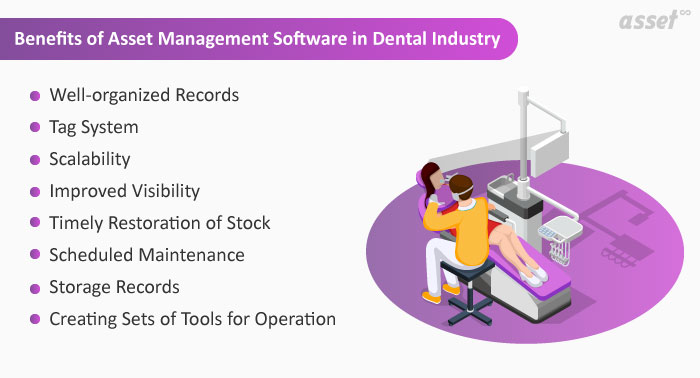
Ways Asset Management Software Helps the Dental Industry
1. Well-organized records
The software keeps records of all your inventory and equipment. Your system is updated automatically whenever assets and equipment are scanned, whether for check-in and check-out, equipment details or scheduled maintenance.
Through these regular, automated updates, the system keeps an up-to-date record of all your inventory and equipment, making it easy for you to make decisions.
2. Tag System
You need to put an asset tag or unique identification number on all your assets and equipment for easy check-in, check-out and verification of equipment details.
Asset tags are labels that identify equipment using a unique serial number, code or barcode.
Asset tagging or asset labeling helps you manage your physical assets and make informed decisions about your inventory and equipment, whether that means repairing or replacing it.
3. Scalability
An automated asset management system can grow with you. A scalable system lets you keep working from the same database as you expand.
Scalable asset management software is important for dental practices that plan to grow and expand in the future.
4. Improved Visibility
With asset management software, you can monitor the check-in and check-out of all inventory and equipment and gain greater visibility.
Whenever the barcode on a piece of equipment is scanned, you can record that as an activity, before and after the equipment is used.
For example, if surgery is scheduled, scan the equipment and record the activity before handing it to your staff member, then do the same at the end. This way your inventory and equipment are managed and monitored efficiently.
Also Read: Need & Benefits of Laboratory Asset Management Software Solution
5. Timely Restocking
Stock always needs refilling. The dental industry uses a large amount of consumable inventory, which must be reordered on time.
These consumables include cotton gauze, disposable syringes and similar items. In healthcare, avoiding overstock matters as much as avoiding understock, because many items have a limited shelf life.
It is therefore important to keep a record of inventory and reorder levels. Asset management software lets you set a minimum level for each item, and the system notifies you when stock runs low and it is time to reorder.
6. Scheduled Maintenance
For mechanical equipment, scheduled maintenance covers the repair, replacement and servicing of tools. It keeps equipment working properly and catches problems that develop during operation.
Even a short period of downtime can reduce overall efficiency and lead to major losses.
That is why it is important for dental practices to put a good maintenance strategy in place for their equipment and assets. Items such as autoclaves, compressors, suction units and X-ray equipment each need servicing at set intervals, and a schedule in the software makes sure none of them is missed.
7. Storage Records
It is always important to know where your equipment is. A dental practice cannot afford to misplace equipment or tools at the moment they are needed.
Keeping a record of used and unused equipment and tools is therefore necessary. Scan each item before and after use and return it to its place.
When equipment is sent to another lab or outside your premises, scan it and update the record, so that if you forget, you can check the system.
8. Creating Sets of Tools for Procedures
For quick, convenient access to equipment and tools, group the tools required for a particular procedure into a set and record it in the system. That way you do not have to look for each one every time; you just take the set from its place.
Also Read: Why Asset Tracking Software is Crucial for Every Business?
Better Patient Care Through Better Asset Records
Asset management software is a healthy approach for dental practices that want their daily work to run smoothly. It gives you accurate records that support patient safety and professional satisfaction.
Asset Infinity is asset tracking and management software with a mobile app. It lets you track your assets using barcode, QR code, RFID and NFC tags.
Other features include asset audits and physical verification, maintenance management, utility monitoring and reports on your equipment that you can use from anywhere, at any time. Asset Infinity offers a free 14-day trial.