






An asset audit checks that the assets in an organization’s records exist, are where the records say, are in the recorded condition and are valued correctly, and that the controls around them work. It is how a business proves to its auditors, lenders and its own management that the fixed asset figures on the balance sheet are real.
This guide explains what an asset audit is, its objectives and benefits, what an asset auditor actually checks, the asset audit process step by step, and what asset audit software and a mobile audit app add. It ends with how Asset Infinity runs audits.
What Is an Asset Audit?
An asset audit is a structured review of an organization’s assets and asset records. It combines physical verification (finding and inspecting each asset) with a review of documents, valuations and controls, to confirm that the register is complete and accurate and that assets are protected against loss, misuse and fraud.
Physical verification is the counting part: is the asset there, where and in what condition? Our guide to physical verification of assets covers it in detail. An asset audit goes further and asks whether depreciation, additions, transfers and disposals were recorded correctly, and whether the procedures that should catch mistakes actually do.
Internal and External Asset Audits
| Internal asset audit | External asset audit | |
|---|---|---|
| Who performs it | The organization’s own staff or internal audit team | An independent firm or a government auditor |
| Purpose | Find and fix problems, test internal controls, improve operations | Give an independent opinion on the financial statements |
| When | Any time; often quarterly or before year-end | Usually at year-end |
| Typical scope | Selected sites, classes or high-risk items | Material balances, tested by sampling |
| Output | Findings and actions for management | An audit opinion and a management letter |
An internal audit before the external one is the cheapest way to pass the external one. Our internal audit procedure for fixed assets walks through it.
Objectives of an Asset Audit
The main objective of an asset audit is to assess whether the controls over assets are adequate and effective, so that the asset records and the balance sheet can be trusted. In practice, that breaks down into these objectives:
- Existence: every recorded asset is real and present.
- Completeness: every asset owned is recorded, and nothing sold or scrapped is still listed.
- Ownership: assets belong to the organization and are not leased or held in someone else’s name.
- Valuation: cost, depreciation and net book value are calculated correctly and impairment is recognized.
- Condition and use: assets are in the recorded condition and used for their intended purpose.
- Safeguarding: controls protect assets from theft, misplacement and unauthorized use.
- Compliance: records meet accounting standards, tax rules, lender covenants and internal policy.
What Does an Asset Auditor Check?
An asset auditor, whether internal staff or an outside firm, tests the register in both directions and follows the paper trail.
| Check | How the auditor does it | What it proves |
|---|---|---|
| Register to floor | Picks assets from the register and asks to see them | Existence |
| Floor to register | Picks assets on site and asks to see them in the register | Completeness |
| Additions | Matches new assets to invoices and approvals | Ownership and correct cost |
| Disposals | Checks the date, method, proceeds and gain or loss | Nothing sold is still listed |
| Depreciation | Recalculates a sample and compares with the register | Valuation |
| Reconciliation | Matches register totals to the general ledger | The books agree |
| Verification results | Reviews the last count and how differences were resolved | Controls work |
| Change history | Looks at who changed which records, and when | Records cannot be altered unseen |
The auditor also examines whether discrepancies found in the last physical verification were properly resolved, because unresolved differences are the most common audit finding.
Benefits of Asset Auditing
Accurate Depreciation and Book Values
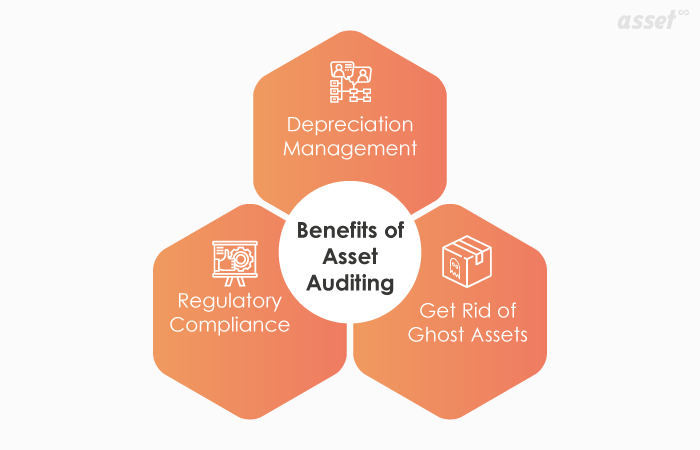
Depreciation spreads each asset’s cost over its useful life. An audit confirms that assets still in the register are still in use and that each carries the right method and life, so the expense and the net book value are correct. That matters for the financial statements and for tax.
Ghost Assets Found and Removed
Ghost assets are recorded but missing: lost, stolen or scrapped without a record. They inflate the balance sheet, keep depreciating and can carry property tax and insurance for nothing. An audit finds them so they can be written off. See how ghost assets build up.
Compliance and Fewer Penalties
Audits show that records meet accounting and tax requirements and that assets are used as intended. They also catch problems such as unlicensed software on company computers before a vendor’s audit does.
Less Fraud and Theft
People are less likely to take or misuse assets they know are counted. Audits also catch fraud in the books, such as assets sold for more than was recorded or purchases of assets that never arrived.
Better Decisions
An audited register shows what you own, its condition and its age. That makes it the starting point for replacement budgets, insurance values and decisions about idle equipment.
The Asset Audit Process Step by Step
- Define the objectives and scope. Decide which sites, asset classes and risks the audit covers, and whether it counts everything or a sample.
- Announce the audit. Tell site managers and custodians when it happens and what they must have ready.
- Prepare the register. Post known additions, transfers and disposals, and fix the expected list before counting starts.
- Hold an opening meeting. Agree areas, counters, the evidence each line needs, and how exceptions are handled.
- Do the fieldwork. Count and inspect assets, scan tags, record condition, and review documents for additions and disposals.
- Investigate differences. Recount missing items, trace moves and find the paperwork for unexplained changes.
- Review and communicate results. Discuss findings with management and agree corrective actions.
- Hold a closing meeting. Confirm the findings, owners and deadlines.
- Issue the audit report. Record what was expected, found, missing and damaged, the adjustments made and the actions agreed.
Asset Audit Software: What It Changes
Manual asset audits work for a handful of assets. For most organizations, a year-end audit run from printouts and spreadsheets takes weeks and still ends with a list of unknowns. Asset audit software changes the audit in four ways:
- One register. Every asset has one record with its location, custodian, condition, maintenance history and value, so the auditor works from a single source.
- Tags and scanning. Barcode, QR or RFID labels let counters identify assets with a scan instead of reading serial numbers.
- Evidence kept automatically. Every scan, outcome, remark and change is recorded with who did it and when.
- Reports on demand. The count summary, exceptions and depreciation register are available as soon as the count closes.
What to Look for in Asset Audit Software
| Capability | Why it matters for an audit |
|---|---|
| A fixed expected list per count | “Not found” only means something against a list that did not change |
| Full, sample, targeted and self counts | Year-end, spot checks, recounts and custodian confirmation are different jobs |
| Offline mobile scanning | Plant rooms, basements and remote sites often have no signal |
| Named outcomes and condition | Each line ends as verified, moved, missing or damaged, not a blank |
| An audit trail on every record | Auditors want to see who changed what, and when |
| Depreciation in the same system | Valuation is tested from the same record that was counted |
| Printable count reports | One document for the working papers |
Asset Audit App: Auditing From a Phone
An asset audit app moves the count onto the phone in the auditor’s hand. The auditor sees the list of assets expected in each area, scans each label, records what was found and its condition, and adds a photo or remark. Results reach the office without anyone retyping a sheet.
A mobile audit app matters most where assets are spread out: vehicles out on delivery, equipment across branches, or laptops with staff who work remotely. For those, a self-audit lets each custodian confirm the assets assigned to them, so auditors only visit what cannot be confirmed that way. Offline scanning matters too, because the places assets are kept are often the places with no signal.
How Asset Infinity Runs an Asset Audit
Asset Infinity runs asset audits as verification rounds on its asset inventory and audits screen, against the same asset register that holds depreciation.
- Pick the kind of round. Full, sample, targeted or self-verification. A sample round records its random draw so an auditor can reproduce it.
- Scope and publish. Choose sites, locations, categories, departments or custodians. Publishing fixes the list of assets the round expects.
- Assign auditors. Each auditor gets a site or location, so nothing is counted twice.
- Scan in the app. Auditors scan QR codes, barcodes or RFID tags in the mobile app, offline where needed, and record each asset as verified, moved, not found, damaged or skipped, with a condition of good, fair, poor or unserviceable.
- Let custodians confirm. In a self-verification round, holders confirm what they have from an emailed link, without an account.
- Close and report. The round report shows counts by site and every exception, with who recorded it.
Every record keeps an audit trail of changes, and the Audit Center brings that history together. Standard reports include asset verification results, the verification round summary, the asset register, the depreciation register and disposals by reason. Labels for every asset are printed from the label designer in asset tags.
Frequently Asked Questions
What does an asset auditor do?
An asset auditor checks that recorded assets exist, that every owned asset is recorded, that values and depreciation are right, and that controls over assets work. They test the register against the floor and the floor against the register, and review documents for additions and disposals.
What is the difference between asset verification and an asset audit?
Asset verification is the physical check that assets exist, where and in what condition. An asset audit uses that evidence along with documents, valuations and a review of controls to show the records are accurate.
How often should an asset audit be done?
Most organizations audit fixed assets at least once a year, before the external audit. Portable and high-value assets are worth checking more often through sample or self-audit rounds.
Can asset audits be done remotely?
Partly. Documents, records and custodian confirmations can be reviewed remotely, and a self-audit lets staff confirm assets from wherever they are. Most auditors still want to see a sample of assets in person.