







Whether your organization has 40 or 50 employees or thousands, an asset management software tool is important. If you are struggling to manage assets by hand, it is time to use asset management software.
What Is Asset Management Software?
Asset management software matters for organizations of every size. It lets you track and manage your assets, so you know where each asset is at any time and how it is performing.
It also shows you how to get more performance from your assets and more productivity from your employees. You can manage the whole asset lifecycle with this software.
With this software, you can maintain assets easily and efficiently. Most importantly, it replaces manual processes with automated ones.
Tracking maintenance is one of the most hectic parts of the job. The software keeps track of maintenance, schedules it and alerts the maintenance team to upcoming tasks.
Asset management is used in every industry. In hospitals, for instance, there are many assets: vehicles, including ambulances, that must always be in good condition, facilities that need maintaining, and costly equipment that needs tracking.
Hospitals also hold a lot of inventory, such as masks, sanitizers and medicines. Managing all of this by hand is not possible; hospitals need asset management.
What Are the Benefits of Asset Management Tools for Small Organizations?
The benefits of asset management tools for small organizations are discussed below:
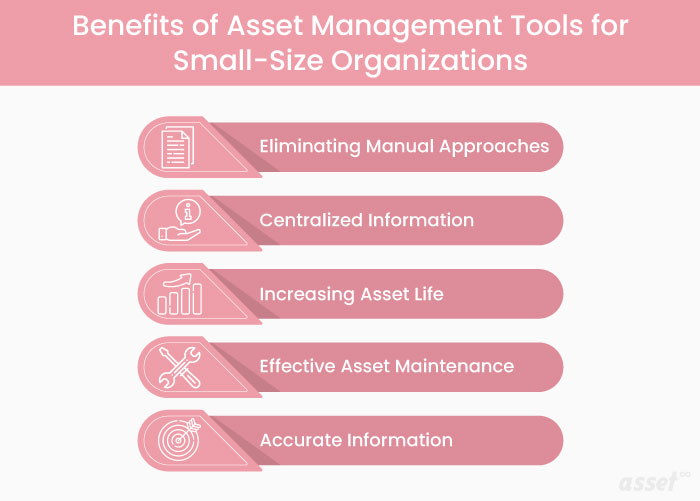
1. Eliminating Manual Approaches
Small organizations mainly use manual approaches such as pen and paper or spreadsheets. Pen and paper records are prone to inaccuracy, mainly because of human error.
Anybody can open a spreadsheet and change its data, intentionally or not, and there is no record of who changed what. These methods work fine when you have only a few assets to maintain.
As the number of assets grows, these methods become inefficient, and you need data you can rely on.
Asset management software keeps data accurate and reliable. It replaces manual approaches with an automated process.
2. Centralized Information
Asset management software gives every employee one place to find information. It saves time, because you no longer have to visit the department.
It also lets you control your assets and manage inventory information from the same place. A centralized system gives you a quick view of the complete asset list.
The system also alerts the maintenance team to upcoming scheduled work orders.
3. Increasing Asset Life
For small organizations, money is a sensitive subject and resources are limited. Getting more while spending less is one of the main objectives.
Extending asset life serves exactly that goal, because it helps organizations get the most from each asset from acquisition to disposal. An asset management tool improves asset performance and also helps with strategic planning.
For instance, knowing what an asset will cost to maintain or replace can save money, and that affects the organization’s bottom line. When the repair bills for an old machine start to approach the cost of a new one, the asset’s history makes the case for replacing it, so the decision is based on records instead of guesswork.
4. Effective Asset Maintenance
Maintenance is important for businesses of every size, but it matters even more for small businesses: their assets drive production, and if production stops, they can lose customers. Nobody wants that.
Asset maintenance keeps assets in good shape. Maintained assets perform better and are less likely to fail suddenly. Maintenance plays a crucial role in extending asset life.
The software lets you schedule maintenance to suit your requirements. Because it schedules maintenance proactively, it saves a lot of maintenance expense.
5. Accurate Information
One of the biggest benefits of an asset management tool is accurate reports and analytics.
Reports give you the complete picture. With them, you can decide where to invest more resources and where to cut expenses, and set goals for the next few years.
Reports show you how to save money, set future goals and grow your organization.
An asset management software tool gives you accurate information, and that matters, because wrong data leads to wrong decisions.
With this software, you can find any information within minutes. It saves time, because you no longer have to dig through files for an asset’s paperwork.
Why Small Businesses Outgrow Manual Asset Tracking
Asset management tools benefit organizations of every size. Asset management software also helps with the audit process, helping organizations meet regulatory requirements.
Cloud-based asset management software can be reached from anywhere, including your smartphone.
With the cloud, you are not tied to your office and can update work from anywhere as needed. These are only a few of the benefits; there are many more you can get from an asset management software tool.
Frequently Asked Questions (FAQs)
1. Does the asset management tool provide asset security?
Yes, it helps protect assets. For asset security, there is asset tracking, which shows where each asset was last recorded and helps protect assets from theft and misplacement.
Theft and misplacement are among the main causes of lost productivity, because when an asset is missing or stolen, employees waste time looking for it.
2. Can asset management software tools help in auditing?
Yes. Asset tracking simplifies the audit process. The software supports physical verification of assets and keeps each asset’s details in one place.
It speeds up the process, so you can always be prepared for external audits. Regular audits reduce the chance of ghost assets, zombie assets and phantom inventory.
3. Can this software be used for inventory tracking?
Inventory tracking is important, particularly when inventory is a critical part of your business. For instance, the maintenance team needs spare parts when it performs maintenance, and those spare parts count as inventory.
If a part is out of stock during maintenance, the job will not be as effective as it should be, and the maintenance may have to be done again.