






Physical verification of assets is the check that every asset in your books actually exists, sits where the records say, belongs to the business and is in the condition recorded. It is the part of a fixed asset audit that happens on the floor, and an audit without it rests on paperwork alone.
This guide explains the meaning of physical verification, what it is meant to prove, the techniques auditors use, a step-by-step fixed asset verification process, what a verification policy should say, the problems teams run into and how software and asset tags make the count faster.
What Is Physical Verification of Assets?
Physical verification of assets is the process of inspecting each recorded asset in person to confirm its existence, location, condition and ownership, and comparing what is found with the fixed asset register. Every difference is investigated and resolved: an asset moved, sold, scrapped or lost without being recorded, or an asset found that was never recorded.
Verification is often defined as an inquiry into the value, ownership, title, existence and possession of assets, and whether any charge (such as a loan secured on them) sits against them. Physical verification covers the parts of that inquiry you can only answer by looking. Ownership and value are confirmed from purchase documents, deeds and the depreciation schedule.
Management is responsible for verifying fixed assets. Auditors review how management did it, test the records against documentary evidence and evaluate internal controls, and usually check a sample of assets themselves.
Physical Verification vs Vouching
Vouching checks that transactions in the books are backed by authorized documents, such as an invoice for each purchase. Verification checks that the assets those transactions created still exist, are owned and are valued correctly. An audit needs both.
Objectives of Physical Verification of Assets
A count is worth the effort when everyone knows what it is meant to prove. The objectives of physical asset verification are:
- Existence. The assets on the balance sheet are real and present.
- Completeness. Assets bought are recorded, and assets sold or scrapped are removed.
- Ownership and title. Each asset belongs to the business, is not leased from someone else, and is not registered to an employee.
- Condition. The recorded condition is true, so damaged or obsolete assets can be impaired or disposed of.
- Valuation. Book values after depreciation reflect assets that are still in use.
- Location and custody. Each asset is where the register says, held by the person responsible for it.
- Fraud detection. Theft, misuse and fictitious assets are found.
- Compliance. The register supports the financial statements and any lender, insurer or regulator who relies on them.
Ghost Assets and Other Frauds Verification Finds
A ghost asset is one that appears in the books but cannot be found. It may have been stolen, scrapped without a record, or never existed. Ghost assets inflate the balance sheet, keep depreciating and can carry property tax and insurance costs for things the business no longer has. Our guide to ghost assets covers how they build up.
Other frauds that verification brings to light include assets sold for more than the books record (with the difference pocketed), purchases booked for assets that were never delivered, and company equipment held privately by an employee.
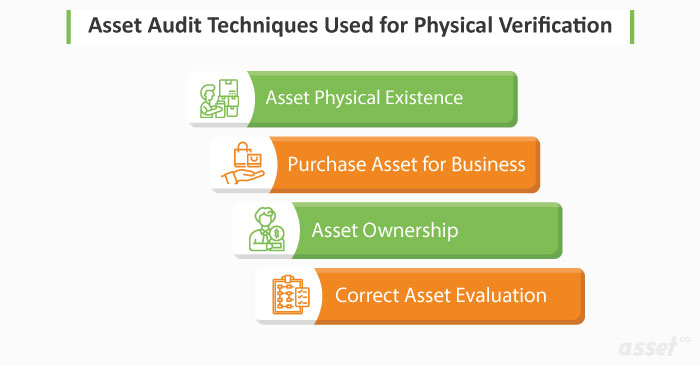
Asset Verification Techniques
Auditors combine several asset verification techniques, because no single one proves every objective.
| Technique | What it proves | How it is done |
|---|---|---|
| Physical inspection | Existence, location and condition | Walk the site and find each asset, or scan its tag |
| Tag scanning | Identity, so the right asset is credited | Read a barcode, QR code or RFID label with a phone or reader |
| Document review | Ownership, title and purchase for the business | Check invoices, deeds and registration in the company’s name |
| Valuation check | Correct carrying value | Recalculate depreciation and compare with the register |
| Custodian confirmation | Possession of portable assets | Each holder confirms the items assigned to them |
| Reconciliation | Completeness | Match register totals to the general ledger |
| Sampling | Reliability when counting everything is not practical | Select a random or targeted set and extend the result |
Custodian confirmation is often called asset confirmation or a self audit. It works well for laptops, phones, tools and test equipment held by people who travel or work remotely, and it frees auditors to walk the sites where assets do not move.
How to Do Fixed Asset Verification Step by Step
Fixed asset verification follows the same steps whether you run it yourself or bring in an outside firm.
- Update the register first. Post every known addition, transfer and disposal, so the list being counted is current. Our guide to preparing a fixed asset register lists the fields each record needs.
- Separate what can be counted. Machinery, vehicles, furniture and IT equipment can be seen. Intangibles such as software licenses and goodwill are verified from documents.
- Set the scope and method. Decide which sites and categories are in, whether you count everything or a sample, and which items custodians will confirm themselves.
- Fix the expected list and assign people. Freeze the list when the count starts and give each counter an area, so nothing is counted twice or missed.
- Count and record evidence. Scan or find each asset, record its condition, and take a photograph where your policy requires one.
- Recount what is missing. Send every unfound asset back for a second look before it is recorded as lost.
- Investigate and reconcile. Explain every difference: moved, disposed of without a record, lost, or found but not on the register. Post the transfers, disposals and additions that follow.
- Report and sign off. Summarize what was expected, found, missing and damaged, by site, and file the report with the audit working papers.
The physical asset verification checklist turns these steps into a list to work through on the day.
What a Fixed Asset Physical Verification Policy Should Cover
A written fixed asset physical verification policy makes the count repeatable and tells auditors what control they are testing. It does not need to be long. It should answer these questions:
| Policy point | What to decide | Example |
|---|---|---|
| Scope | Which asset classes and sites are counted | All capitalized assets above the threshold, at every site |
| Frequency | How often each class is counted | Full count yearly; laptops and tools quarterly |
| Method | Full, sample or self-confirmation, by class | Sample of 20% of furniture; self-confirmation for issued devices |
| Responsibility | Who counts, who reviews, who approves | Site teams count, finance reviews, the controller signs off |
| Independence | Who must not count their own assets | A custodian never verifies their own items alone |
| Evidence | What each verified line must carry | A scan, a condition grade and a photo for high-value items |
| Discrepancies | How differences are investigated and approved | Missing items recounted, then written off with approval |
| Records | Where reports are kept and for how long | Signed report filed with the year-end audit file |
Common Challenges in Fixed Asset Physical Verification
Most teams meet the same problems the first time they verify fixed assets seriously.
- A long, tiring count. Many assets across several sites, each needing a document check, turn verification into weeks of work.
- Ghost assets. Items lost or scrapped years ago still sit in the register, and nobody knows which ones.
- No system. Without a scope, assigned areas and a fixed list, two people count the same room and nobody counts the warehouse.
- Pen and paper. Printed lists get lost, ticks are hard to read, and nobody can show an auditor who counted what.
- Assets that move. Laptops, tools and test equipment change hands between counts, so the register is out of date before the count ends.
Each of these is solved by the same three things: a label on every asset, a count against a fixed list, and a record of every outcome.
Asset Verification Services and Software
Organizations either verify assets themselves or bring in an outside firm for asset verification services. An outside team adds independence and hands for a first count, which helps when assets have never been tagged. Doing it in-house with software is easier to repeat and builds a habit of counting more than once a year.
Spreadsheets struggle with either approach. Software gives each asset one record, lets counters scan instead of searching a printout, and keeps the result as evidence. These are the capabilities to look for in asset verification software:
- A frozen list for each count, so “not found” means something.
- Full, sample, targeted and self-confirmation counts.
- Scanning of QR codes, barcodes and RFID tags from a phone, offline as well as online.
- Named outcomes for every asset, with condition and remarks.
- A printable report by site, with every exception and who recorded it.
IT equipment needs one more thing. Laptops, monitors and phones move most often, so asset tracking software for IT equipment should know who holds each device. Discovery agents also report when a computer last checked in, which tells you which devices to look for before the count starts. See IT asset management software for that side.
How Asset Infinity Handles Physical Verification
Asset Infinity runs physical verification of assets as verification rounds on the asset inventory and audits screen.
- Choose the kind of round. Full, sample, targeted or self-verification. A sample round records its random draw so an auditor can reproduce it.
- Scope it and publish. Rules by site, location, category, department, status, criticality or custodian select the assets. Publishing fixes the list.
- Assign slices. Each auditor gets a site or location, and a line belongs to at most one auditor.
- Scan. Counters scan QR codes, barcodes or RFID tags in the mobile app, and keep counting without a signal. Each asset is recorded as verified, somewhere else, not found, damaged or skipped, with a condition of good, fair, poor or unserviceable.
- Confirm by email. In a self-verification round, custodians confirm what they hold from an emailed link that needs no account.
- Recount and close. A round can send every unfound asset back for a second look. Closing fixes the report, which shows counts by site and every exception.
Labels come from the label designer in asset tags, and every count starts from the asset register, where moves and disposals found in the count are recorded. If you would rather not tag and count the first time yourselves, Asset Infinity can do the tagging and a first count for you; build a quote with your asset count.
Frequently Asked Questions
What is the meaning of physical verification?
Physical verification means inspecting assets in person to confirm they exist, are where the records say and are in the recorded condition. It is compared with the fixed asset register, and every difference is investigated.
Who is responsible for physical verification of fixed assets?
Management is responsible for verifying fixed assets and keeping the register accurate. Auditors test the records and the verification process, and often count a sample themselves.
How often should fixed assets be physically verified?
Most organizations count all fixed assets at least once a year, before the year-end audit. Portable, high-value items such as laptops and tools are worth counting quarterly, through sample or self-confirmation rounds.
What is asset confirmation?
Asset confirmation, or a self audit, asks the person holding each asset to confirm they still have it and in what condition. It suits devices issued to remote and traveling staff.
What is the difference between asset verification and an asset audit?
Asset verification proves that assets exist, where and in what condition. An asset audit is the wider review that uses that evidence, along with documents and valuations, to show the books are right.