






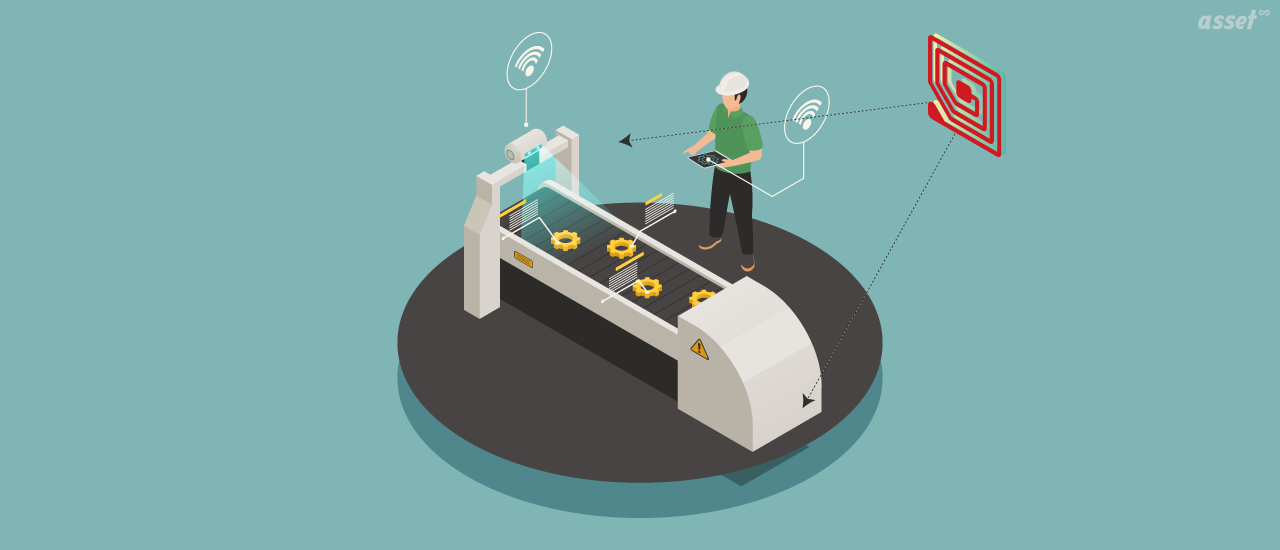
RFID in manufacturing means putting radio tags on tools, equipment, containers and parts, and reading them automatically as they move through the plant. A reader at the tool crib door records which gauge went out, a reader at the dock records which pallets of spares arrived, and a handheld reader counts a rack of fixtures without anyone reading labels one by one.
Plants have long tracked assets with spreadsheets, paper logs and barcodes, which only update when someone remembers to write or scan. This guide covers how asset tracking with RFID technology works on a plant floor, the main uses, how RFID supports supply chain transparency and traceability, its limits, and how to roll it out.
What Is RFID in Manufacturing?
RFID in manufacturing is the use of radio frequency identification tags and readers to identify and locate assets, materials and products inside a plant and across its supply chain. Each tag carries a unique number. Fixed readers at doorways and handheld readers on the floor record where and when that number was seen, without line of sight, and software matches it to the asset or batch it belongs to.
Manufacturers buy it for three reasons. Tools and equipment go missing and stop production while someone searches. Counts of spares and fixtures take days. And customers and regulators increasingly want to know where a part came from and what it passed through.
How Asset Tracking with RFID Technology Works on a Plant Floor
An RFID system in a plant has four parts:
| Part | On a plant floor | What to plan for |
|---|---|---|
| Tags | On tools, machines, fixtures, totes, pallets and parts | On-metal tags for steel; heat-resistant tags for ovens and autoclaves |
| Fixed readers and antennas | At tool cribs, dock doors, line entrances and yard gates | One antenna per doorway, tuned so it does not hear the next one |
| Handheld readers | For counts and for finding a single item | Paired with a phone or tablet app |
| Software | Turns reads into arrivals, departures and locations | Matching tags to assets, filtering duplicates, rules and alerts |
Most plants use passive UHF tags, which have no battery, read from several meters away and follow the EPC Gen2 standard, so tags and readers from different makers work together. The tag answers the reader with its number many times a second; the software turns that burst into one event such as “torque wrench TW-014 left the tool crib at 7:52.”
Where RFID Pays Off in Manufacturing
Tools and Gauges
Tool cribs lose expensive torque wrenches, gauges and fixtures because sign-out sheets are skipped at shift change. A reader on the crib doorway records each tool leaving and returning, and the record says who checked it out.
Machines and Mobile Equipment
Welders, carts, forklifts, test rigs and portable compressors move between lines and buildings. Readers at doorways record which building they are in, so a maintenance planner finds the machine due for service.
Work in Progress
Tags on totes, racks or carriers show which station a batch has reached. Supervisors see where work is queuing without walking the line.
Returnable Containers and Pallets
Reusable containers, pallets and racks travel to suppliers and customers and often do not come back. Readers at dock doors record each one leaving and returning, so a shortage is traced to the site that kept them.
Spare Parts and Inventory
Tagged spare parts and bins make stock counts a walk past the shelves, and a dock reader records deliveries as they arrive. That reduces both stockouts that stop a line and overstock of slow-moving parts.
Maintenance and Compliance
When a technician scans a machine’s tag, its maintenance history and open work come up. Regulated plants use the same reads as evidence that equipment was where it should be, and that calibrated tools were used.
RFID for Supply Chain Transparency and Traceability
Supply chain transparency means being able to show where materials came from, what happened to them in the plant, and where finished products went. It matters for several reasons:
- Recalls. If a batch of components is faulty, traceability narrows a recall to the products that contain it.
- Compliance. Industries such as automotive, aerospace, food and pharmaceuticals must keep lot or serial records.
- Risk. Knowing which supplier’s parts are in which product shows the effect of a supplier problem quickly.
- Customer trust. Buyers increasingly ask for proof of origin and handling.
- Efficiency. Seeing where goods wait shows bottlenecks in the chain.
RFID supports traceability because reads are recorded automatically at each step: received at the dock, issued to a line, moved into a finished goods area, shipped. A tag number linked to a lot or serial number gives an unbroken record without anyone typing it in. The reads are only as good as the tags, so plants agree on tagging rules with suppliers and customers before they rely on them.
Benefits and Limits of RFID in Manufacturing
| Benefit | Limit to plan for |
|---|---|
| Tools and equipment found in minutes | Metal surfaces need on-metal tags |
| Counts of spares and fixtures in hours instead of days | Liquids and dense metal racks reduce read range |
| Movement recorded without anyone scanning | Readers need tuning to avoid stray reads |
| Fewer losses of returnable containers | Hardware and installation cost more than labels |
| Traceability records built as goods move | Tags in harsh areas need heat or chemical resistance |
| Maintenance history one scan away | Day one brings many unknown tags to sort out |
How to Implement RFID in a Manufacturing Plant
- Pick one problem. Choose a tool crib, a dock door or a class of returnable containers where losses or count time are easy to measure.
- Choose tags for the environment. Test tags on the actual surfaces, including steel, painted parts and anything that goes through heat.
- Tag the assets. Print labels that carry both a QR code for people and an RFID chip for readers, so a damaged chip can still be scanned by eye.
- Install and tune one reader. Name each antenna for the place it watches, such as “tool crib doorway,” and set how many reads count as a visit.
- Clean up unknown tags. Claim tags for their assets and dismiss supplier and carton tags that are not yours.
- Add rules. Move an asset’s location when it passes a doorway, or notify a supervisor when tooling leaves the building.
- Expand. Add doorways, lines and sites once the first area gives clean data.
RFID in Manufacturing by Plant Type
Automotive and Discrete Manufacturing
Tagged fixtures, dies and gauges, plus readers on returnable rack lanes, keep tooling available for each changeover and containers moving back from suppliers.
Food and Beverage
Tags on totes, kegs and reusable crates track where they are and when they were cleaned. Washdown-rated tags survive the cleaning cycle.
Pharmaceuticals and Life Sciences
Tags on equipment and carriers support the records regulated plants keep on where equipment was used. High-temperature tags exist for items that go through sterilization.
Electronics
Small tags on reels, trays and test fixtures make counts fast and help keep track of high-value components.
How Asset Infinity Handles RFID in Manufacturing
Asset Infinity records every RFID read on the same asset record that holds the machine’s work orders, meters and costs. The RFID asset tracking page has the full detail; the parts a plant uses most:
- Fixed readers at doorways. Readers connect over MQTT or HTTPS. Each antenna is a place with a purpose of observe, entry, exit or checkpoint, such as dock door 1 inbound.
- Visits instead of raw reads. Reads become one visit with an arrival and a departure, with per-antenna thresholds so a forklift parked in a doorway does not arrive four times.
- Rules on arrival. A rule can move a tagged asset to the line it was carried into, or tell someone when an asset leaves the yard.
- Hardware watched. A reader that goes down, or an antenna that stops reading, is reported to named people.
- Handhelds and labels. Zebra, TSL and Chainway handhelds pair with the Android app to count, locate and encode tags, and the label designer writes RFID tags as labels print. See asset tags.
- Tools and maintenance. The tool tracking register handles check-out, return and calibration, and preventive maintenance plans by calendar, meter or condition raise work orders for the machines you track.
For a wider view of plant maintenance, see maintenance software for manufacturing, and for a client example, read about manufacturing asset tracking with Asset Infinity.
Frequently Asked Questions
How is RFID used in manufacturing?
It tracks tools, machines, work in progress, returnable containers and spare parts. Readers at doorways record movement automatically, and handheld readers count and find items without line of sight.
Does RFID work on metal machines and tools?
Yes, with on-metal tags. Standard tags read poorly on metal because it reflects the signal, so plants use tags designed with a spacer or special antenna.
What is the difference between RFID and barcodes in a plant?
Barcodes are cheaper but must be scanned one at a time by a person. RFID reads many tags at once and records movement through doorways without anyone scanning.
How does RFID improve supply chain traceability?
Each time a tagged item passes a reader, the system records where and when. Linked to lot or serial numbers, those reads build a record from receiving to shipping.
Where should a plant start with RFID?
At one place where losses or count time are easy to measure, such as the tool crib or a dock door. Prove it there before adding more readers.